


Page 117 - JSOM Summer 2022
P. 117
diseases and illnesses have a linked connection between in-  TABLE 1  Thromboelastography (TEG) Parameters
              flammation and coagulopathy. 41                         Variable         TEG            ROTEM
                                                                   From start until    R value
              Endotheliopathy                                       2 mm baseline   (reaction time)  Clotting time (CT)
              Endotheliopathy is the breakdown of the endothelial glycoc-  From 2–20 mm           Clot formation time
              alyx (EG). The EG is a heterogeneous group of proteoglycan   above baseline  K value     (CFT)
              core proteins linked with glycosaminoglycan chains that line                         Angle of tangent
              the luminal side of the vascular endothelium. The EG works   Alpha angle (°)  Slope     at 2 mm
              as an anticoagulant due to components such as heparin and   Maximum strength  Maximal amplitude  Maximal clot
              chondroitin sulfates. There are three main components that                              firmness
                                               38
              cause the EG disruption and destruction : (1) endothelial   Clot lysis (CL)    CL 30, CL 60  LY30, LY 60
              compromise and paracellular permeability, (2) dysfunctional   at minutes
              coagulation, and (3) inflammation.                 Used with permission from: Lancé MD. A general review of major
                                                                 global coagulation assays: thrombelastography, thrombin generation
                                                                 test and clot waveform analysis. Thromb J. 2015;13:1.
              Acute inflammatory states, such as hemorrhagic shock, dis-
              rupt EG function and cause transfer of plasma protein into the
              interstitial space. 42,43  Breakdown of the EG leads to increased
              permeability.                                      FIGURE 5  TEG versus ROTEM.

              Determining Coagulopathy
              There are several signs and symptoms that may accompany
              ATC, including an injury severity score > 15, a base defi-
              cit > 6mmol/L (normal range –2 to +2mmol/L), hypotension
              (< 90mmHg), and tachycardia (> 100 beats/min). 10,35,44,45  While
              coagulopathy is defined as a PT ratio more than 1.5 times   Used with permission from: Cannata G, Mariotti Zani E, Argentiero
                                                                                    ®
                                                                          ®
              greater than normal, PTT ratio is at least 1.5 times greater than   A, et al. TEG  and ROTEM  traces: Clinical applications of viscoelas-
              normal, fibrinogen > 0.8 g/L, coagulation factor levels < 30%   tic coagulation monitoring in neonatal intensive care unit. Diagnostics
                                                                 (Basel). 2021;11(9):1642.
                                               12
                                            9
              of normal, and platelet count < 50 × 10 /L . The PT/ interna-
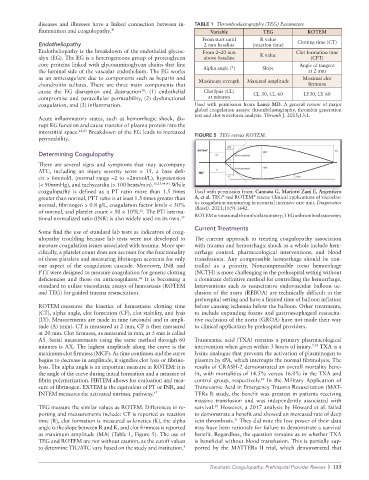
              tional normalized ratio (INR) is also widely used on its own. 37  ROTEM = rotational thromboelastometry; TEG = thromboelastometry
                                                                 Current Treatments
              Some find the use of standard lab tests as indicators of coag-
              ulopathy troubling because lab tests were not developed to   The  current  approach  to  treating  coagulopathy  association
              measure coagulation issues associated with trauma. More spe-  with trauma and hemorrhagic shock as a whole include hem-
              cifically, a platelet count does not account for the functionality   orrhage control, pharmacological interventions, and blood
              of those platelets and measuring fibrinogen accounts for only   transfusions. Any compressible hemorrhage should be con-
              one aspect of the coagulation cascade. Moreover, INR and   trolled as a priority. Noncompressible  torso hemorrhage
              PTT were designed to measure coagulation for genetic clotting   (NCTH) is more challenging in the prehospital setting without
                                              46
              deficiencies and those on anticoagulants.  It is becoming a   a dominant definitive method for controlling the hemorrhage.
              standard to utilize viscoelastic assays of hemostasis (ROTEM   Interventions such as resuscitative endovascular balloon oc-
              and TEG) for guided trauma resuscitation.          clusion of the aorta (REBOA) are technically difficult in the
                                                                 prehospital setting and have a limited time of balloon inflation

              ROTEM measures the kinetics of hemostasis: clotting time   before causing ischemia below the balloon. Other treatments,
              (CT), alpha angle, clot formation (CF), clot stability, and lysis   to include expanding foams and gastroesophageal resuscita-
              (LY). Measurements are made in time (seconds) and in ampli-  tive occlusion of the aorta (GROA) have not made their way
              tude (A) (mm). CT is measured at 2 mm, CF is then measured   to clinical application by prehospital providers.
              at 20 mm. Clot firmness, as measured in mm, at 5 min is called
              A5. Serial measurements using the same method through 60   Tranexamic acid (TXA) remains a primary pharmacological
              minutes is AX. The highest amplitude along the curve is the   intervention when given within 3 hours of injury. 7,48  TXA is a
              maximum clot firmness (MCF). As time continues and the curve   lysine analogue that prevents the activation of plasminogen to
              begins to decrease in amplitude, it signifies clot lysis or fibrino-  plasmin by tPA, which interrupts the normal fibrinolysis. The
              lysis. The alpha angle is an important measure in ROTEM: it is   results of CRASH-2 demonstrated an overall mortality bene-
              the angle of the curve during initial formation and a measure of   fit, with mortalities of 14.5% versus 16.0% in the TXA and
                                                                                      49
              fibrin polymerization. FIBTEM allows for evaluation and mea-  control group, respectively.  In the Military Application of
              sure of fibrinogen. EXTEM is the equivalent of PT or INR, and   Tranexamic Acid in Emergency Trauma Resuscitation (MAT-
              INTEM measures the activated intrinsic pathway. 47  TERs I) study, the benefit was greatest in patients receiving
                                                                 massive transfusion and was independently associated with
                                                                       50
              TEG measure the similar values as ROTEM. Differences in re-  survival.  However, a 2017 analysis by Howard et al. failed
              porting and measurements include: CT is reported as reaction   to demonstrate a benefit and showed an increased rate of deep
              time (R), clot formation is measured as kinetics (K), the alpha   vein thrombosis.  They did note the low power of their data
                                                                              51
              angle is the slope between R and K, and clot firmness is reported   may have been rationale for failure to demonstrate a survival
              as maximum amplitude (MA) (Table 1, Figure 5). The use of   benefit. Regardless, the question remains as to whether TXA
              TEG and ROTEM are not without caution, as the cutoff values   is beneficial without blood transfusion. This is partially sup-
              to determine TIC/ATC vary based on the study and institution. 4  ported by the MATTERs II trial, which demonstrated that

                                                                     Traumatic Coagulopathy: Prehospital Provider Review  |  113

