


Page 116 - JSOM Summer 2022
P. 116
the enzymatic formation of fibrin from fibrinogen. The loss   FIGURE 4  Fibrinolysis.
          of calcium from hemorrhage or from consumptive factors can
          impair the clotting cascade and contribute to coagulopathy in
          trauma. Recent literature suggests that patients are hypocal-
          cemic upon arrival to the emergency department, showing a
          potential endogenous cause. 29–31  There is some variability in
          the definition of hypocalcemia, but for the purpose of this re-
          view, it is defined as ionized calcium < 1.2mmol/L (4.8mg/dL).
          This problem is exacerbated by blood transfusion protocols
          requiring the use of citrated blood products. 32,33  Citrate is an
          anticoagulant found in fresh frozen plasma (3g) and whole
          blood (1.66g). Citrate functions by chelating calcium in blood
          to inhibit coagulation in the collection bag, which continues
          in the body. Hypothermia also potentiates ATC during blood
          transfusions due to the liver’s inability to clear citrate second-
                           34
          ary to hypoperfusion.  Because of these findings, researchers
          suggested the addition of hypocalcemia to the lethal triad, cre-
          ating a new model known as the lethal diamond (Figure 3).
                                                             Used with permission: Jfdwolff at en.wikipedia, CC BY-SA 3.0 http://
          FIGURE 3  The lethal diamond.                      creativecommons.org/licenses/by-sa/3.0/>, via Wikimedia Commons.
                                                             Another  explanation  of  coagulopathy  in  trauma  revolves
                                                             around the understanding of both blood and the circulatory
                                                             system as one uninterrupted organ system, with each part re-
                                                             liant on the other. This concept states that coagulopathy in
                                                             trauma results from oxygen debt – caused by hemorrhage –
                                                             which in turn leads to profound blood failure, combined with
                                                             endotheliopathy. In coagulopathy in trauma, the anticoagula-
                                                             tion pathway is much more prominent, resulting in massive
                                                             fibrinolysis. Much like the previous explanation, each of these
                                                             factors contribute to each other, with endotheliopathy exac-
                                                             erbating blood failure, and vice versa, creating a similar cycle
                                                             to the previous explanation. Therefore, it is crucial to view
                                                             coagulopathy as the failure of both parts of one larger organ,
                                                             and not two separate issues. 38
          Consumption, Dysfunction, and Fibrinolysis         When endothelial tissue is damaged, platelets are activated
          Hemostasis is an ongoing process throughout the body that   through  calcium  dependent  pathways  and  form  a  plug  by
          involves the formation and dissolution of clots. In addition to   sticking to the exposed collagen of the extracellular matrix.
                                                                                                            39
          cleaving fibrinogen, thrombin also activates protein C, a vi-  However, this plug is fairly tenuous, and must be solidified
          tamin K–dependent anticoagulant, into activated protein C   into a true clot by fibrin, which is created by the cleaving of fi-
          (aPC). aPC consumes plasminogen activator inhibitor 1, result-  brinogen by thrombin. Fibrinogen is produced in the liver, and
          ing in increased tissue plasminogen activator (tPA) and plasmin,   though it is rapidly depleted in massive hemorrhage, animal
          as well as inactivating factors V and VIII. 10,35  In the presence of   hemorrhagic shock studies have shown continued production
          aPC, thrombin becomes more anticoagulating. Hypoperfusion   of fibrinogen.  Early fibrinogen deficiencies can contribute to
                                                                        7
          upregulates thrombomodulin, an endothelial protein, which in-  endogenous coagulopathy and low fibrinogen levels have been
          creases activation of protein C. As a result, thrombin becomes   associated with increased injury severity and mortality. 40
          less of a procoagulant and more of an anticoagulant, which in
          turn increases production of aPC.  Increased thrombomodulin   Additionally, it is theorized that well-functioning platelets
                                    10
          secondary to hypoperfusion also drives thrombin from pri-  are used up first, and those remaining in circulation approx-
          marily causing fibrin deposition to protein C activation. This   imately one-hour post-injury do not function properly as a
          creates a cycle similar to the lethal triad, in which each part   result of being “stunned,” though this mechanism is not well
          contributes to the other and serves to exacerbate the overall ef-  understood.  This phenomenon can lead providers to mistak-
                                                                      7
          fect. While aPC has been shown to cause ATC in healthy blood,   enly withhold platelet therapy in trauma patients, as patients
          the amount needed to cause ATC is exceedingly high and the   initially have normal platelet levels. However, since it can be
          overall impact of aPC in ATC has been questioned. 36,37  reasonably assumed that the platelets left in the blood one
                                                             hour or more postinjury are likely dysfunctional, these pa-
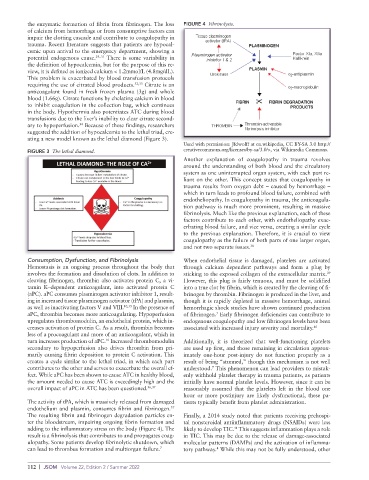
          The activity of tPA, which is massively released from damaged   tients typically benefit from platelet administration.
          endothelium and plasmin, consumes fibrin and fibrinogen.
                                                         37
          The resulting fibrin and fibrinogen degradation particles en-  Finally, a 2014 study noted that patients receiving prehospi-
          ter the bloodstream, impairing ongoing fibrin formation and   tal nonsteroidal antiinflammatory drugs (NSAIDs) were less
          adding to the inflammatory stress on the body (Figure 4). The   likely to develop TIC.  This suggests inflammation plays a role
                                                                              41
          result is a fibrinolysis that contributes to and propagates coag-  in TIC. This may be due to the release of damage- associated
          ulopathy. Some patients develop fibrinolytic shutdown, which   molecular patterns (DAMPs) and the activation of inflamma-
          can lead to thrombus formation and multiorgan failure. 7  tory pathway.  While this may not be fully understood, other
                                                                        4

          112  |  JSOM   Volume 22, Edition 2 / Summer 2022

