


Page 124 - 2022 Spring JSOM
P. 124
Methods                                            Assessment Tool for Observational Cohort and Cross-Sectional
                                                                   18
          The Preferred Reporting Items for Systematic Reviews and   Studies.  The instrument has 14 questions that address subject
          Meta-Analyses (PRISMA) guidelines were used to guide this   selection, sources of bias, confounding, statistical power, statis-
               16
          study.  Specific details of the review protocol are described   tical analysis, and other factors. Each study was rated on the
          below.                                             14 questions in the instrument as either “yes,” “no,” “cannot
                                                             determine,” “not reported,” or “not applicable.” The poten-
          Information Sources and Search                     tial risk of bias was determined for each “no,” “cannot deter-
          PubMed, Web of Science, and Cumulative Index to Nursing   mine,” and “not reported” response. A rating of “good” was
          and Allied Health Literature (CINAHL) were searched to find   given if there was low risk of bias and results appeared valid,
          articles relating to injuries during HIFT. Keywords used in the   “moderate” if there was some risk of bias but results still ap-
          search were injury AND CrossFit, OR “High Intensity Func-  peared valid, or “poor” if there was significant risk of bias that
          tional Training” OR “Extreme Exercise Programs” OR “Gym   appeared to reduce confidence in the results.
          Jones” OR “Insanity Training.” The reference lists of the ob-
          tained articles and reviews found in the search 7–15  were also   Meta-Analyses
          examined for other articles that were missed by the formal   The Comprehensive Meta-Analysis Statistical Package, Ver-
          search. The final search was completed in November 2021.   sion 3.2 (Biostat, Englewood, New Jersey, US) was used to per-
          Four authors were contacted to clarify data in their study, but   form the meta-analyses. For injury prevalence, data obtained
                 17
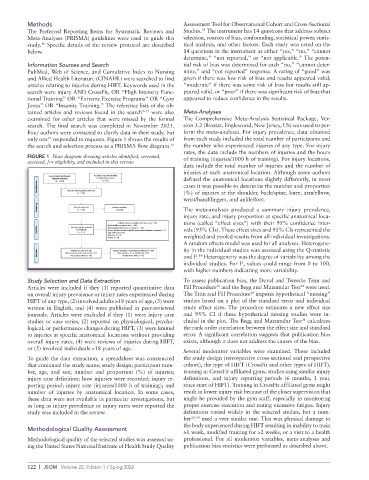
          only one  responded to requests. Figure 1 shows the results of   from each study included the total number of participants and
          the search and selection process as a PRISMA flow diagram. 16  the number who experienced injuries of any type. For injury
                                                             rates, the data include the numbers of injuries and the hours
          FIGURE 1  Flow diagram showing articles identified, screened,   of training (injuries/1000 h of training). For injury locations,
          assessed, for eligibility, and included in this review.
                                                             data include the total number of injuries and the number of
                                                             injuries at each anatomical location. Although some authors
                                                             defined the anatomical locations slightly differently, in most
                                                             cases it was possible to determine the number and proportion
                                                             (%) of injuries at the shoulder, back/spine, knee, arm/elbow,
                                                             wrist/hand/fingers, and ankle/foot.
                                                             The meta-analyses produced a summary injury prevalence,
                                                             injury rate, and injury proportion at specific anatomical loca-
                                                             tions (called “effect sizes”) with their 95% confidence inter-
                                                             vals (95% CIs). These effect sizes and 95% CIs represented the
                                                             weighted and pooled results from all individual investigations.
                                                             A random effects model was used for all analyses. Heterogene-
                                                             ity in the individual studies was assessed using the Q-statistic
                                                             and I .  Heterogeneity was the degree of variability among the
                                                                 2 19
                                                             individual studies. For I , values could range from 0 to 100,
                                                                                2
                                                             with higher numbers indicating more variability.
          Study Selection and Data Extraction                To assess publication bias, the Duval and Tweedie Trim and
                                                                                                   21
                                                                        20
          Articles were included if they (1) reported quantitative data   Fill Procedure  and the Begg and Mazumdar Test  were used.
                                                                                   20
          on overall injury prevalence or injury rates experienced during   The Trim and Fill Procedure  imputes hypothetical “missing”
          HIFT of any type, (2) involved adults ≥18 years of age, (3) were   studies based on a plot of the standard error and individual
          written in English, and (4) were published in peer-reviewed   study effect sizes. The procedure estimates a new effect size
          journals. Articles were excluded if they (1) were injury case   and 95% CI if these hypothetical missing studies were in-
                                                                                                    21
          studies or case series, (2) reported on physiological, psycho-  cluded in the plot. The Begg and Mazumdar Test  calculates
          logical, or performance changes during HIFT, (3) were limited   the rank order correlation between the effect size and standard
          to injuries at specific anatomical locations without providing   error. A significant correlation suggests that publication bias
          overall injury rates, (4) were reviews of injuries during HIFT,   exists, although it does not address the causes of the bias.
          or (5) involved individuals <18 years of age.
                                                             Several moderator variables were examined. These included
          To guide the data extraction, a spreadsheet was constructed   the study design (retrospective cross-sectional and prospective
          that contained the study name; study design; participant num-  cohort), the type of HIFT (CrossFit and other types of HIFT),
          ber, age, and sex; number and proportion (%) of injuries;   training in CrossFit-affiliated gyms, studies using similar injury
          injury case definition; how injuries were recorded; injury re-  definitions,  and  injury  reporting  periods  (6  months,  1  year,
          porting period; injury rate (injuries/1000 h of training); and   since start of HIFT). Training in CrossFit-affiliated gyms might
          number of injuries by anatomical location. In some cases,   result in lower injury risk because of the closer supervision that
          these data were not available in particular investigations, but   might be provided by the gym staff, especially in monitoring
          as long as injury prevalence or injury rates were reported the   proper exercise execution and noting excessive fatigue. Injury
          study was included in the review.                  definitions varied  widely in the  selected  studies, but  a  num-
                                                             ber 22–29  used a very similar one. This was physical damage to
                                                             the body experienced during HIFT resulting in inability to train
          Methodological Quality Assessment
                                                             ≥1 week, modified training for >2 weeks, or a visit to a health
          Methodological quality of the selected studies was assessed us-  professional.  For  all  moderator  variables,  meta-analyses  and
          ing the United States National Institute of Health Study Quality   publication bias statistics were performed as described above.


          122  |  JSOM   Volume 22, Edition 1 / Sping 2022

