


Page 80 - JSOM Winter 2021
P. 80
We maintained general anesthesia with 2–2.5% isoflurane   We delivered pulmonary contusions as described above. Subse-
          in 40–100% oxygen to maintain an oxygen saturation of     quently, we subjected swine to tibial fracture using a benchtop
          > 92%. We used volume-controlled mechanical ventilation   shop press (Northern Tool,  https://www.northerntool.com/).
          with a respiratory rate of 10–15 breaths/min and a tidal vol-  Swine hind limbs were unrestrained for this procedure. We
          ume of 12–15 ml/kg. We managed temperature with a warm-  centered the tibia in the benchtop shop press, which we then
          ing blanket set to 38°C to prevent hypothermia.    used to apply pressure to the tibia until fracture was achieved.
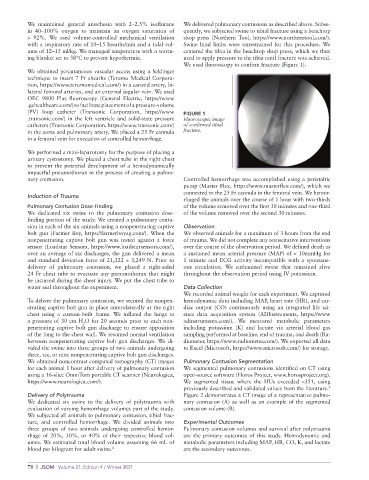
                                                             We used fluoroscopy to confirm fracture (Figure 1).
          We obtained percutaneous vascular access using a Seldinger
          technique to insert 7 Fr sheaths (Terumo Medical Corpora-
          tion, https://www.terumomedical.com/) in a carotid artery, bi-
          lateral femoral arteries, and an external jugular vein. We used
          OEC  9800  Plus  fluoroscopy  (General  Electric,  https://www
          .gehealthcare.com/) to facilitate placement of a pressure- volume
          (PV) loop catheter (Transonic Corporation,  https://www   FIGURE 1
          .transonic.com/) in the left ventricle and solid-state pressure   Fluoroscopic image
          catheters (Transonic Corporation, https://www.transonic.com/)   of confirmed tibial
          in the aorta and pulmonary artery. We placed a 25 Fr cannula   fracture.
          in a femoral vein for execution of controlled hemorrhage.
          We performed a mini-laparotomy for the purpose of placing a
          urinary cystostomy. We placed a chest tube in the right chest
          to prevent the potential development of a hemodynamically
          impactful pneumothorax in the process of creating a pulmo-
          nary contusion.                                    Controlled hemorrhage was accomplished using a peristaltic
                                                             pump (Master Flex, https://www.masterflex.com/), which we
                                                             connected to the 25 Fr cannula in the femoral vein. We hemor-
          Induction of Trauma
                                                             rhaged the animals over the course of 1 hour with two-thirds
          Pulmonary Contusion Dose-Finding                   of the volume removed over the first 30 minutes and one-third
          We dedicated six swine to the pulmonary contusion dose-   of the volume removed over the second 30 minutes.
          finding portion of the study. We created a pulmonary contu-
          sion in each of the six animals using a nonpenetrating captive   Observation
          bolt gun (Farmer Boy,  https://farmerboyag.com/). When the   We observed animals for a maximum of 3 hours from the end
          nonpenetrating captive bolt gun was tested against a force   of trauma. We did not complete any resuscitative interventions
          sensor (Loadstar Sensors, https://www.loadstarsensors.com/),   over the course of the observation period. We defined death as
          over an average of six discharges, the gun delivered a mean   a sustained mean arterial pressure (MAP) of < 10mmHg for
          and standard deviation force of 21,322 ± 3,249 N. Prior to   1  minute  and  ECG  activity  incompatible  with  a  spontane-
          delivery of pulmonary contusion, we placed a right-sided     ous circulation. We euthanized swine that remained alive
          24 Fr chest tube to evacuate any pneumothorax that might   throughout the observation period using IV potassium.
          be incurred during the chest injury. We put the chest tube to
          water seal throughout the experiment.              Data Collection
                                                             We recorded animal weight for each experiment. We captured
          To deliver the pulmonary contusion, we secured the nonpen-  hemodynamic data including MAP, heart rate (HR), and car-
          etrating captive bolt gun in place anterolaterally at the right   diac output (CO) continuously using an integrated life sci-
          chest using a custom-built frame. We inflated the lungs to   ence data acquisition system (ADInstruments,  https://www
          a pressure of 30 cm H O for 20 seconds prior to each non-  adinstruments.com/). We measured metabolic parameters
                            2
          penetrating captive bolt gun discharge to ensure apposition   including  potassium  (K)  and  lactate  via  arterial  blood  gas
          of the lung to the chest wall. We resumed normal ventilation   sampling performed at baseline, end of trauma, and death (Ra-
          between nonpenetrating captive bolt gun discharges. We di-  diometer, https://www.radiometer.com/). We exported all data
          vided the swine into three groups of two animals undergoing   to Excel (Microsoft, https://www.microsoft.com/) for storage.
          three, six, or nine nonpenetrating captive bolt gun discharges.
          We obtained noncontrast computed tomography (CT) images   Pulmonary Contusion Segmentation
          for each animal 1 hour after delivery of pulmonary contusion   We segmented pulmonary contusions identified on CT using
          using a 16-slice OmniTom portable CT scanner (Neurologica,   open-source software (Horos Project, www.horosproject.org).
          https://www.neurologica.com/).                     We  segmented  tissue  where  the  HUs  exceeded  –351,  using
                                                             previously described and validated values from the literature.
                                                                                                            9
          Delivery of Polytrauma                             Figure 2 demonstrates a CT image of a representative pulmo-
          We  dedicated  six swine  to  the  delivery  of  polytrauma  with   nary contusion (A) as well as an example of the segmented
          evaluation of varying hemorrhage volumes part of the study.   contusion volume (B).
          We subjected all animals to pulmonary contusion, tibial frac-
          ture, and controlled hemorrhage. We divided animals into   Experimental Outcomes
          three groups of two animals undergoing controlled hemor-  Pulmonary contusion volumes and survival after polytrauma
          rhage of 20%, 30%, or 40% of their respective blood vol-  are the primary outcomes of this study. Hemodynamic and
          umes. We estimated total blood volume assuming 66 mL of   metabolic parameters including MAP, HR, CO, K, and lactate
          blood per kilogram for adult swine. 8              are the secondary outcomes.


          78  |  JSOM   Volume 21, Edition 4 / Winter 2021

