


Page 75 - JSOM Winter 2021
P. 75
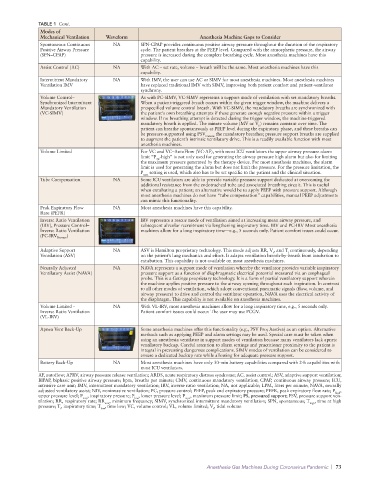
TABLE 1  Cont.
              Modes of
              Mechanical Ventilation  Waveform                    Anesthesia Machine Gaps to Consider
              Spontaneous Continuous   NA      SPN-CPAP provides continuous positive airway pressure throughout the duration of the respiratory
              Positive Airway Pressure         cycle. The patient breathes at the PEEP level. Compared with the atmospheric pressure, the airway
              (SPN–CPAP)                       pressure is increased during the complete breathing cycle. Most anesthesia machines have this
                                               capability.
              Assist Control (AC)     NA       With AC – set rate, volume – breath will be the same. Most anesthesia machines have this
                                               capability.
              Intermittent Mandatory   NA      With IMV, the user can use AC or SIMV for most anesthesia machines. Most anesthesia machines
              Ventilation IMV                  have replaced traditional IMV with SIMV, improving both patient comfort and patient-ventilator
                                               synchrony.
              Volume Control–                  As with PC-SIMV, VC-SIMV represents a support mode of ventilation with set mandatory breaths.
              Synchronized Intermittent        When a patient-triggered breath occurs within the given trigger window, the machine delivers a
              Mandatory Ventilation            prespecified volume control breath. With VC-SIMV, the mandatory breaths are synchronized with
              (VC-SIMV)                        the patient‘s own breathing attempts if these generate enough negative pressure within a trigger
                                               window. If no breathing attempt is detected during the trigger window, the machine-triggered
                                               mandatory breath is applied. The minute volume (MV or V ) remains constant over time. The
                                                                                      E
                                               patient can breathe spontaneously at PEEP level during the expiratory phase, and these breaths can
                                               be pressure-supported using PSV Outside  the mandatory breathes; pressure support breaths are supplied
                                               to augment the patient’s intrinsic ventilatory drive. This is a readily available function with most
                                               anesthesia machines.
              Volume Limited                   For VC and VC–AutoFlow (VC-AF), with most ICU ventilators the upper airway pressure alarm
                                               limit “P -high” is not only used for generating the airway pressure high alarm but also for limiting
                                                    aw
                                               the maximum pressure generated by the therapy device. For most anesthesia machines, the alarm
                                               limit is used for generating the alarm but does not limit the pressure. For the pressure limitation, the
                                               P max  setting is used, which also has to be set specific to the patient and the clinical situation.
              Tube Compensation       NA       Some ICU ventilators are able to provide variable pressure support dedicated at overcoming the
                                               additional resistance from the endotracheal tube and associated breathing circuit. This is useful
                                               when extubating a patient; an alternative would be to apply PEEP with pressure support. Although
                                               most anesthesia machines do not have “tube compensation” capabilities, manual PEEP adjustments
                                               can mimic this functionality.
              Peak Expiratory Flow    NA       Most anesthesia machines have this capability.
              Rate (PEFR)
              Inverse Ratio Ventilation        IRV represents a rescue mode of ventilation aimed at increasing mean airway pressure, and
              (IRV), Pressure Control–         subsequent alveolar recruitment via lengthening inspiratory time. IRV and PC-IRV Most anesthesia
              Inverse Ratio Ventilation        machines allow for a long inspiratory time—e.g., 5 seconds only. Patient comfort issues could occur.
              (PC-IRV Pressure )
              Adaptive Support        NA       ASV is Hamilton proprietary technology. This mode adjusts RR, V , and T continuously, depending
                                                                                          t
                                                                                               i
              Ventilation (ASV)                on the patient’s lung mechanics and effort. It adapts ventilation breath-by-breath from intubation to
                                               extubation. This capability is not available on most anesthesia machines.
              Neurally Adjusted       NA       NAVA represents a support mode of ventilation whereby the ventilator provides variable inspiratory
              Ventilatory Assist (NAVA)        pressure support as a function of diaphragmatic electrical potential measured via an esophageal
                                               probe. This is a Getinge proprietary technology. It is a form of partial ventilatory support wherein
                                               the machine applies positive pressure to the airway opening throughout each inspiration. In contrast
                                               to all other modes of ventilation, which adopt conventional pneumatic signals (flow, volume, and
                                               airway pressure) to drive and control the ventilator operation, NAVA uses the electrical activity of
                                               the diaphragm. This capability is not available on anesthesia machines.
              Volume Limited -        NA       With VL-IRV, most anesthesia machines allow for a long inspiratory time, e.g., 5 seconds only.
              Inverse Ratio Ventilation        Patient comfort issues could occur. The user may use PCGV.
              (VL-IRV)
              Apnea Vent Back-Up               Some anesthesia machines offer this functionality (e.g., PSV Pro; Aestiva) as an option. Alternative
                                               methods such as applying PEEP and alarm settings may be used. Special care must be taken when
                                               using an anesthesia ventilator in support modes of ventilation because many ventilators lack apneic
                                               ventilatory backup. Careful attention to alarm settings and practitioner proximity to the patient is
                                               integral in preventing dangerous complications. SIMV modes of ventilation can be considered to
                                               ensure a dedicated backup rate while allowing for adequate pressure support.
              Battery Back-Up         NA       Most anesthesia machines have only 30-min battery capabilities compared with 2-h capabilities with
                                               most ICU ventilators.
              AF, autoflow; APRV, airway pressure release ventilation; ARDS, acute respiratory distress syndrome; AC, assist control; ASV, adaptive support ventilation;
              BIPAP, biphasic positive airway pressure; bpm, breaths per minute; CMV, continuous mandatory ventilation; CPAP, continuous airway pressure; ICU,
              intensive care unit; IMV, intermittent mandatory ventilation; IRV, inverse ratio ventilation; NA, not applicable; LPM, liters per minute; NAVA, neurally
              adjusted ventilatory assist; NIV, noninvasive ventilation; PC, pressure control; PEEP, peak end expiratory pressure; PEFR, peak expiratory flow rate; P high ,
              upper pressure level; P insp , inspiratory pressure; P , lower pressure level; P max , maximum pressure limit; PS, pressured support; PSV, pressure support ven-
                                             low
              tilation; RR, respiratory rate; RR , minimum frequency; SIMV, synchronized intermittent mandatory ventilation; SPN, spontaneous; T high , time at high
                                   min
              pressure; T, inspiratory time; T , time low; VC, volume control; VL, volume limited; V , tidal volume
                     i            low                                  t


                                                                     Anesthesia Gas Machines During Coronavirus Pandemic  |  73

