


Page 74 - JSOM Winter 2021
P. 74
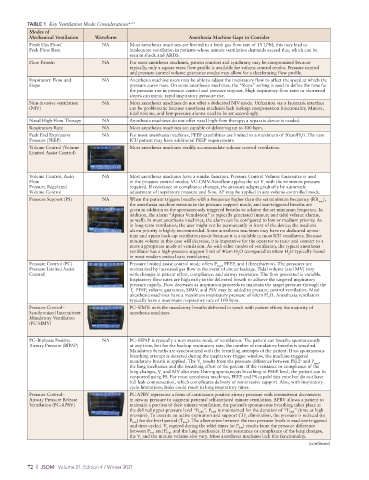
TABLE 1  Key Ventilation Mode Considerations 6–11
           Modes of
           Mechanical Ventilation  Waveform                    Anesthesia Machine Gaps to Consider
           Fresh Gas Flow/        NA       Most anesthesia machines are limited to a fresh gas flow rate of 15 LPM; this may lead to
           Peak Flow Rate                  inadequate ventilation in patients whose minute ventilation demands exceed this, which can be
                                           seen in shock and ARDS.
           Flow Pattern           NA       For most anesthesia machines, patient comfort and synchrony may be compromised because
                                           typically, only a square wave flow profile is available for volume control modes. Pressure control
                                           and pressure control volume guarantee modes may allow for a decelerating flow profile.
           Inspiratory Flow and   NA       Anesthesia machine users may be able to adjust the inspiratory flow to affect the speed at which the
           Slope                           pressure curve rises. On some anesthesia machines, the “Slope” setting is used to define the time for
                                           the pressure rise in pressure control and pressure support. High inspiratory flow rates or shortened
                                           slopes can mimic rapid inspiratory pressure rise.
           Non-invasive ventilation   NA   Most anesthesia machines do not offer a dedicated NIV mode. Utilization via a facemask interface
           (NIV)                           can be problematic because anesthesia machines lack leakage compensation functionality. Minute,
                                           tidal volume, and low-pressure alarms need to be set accordingly.
           Nasal High-Flow Therapy  NA     Anesthesia machines do not offer nasal high-flow therapy; a separate device is needed.
           Respiratory Rate       NA       Most anesthesia machines are capable of delivering up to 100 bpm.
           Peak End Expiratory    NA       For most anesthesia machines, PEEP capabilities are limited to a maximum of 30cm/H 0. The rare
                                                                                                   2
           Pressure (PEEP)                 ICU patient may have additional PEEP requirements.
           Volume Control (Volume          Most anesthesia machines readily accommodate volume control ventilation.
           Limited Assist Control)


           Volume Control, Auto   NA       Most anesthesia machines have a similar function. Pressure Control Volume Guarantee is used
           Flow                            in the pressure control modes. VC-CMV-Autoflow applies the set V  with the minimum pressure
                                                                                       t
           Pressure Regulated              required. If resistance or compliance changes, the pressure adapts gradually by automatic
           Volume Control                  adjustment of inspiratory pressure and flow. AF may be applied in any volume-controlled mode.
           Pressure Support (PS)  NA       When the patient triggers breaths with a frequency higher than the set minimum frequency (RR ),
                                                                                                         min
                                           the anesthesia machine remains in the pressure support mode, and non-triggered breaths are
                                           given in addition to the spontaneously triggered breaths to achieve the set minimum frequency. In
                                           addition, the alarm “Apnea Ventilation” is typically generated (minute and tidal volume alarms,
                                           as well). In most anesthesia machines, the alarm can be configured to low or medium priority. As
                                           in long-term ventilation, the user might not be permanently in front of the device; the medium
                                           alarm priority is highly recommended. Some anesthesia machines may have no dedicated apnea-
                                           time and apnea back-up ventilation mode because it is available in most ICU ventilators. Because
                                           minute volume in this case will decrease, it is imperative for the operator to react and convert to a
                                           more appropriate mode of ventilation. As with other modes of ventilation, the typical anesthesia
                                           ventilator has a high-pressure support limit of 40cm H O (compared to 60cm H O typically found
                                                                                               2
                                                                               2
                                           in most modern critical care ventilators).
           Pressure Control (PC)           Pressure limited assist control mode offers P insp , PEEP, and f (breaths/min). The pressures are
           Pressure Limited Assist         maintained by increased gas flow in the event of circuit leakage. Tidal volume (and MV) vary
           Control                         with changes in patient effort, compliance, and airway resistance. The flow generated is variable.
                                           Inspiratory flow rates are high early in the delivered breath to achieve the targeted inspiratory
                                           pressure rapidly. Flow decreases as inspiration proceeds to maintain the target pressure through the
                                           T. PEEP, volume guarantee, SIMV, and PSV may be added to pressure control ventilation. Most
                                            i
                                           anesthesia machines have a maximum inspiratory pressure of 60cm H O. Anesthesia ventilators
                                                                                         2
                                           typically have a maximum respiratory rate of 100 bpm.
           Pressure Control–               PC–SIMV: with the mandatory breaths delivered in synch with patient effort; the majority of
           Synchronized Intermittent       anesthesia machines
           Mandatory Ventilation
           (PC-SIMV)
           PC–Biphasic Positive   NA       PC–BIPAP is typically a noninvasive mode of ventilation. The patient can breathe spontaneously
           Airway Pressure (BIPAP)         at any time, but for the backup respiratory rate, the number of mandatory breaths is specified.
                                           Mandatory breaths are synchronized with the breathing attempts of the patient. If no spontaneous
                                           breathing attempt is detected during the inspiratory trigger window, the machine-triggered
                                           mandatory breath is applied. The V  results from the pressure difference between PEEP and P insp ,
                                                                  t
                                           the lung mechanics and the breathing effort of the patient. If the resistance or compliance of the
                                           lung changes, V  and MV also vary. During spontaneous breathing at PEEP level, the patient can be
                                                      t
                                           supported using PS. For most anesthesia machines, PEEP and PS capabilities exist but do not have
                                           full leak compensation, which complicates delivery of noninvasive support. Also, with inspiratory
                                           cycle limitations, leaks could result in long inspiratory times.
           Pressure Control–               PC-APRV represents a form of continuous positive airway pressure with intermittent decrements
           Airway Pressure Release         in airway pressure to augment patients’ self-initiated minute ventilation. APRV allows a patient to
           Ventilation (PC-APRV)           maintain a portion of their minute ventilation; the patient’s spontaneous breathing takes place at
                                           the defined upper pressure level “P high ”. P high  is maintained for the duration of “T high ” (time at high
                                           pressure). To execute an active expiration and support CO  elimination, the pressure is reduced (to
                                                                                 2
                                           P low ) for the brief period (T low ). The alternation between the two pressure levels is machine-triggered
                                           and time-cycled. V  expired during the relief times (at P low ) results from the pressure difference
                                                       t
                                           between P low  and P high  and the lung mechanics. If the resistance or compliance of the lung changes,
                                           the V  and the minute volume also vary. Most anesthesia machines lack this functionality.
                                               t
                                                                                                      (continues)
          72  |  JSOM   Volume 21, Edition 4 / Winter 2021

