


Page 72 - JSOM Winter 2021
P. 72
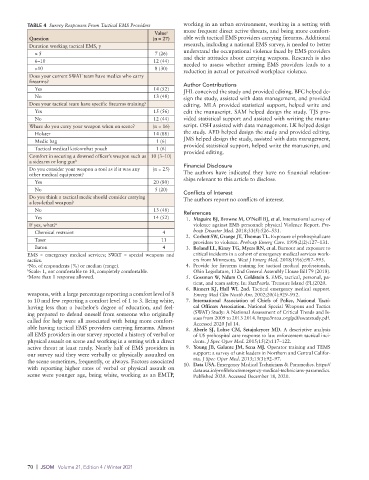
TABLE 4  Survey Responses From Tactical EMS Providers  working in an urban environment, working in a setting with
                                                       a
                                                    Value     more frequent direct active threats, and being more comfort-
           Question                                (n = 27)  able with tactical EMS providers carrying firearms. Additional
           Duration working tactical EMS, y                  research, including a national EMS survey, is needed to better
            ≤ 5                                     7 (26)   understand the occupational violence faced by EMS providers
            6–10                                   12 (44)   and their attitudes about carrying weapons. Research is also
                                                             needed to assess whether arming EMS providers leads to a
            >10                                     8 (30)   reduction in actual or perceived workplace violence.
           Does your current SWAT team have medics who carry
           firearms?                                         Author Contributions
            Yes                                    14 (52)   JHL conceived the study and provided editing. BFC helped de-
            No                                     13 (48)   sign the study, assisted with data management, and provided
           Does your tactical team have specific firearms training?  editing. MLA provided statistical support, helped write and
            Yes                                    15 (56)   edit the manuscript. SAM helped design the study. TJS pro-
            No                                     12 (44)   vided statistical support and assisted with writing the manu-
           Where do you carry your weapon when on scene?  (n = 16)  script. OSH assisted with data management. LK helped design
            Holster                                14 (88)   the study. AFD helped design the study and provided editing.
            Medic bag                               1 (6)    JMS helped design the study, assisted with data management,
            Tactical medical kit/combat pouch       1 (6)    provided statistical support, helped write the manuscript, and
                                                             provided editing.
           Comfort in securing a downed officer’s weapon such as  10 (3–10)
           a sidearm or long gun b
                                                             Financial Disclosure
           Do you consider your weapon a tool as if it was any   (n = 25)
           other medical equipment?                          The authors have indicated they have no financial relation-
            Yes                                    20 (80)   ships relevant to this article to disclose.
            No                                      5 (20)
           Do you think a tactical medic should consider carrying   Conflicts of Interest
                                                             The authors report no conflicts of interest.
           a less-lethal weapon?
            No                                     13 (48)
                                                             References
            Yes                                    14 (52)    1.  Maguire BJ, Browne M, O’Neill BJ, et al. International survey of
           If yes, what? c                                      violence against EMS personnel: physical Violence Report. Pre-
            Chemical restraint                        4         hosp Disaster Med. 2018;33(5):526–531.
            Taser                                     11      2.  Corbett SW, Grange JT, Thomas TL. Exposure of prehospital care
                                                                providers to violence. Prehosp Emerg Care. 1998;2(2):127–131.
            Baton                                     4       3.  Boland LL, Kinzy TG, Myers RN, et al. Burnout and exposure to
          EMS  =  emergency  medical  services;  SWAT  =  special  weapons  and   critical incidents in a cohort of emergency medical services work-
          tactics.                                              ers from Minnesota. West J Emerg Med. 2018;19(6):987–995.
          a No. of respondents (%) or median (range).         4.  Provide for firearms training for tactical medical professionals,
          b Scale: 1, not comfortable to 10, completely comfortable.  Ohio Legislature, 132nd General Assembly House Bill 79 (2018).
          c More than 1 response allowed.                     5.  Gossman W, Ndum O, Goldstein S. EMS, tactical, personal, pa-
                                                                tient, and team safety. In: StatPearls. Treasure Island (FL)2020.
                                                              6.  Rinnert KJ, Hall WL 2nd. Tactical emergency medical support.
          weapons, with a large percentage reporting a comfort level of 8   Emerg Med Clin North Am. 2002;20(4):929–952.
          to 10 and few reporting a comfort level of 1 to 3. Being white,   7.  International Association of Chiefs of Police, National Tacti-
          having less than a bachelor’s degree of education, and feel-  cal Officers Association. National Special Weapons and Tactics
          ing prepared to defend oneself from someone who originally   (SWAT) Study: A National Assessment of Critical Trends and Is-
          called for help were all associated with being more comfort-  sues from 2009 to 2013 2014. https://ntoa.org/pdf/swatstudy.pdf.
                                                                Accessed 2020 Jul 14.
          able having tactical EMS providers carrying firearms. Almost   8.  Aberle SJ, Lohse CM, Sztajnkrycer MD. A descriptive analysis
          all EMS providers in our survey reported a history of verbal or   of US prehospital care response to law enforcement tactical inci-
          physical assault on scene and working in a setting with a direct   dents. J Spec Oper Med. 2015;15(2):117–122.
          active threat at least rarely. Nearly half of EMS providers in   9.  Young JB, Galante JM, Sena MJ. Operator training and TEMS
          our survey said they were verbally or physically assaulted on   support: a survey of unit leaders in Northern and Central Califor-
          the scene sometimes, frequently, or always. Factors associated   nia. J Spec Oper Med. 2013;13(3):92–97.
          with  reporting  higher  rates  of verbal  or  physical  assault  on   10.  Data USA. Emergency Medical Technicians & Paramedics. https://
                                                                datausa.io/profile/soc/emergency-medical-technicians-paramedics.
          scene were younger age, being white, working as an EMTP,   Published 2020. Accessed December 18, 2020.


          70  |  JSOM   Volume 21, Edition 4 / Winter 2021

