


Page 51 - JSOM Winter 2021
P. 51
and tracking of physical movements. 21,22  Slowed recognition,   given opportunities to practice sequences required for iden-
              or lack of awareness or adaptive skillsets, would delay effi-  tifying, challenging, and replacing distorted/performance de-
              ciency or completely disrupt optimal performance restoration.   grading thoughts with more accurate/performance- enhancing
              However, effective breathing regulation techniques can im-  thoughts. Catalytic narratives were presented to the group
              prove fine motor dexterity, working memory, and attention –     projected onto the dry-erase board, followed by a Scenario
              all of which are critical requirements for complex skills in mul-  Strategy Grid with a partially worked-out example of the cog-
              tiple occupational specialties (e.g., stripping a wire on an im-  nitive skill being learned (SEASITE method). 25–26  Trainees were
              provised explosive device (IED), calling in close air support or   tasked with generating ideas, strategies, solutions, and work-
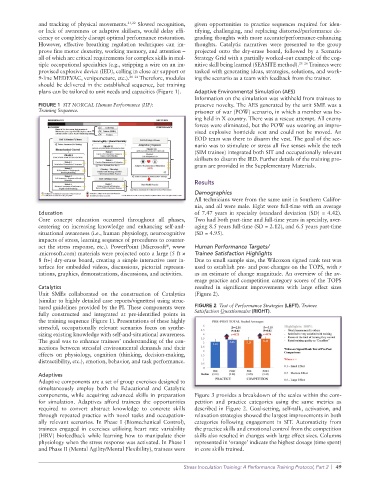
              9-line MEDEVAC, venipuncture, etc.). 21–24  Therefore, modules   ing the scenario as a team with feedback from the trainer.
              should be delivered in the established sequence, but training
              plans can be tailored to unit needs and capacities (Figure 1).  Adaptive Environmental Simulation (AES)
                                                                 Information on the simulation was withheld from trainees to
              FIGURE 1  SIT NORCAL Human Performance (HP):       preserve novelty. The AES generated by the unit SME was a
              Training Sequence.                                 prisoner of war (POW) scenario, in which a member was be-
                                                                 ing held in X country. There was a rescue attempt. All enemy
                                                                 forces were eliminated, but the POW was wearing an impro-
                                                                 vised explosive homicide vest and could not be moved. An
                                                                 EOD team was there to disarm the vest. The goal of the sce-
                                                                 nario was to stimulate or stress all five senses while the tech
                                                                 (SIM trainee) integrated both SIT and occupationally relevant
                                                                 skillsets to disarm the IED. Further details of the training pro-
                                                                 gram are provided in the Supplementary Materials.


                                                                 Results
                                                                 Demographics
                                                                 All technicians were from the same unit in Southern Califor-
                                                                 nia, and all were male. Eight were full-time with an average
              Education                                          of  7.47 years  in specialty  (standard deviation  (SD)  =  4.42).
              Core concept education occurred throughout all phases,   Two had both part-time and full-time years in specialty, aver-
              centering on increasing knowledge and enhancing self-and-   aging 8.5 years full-time (SD = 2.12), and 6.5 years part-time
              situational awareness (i.e., human physiology, neurocognitive   (SD = 4.95).
              impacts of stress, learning sequence of procedures to counter-
              act the stress response, etc.). PowerPoint (Microsoft , www   Human Performance Targets/
                                                       ®
              .microsoft.com) materials were projected onto a large (5 ft ×   Trainee Satisfaction Highlights
              8 ft+) dry-erase board, creating a simple interactive user in-  Due to small sample size, the Wilcoxon signed rank test was
              terface for embedded videos, discussions, pictorial represen-  used to establish pre- and post-changes on the TOPS, with r
              tations, graphics, demonstrations, discussions, and activities.  as an estimate of change magnitude. An overview of the av-
                                                                 erage practice and competition category scores of the TOPS
              Catalytics                                         resulted in significant improvements with large effect sizes
              Unit SMEs collaborated on the construction of Catalytics   (Figure 2).
              (similar to highly detailed case reports/vignettes) using struc-
              tured guidelines provided by the PI. These components were   FIGURE 2  Test of Performance Strategies (LEFT), Trainee
              fully constructed and integrated at pre-identified points in   Satisfaction Questionnaire (RIGHT).
              the training sequence (Figure 1). Presentations of these highly
              stressful, occupationally relevant scenarios focus on synthe-
              sizing existing knowledge with self-and-situational awareness.
              The goal was to enhance trainees’ understanding of the con-
              nections between stressful environmental demands and their
              effects on physiology, cognition (thinking, decision-making,
              distractibility, etc.), emotion, behavior, and task performance.

              Adaptives
              Adaptive components are a set of group exercises designed to
              simultaneously employ both the Educational and Catalytic
              components,  while  acquiring  advanced  skills  in  preparation   Figure 3 provides a breakdown of the scales within the com-
              for  simulation.  Adaptives  afford  trainees  the  opportunities   petition and practice categories using the same metrics as
              required to convert abstract knowledge to concrete skills   described in Figure 2. Goal-setting, self-talk, activation, and
              through repeated practice with novel tasks and occupation-  relaxation strategies showed the largest improvements in both
              ally relevant scenarios. In  Phase  I (Biomechanical  Control),   categories  following  engagement  in  SIT.  Automaticity  from
              trainees engaged in exercises utilizing heart rate variability   the practice skills and emotional control from the competition
              (HRV)  biofeedback  while  learning how  to  manipulate their   skills also resulted in changes with large effect sizes. Columns
              physiology when the stress response was activated. In Phase I   represented in ‘orange’ indicate the highest dosage (time spent)
              and Phase II (Mental Agility/Mental Flexibility), trainees were   in core skills trained.

                                                             Stress Inoculation Training: A Performance Training Protocol, Part 2  |  49

