


Page 33 - JSOM Winter 2021
P. 33
This is especially true during high performance tasks, such   Three-dimensional motion capture was used to capture lower
              as a double-limb stop jump in which side-to-side movement   extremity mechanics during the landing phase of the double-
                                                 14
              asymmetries have been previously observed.  For example,   limb stop jump. Lower extremity segments were defined and
              a stop jump type of task translates easily to military opera-  tracked using the plug-in-gait marker set. Retro-reflective
              tions, such as scaling walls and jumping across and over ter-  markers were placed at the following anatomical landmarks:
              rain. Therefore, the purpose of this project was to determine   bilateral anterior superior iliac spine, posterior superior iliac
              if military personnel with chronic low back pain have reduced   spine, lateral thigh, lateral femoral epicondyle, lateral shank,
              performance, and if they use a different strategy to complete a   lateral malleolus, posterior heel, and head of second metatarsal.
              functional performance task as compared to healthy military   Anthropometric calipers and a tape measure were used to col-
              personnel. We hypothesize that those with chronic low back   lect lower extremity leg length, knee diameter, and ankle inter-
              pain will have reduced performance and asymmetrical lower   malleolar distance for the plug-in-gait model. Kinematics were
              extremity mechanics compared to healthy individuals.  collected at 200 Hz with an eight-camera three- dimensional
                                                                 motion capture system (Vicon, https://www.vicon.com/) and
                                                                 marker trajectories were filtered using a fourth-order lowpass
              Methods
                                                                 Butterworth  filter  with  a cutoff of  6  Hz.  Ground reaction
              United States Marines were recruited from the United   forces captured on two in-ground force plates (Type 9286BA,
              States   Marines Corps Forces Special Operations Command   Kistler Instrument Corp.,  https://www.kistler.com/en/) and
              ( MARSOC) individual training program classes as part of a   raw vertical ground reaction forces (VGRF) were sampled at
              larger surveillance study. Those who reported they had suffered   1200 Hz. These were filtered using a fourth order low-pass
              from chronic low back pain for a minimum of 6 months were   Butterworth filter with a cutoff of 50 Hz. All biomechanical
              included in this study. Inclusion in the low back pain group   data were processed using Visual 3D (C-Motion, https://www
              included individuals who (1) indicated they were experiencing   .c-motion.com/). Jump height was calculated from the posi-
              low back pain but were also currently cleared for full and un-  tion of the posterior superior iliac spine makers from the point
              restricted participation in physical and tactical training despite   of takeoff, as determined by the force plates, to peak vertical
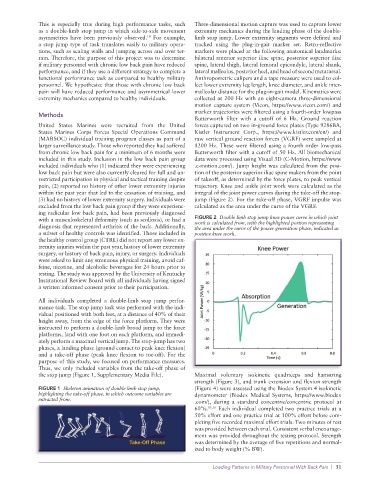
              pain, (2) reported no history of other lower extremity injuries   trajectory. Knee and ankle joint work were calculated as the
              within the past year that led to the cessation of training, and   integral of the joint power curves during the take-off the stop-
              (3) had no history of lower extremity surgery. Individuals were   jump (Figure 2). For the take-off phase, VGRF impulse was
              excluded from the low back pain group if they were experienc-  calculated as the area under the curve of the VGRF.
              ing radicular low back pain, had been previously diagnosed
              with a musculoskeletal deformity (such as scoliosis), or had a   FIGURE 2  Double limb stop jump knee power curve in which joint
              diagnosis that represented arthritis of the back. Additionally,   work is calculated from, with the highlighted portion representing
                                                                 the area under the curve of the power generation phase, indicated as
              a subset of healthy controls was identified. Those included in   positive knee work.
              the healthy control group (CTRL) did not report any lower ex-
              tremity injuries within the past year, history of lower extremity
              surgery, or history of back pain, injury, or surgery. Individuals
              were asked to limit any strenuous physical training, avoid caf-
              feine, nicotine, and alcoholic beverages for 24 hours prior to
              testing. The study was approved by the University of Kentucky
              Institutional Review Board with all individuals having signed
              a written informed consent prior to their participation.

              All individuals completed a double-limb stop jump perfor-
              mance task. The stop jump task was performed with the indi-
              vidual positioned with both feet, at a distance of 40% of their
              height away, from the edge of the force platform. They were
              instructed to perform a double-limb broad jump to the force
              platforms, land with one foot on each platform, and immedi-
              ately perform a maximal vertical jump. The stop-jump has two
              phases, a landing phase (ground contact to peak knee flexion)
              and a take-off phase (peak knee flexion to toe-off). For the
              purpose of this study, we focused on performance measures.
              Thus, we only included variables from the take-off phase of
              the stop jump (Figure 1, Supplementary Media File).  Maximal voluntary isokinetic quadriceps and hamstring
                                                                 strength (Figure 3), and trunk extension and flexion strength
              FIGURE 1  Skeleton animation of double limb stop jump,   (Figure 4) were assessed using the Biodex System 4 isokinetic
              highlighting the take-off phase, in which outcome variables are   dynamometer (Biodex Medical Systems,  https://www.biodex
              extracted from.                                    .com/), during a standard concentric/concentric protocol at
                                                                 60°/s. 15,16  Each individual completed two practice trials at a
                                                                 50% effort and one practice trial at 100% effort before com-
                                                                 pleting five recorded maximal effort trials. Two minutes of rest
                                                                 was provided between each trial. Consistent verbal encourage-
                                                                 ment was provided throughout the testing protocol. Strength
                                                                 was determined by the average of five repetitions and normal-
                                                                 ized to body weight (% BW).

                                                                      Loading Patterns in Military Personnel With Back Pain  |  31

