


Page 85 - JSOM Fall 2021
P. 85
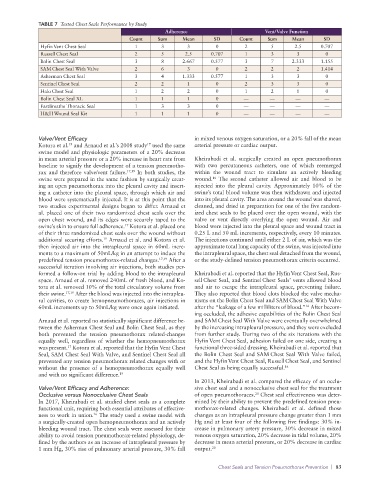
TABLE 7  Tested Chest Seals Performance by Study
                                                       Adherence                        Vent/Valve Function
                                           Count     Sum     Mean      SD      Count     Sum    Mean       SD
              Hyfin Vent Chest Seal          1        3       3         0        2        5      2.5      0.707

              Russell Chest Seal             2        5       2.5     0.707      1        3       3        0

              Bolin Chest Seal               3        8      2.667    0.577      3        7     2.333     1.155
              SAM Chest Seal With Valve      2        6       3         0        2        2       2       1.414

              Asherman Chest Seal            3        4      1.333    0.577      1        3       3        0

              Sentinel Chest Seal            2        2       1         0        2        3       3        0

              Halo Chest Seal                1        2       2         0        1        2       1        0
              Bolin Chest Seal XL            1        1       1         0        —       —        —        —
              FastBreathe Thoracic Seal      1        3       3         0        —       —        —        —
              H&H Wound Seal Kit             1        1       1         0        —       —        —        —


              Valve/Vent Efficacy                                in mixed venous oxygen saturation, or a 20% fall of the mean
                                                 17
              Kotora et al.  and Arnaud et al.’s 2008 study  used the same   arterial pressure or cardiac output.
                       19
              swine model and physiologic parameters of a 20% decrease
              in mean arterial pressure or a 20% increase in heart rate from   Kheirabadi et al. surgically created an open pneumothorax
              baseline to signify the development of a tension pneumotho-  with two percutaneous catheters, one of which reemerged
              rax and therefore valve/vent failure. 17,19  In both studies, the   within the wound tract to simulate an actively bleeding
                                                                       16
              swine were prepared in the same fashion by surgically creat-  wound.  The second catheter allowed air and blood to be
              ing an open pneumothorax into the pleural cavity and insert-  injected into the pleural cavity. Approximately 10% of the
              ing a catheter into the pleural space, through which air and   swine’s total blood volume was then withdrawn and injected
              blood were systematically injected. It is at this point that the   into its pleural cavity. The area around the wound was shaved,
              two studies experimental designs began to differ. Arnaud et   cleaned, and dried in preparation for one of the five random-
              al. placed one of their two randomized chest seals over the   ized chest seals to be placed over the open wound, with the
              open chest wound, and its edges were securely taped to the   valve or vent directly overlying the open wound. Air and
                                          17
              swine’s skin to ensure full adherence.  Kotora et al. placed one   blood were injected into the pleural space and wound tract in
              of their three randomized chest seals over the wound without   0.25 L and 50 mL increments, respectively, every 10 minutes.
                                   19
              additional securing efforts.  Arnaud et al. and Kotora et al.   The injections continued until either 2 L of air, which was the
              then injected air into the intrapleural space in 60mL incre-  approximate total lung capacity of the swine, was injected into
              ments to a maximum of 50mL/kg in an attempt to induce the   the intrapleural space, the chest seal detached from the wound,
              predefined tension pneumothorax-related changes. 17,19  After a   or the study-defined tension pneumothorax criteria occurred.
              successful iteration involving air injections, both studies per-
              formed a follow-on trial by adding blood to the intrapleural   Kheirabadi et al. reported that the HyfinVent Chest Seal, Rus-

              space. Arnaud et al. removed 240mL of fresh blood, and Ko-  sell Chest Seal, and Sentinel Chest Seals’ vents allowed blood


              tora et al. removed 10% of the total circulatory volume from   and air to escape the intrapleural space, preventing failure.
              their swine. 17,19  After the blood was injected into the intrapleu-  They also reported that blood clots blocked the valve mecha-
              ral cavities, to create hemopneumothoraces, air injections in   nisms on the Bolin Chest Seal and SAM Chest Seal With Valve

                                                                                                     16
              60mL increments up to 50mL/kg were once again initiated.  after the “leakage of a few milliliters of blood.”  After becom-
                                                                 ing occluded, the adhesive capabilities of the Bolin Chest Seal

              Arnaud et al. reported no statistically significant difference be-  and SAMChest Seal With Valve were eventually overwhelmed
              tween the Asherman Chest Seal and Bolin Chest Seal, as they   by the increasing intrapleural pressure, and they were excluded
              both prevented  the  tension pneumothorax  related-changes   from further study. During two of the six iterations with the
              equally  well,  regardless  of  whether  the  hemopneumothorax   Hyfin Vent Chest Seal, adhesion failed on one side, creating a

              was present.  Kotora et al. reported that the Hyfin Vent Chest   functional three-sided dressing. Kheirabadi et al. reported that
                       17

              Seal, SAM Chest Seal With Valve, and Sentinel Chest Seal all   the Bolin Chest Seal and SAM Chest Seal With Valve failed,


              prevented any tension pneumothorax related changes with or   and the HyfinVent Chest Seal, RussellChest Seal, and Sentinel
              without the presence of a hemopneumothorax equally well   Chest Seal as being equally successful. 16
              and with no significant difference. 19
                                                                 In 2013, Kheirabadi et al. compared the efficacy of an occlu-
              Valve/Vent Efficacy and Adherence:                 sive chest seal and a nonocclusive chest seal for the treatment
              Occlusive versus Nonocclusive Chest Seals          of open pneumothoraces.  Chest seal effectiveness was deter-
                                                                                    20
              In 2017, Kheirabadi et al. studied chest seals as a complete   mined by their ability to prevent the predefined tension pneu-
              functional unit, requiring both essential attributes of effective-  mothorax-related changes. Kheirabadi et al. defined those
              ness to work in union.  The study used a swine model with   changes as an intrapleural pressure change greater than 1 mm
                                16
              a surgically-created open hemopneumothorax and an actively   Hg and at least four of the following five findings: 30% in-
              bleeding wound tract. The chest seals were assessed for their   crease in pulmonary artery pressure, 30% decrease in mixed
              ability to avoid tension pneumothorax-related physiology, de-  venous oxygen saturation, 20% decrease in tidal volume, 20%
              fined by the authors as an increase of intrapleural pressure by   decrease in mean arterial pressure, or 20% decrease in cardiac
              1 mm Hg, 30% rise of pulmonary arterial pressure, 30% fall   output. 20
                                                                        Chest Seals and Tension Pneumothorax Prevention  |  83

