


Page 84 - JSOM Fall 2021
P. 84
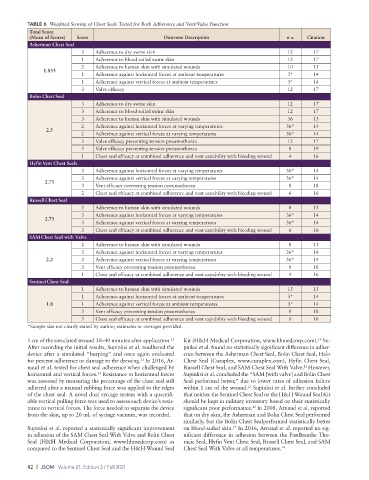
TABLE 6  Weighted Scoring of Chest Seals Tested for Both Adherence and Vent/Valve Function
           Total Score
           (Mean of Scores)  Score                     Outcome Description                     n =   Citation
           Asherman Chest Seal
                            3   Adherence to dry swine skin                                    12      17
                            1   Adherence to blood soiled swine skin                           12      17
                            2   Adherence to human skin with simulated wounds                  10      13
               1.833
                            1   Adherence against horizontal forces at ambient temperatures    3*      14
                            1   Adherence against vertical forces at ambient temperatures      3*      14
                            3   Valve efficacy                                                 12      17
           Bolin Chest Seal
                            3   Adherence to dry swine skin                                    12      17
                            3   Adherence to blood soiled swine skin                           12      17
                            3   Adherence to human skin with simulated wounds                  36      13
                            2   Adherence against horizontal forces at varying temperatures    36*     14
                2.5
                            2   Adherence against vertical forces at varying temperatures      36*     14
                            3   Valve efficacy preventing tension pneumothorax                 12      17
                            3   Valve efficacy preventing tension pneumothorax                 8       19
                            1   Chest seal efficacy at combined adherence and vent capability with bleeding wound  4  16
           Hyfin Vent Chest Seals

                            3   Adherence against horizontal forces at varying temperatures    36*     14
                            3   Adherence against vertical forces at varying temperatures      36*     14
                2.75
                            3   Vent efficacy preventing tension pneumothorax                  8       18
                            2   Chest seal efficacy at combined adherence and vent capability with bleeding wound  6  16
           Russell Chest Seal

                            2   Adherence to human skin with simulated wounds                  8       13
                            3   Adherence against horizontal forces at varying temperatures    36*     14
                2.75
                            3   Adherence against vertical forces at varying temperatures      36*     14
                            3   Chest seal efficacy at combined adherence and vent capability with bleeding wound  6  16
           SAM Chest Seal with Valve

                            2   Adherence to human skin with simulated wounds                  8       13
                            3   Adherence against horizontal forces at varying temperatures    36*     14
                2.2         3   Adherence against vertical forces at varying temperatures      36*     14
                            3   Vent efficacy preventing tension pneumothorax                  8       18
                            1   Chest seal efficacy at combined adherence and vent capability with bleeding wound  4  16
           Sentinel Chest Seal

                            1   Adherence to human skin with simulated wounds                  15      13
                            1   Adherence against horizontal forces at ambient temperatures    3*      14
                1.8         1   Adherence against vertical forces at ambient temperatures      3*      14
                            3   Vent efficacy preventing tension pneumothorax                  8       18
                            3   Chest seal efficacy at combined adherence and vent capability with bleeding wound  6  16
          *Sample size not clearly stated by author; estimates or averages provided.

                                                         13
          1 cm of the simulated wound 30–40 minutes after application.    Kit (H&H Medical Corporation, www.hhmedcorp.com).  Su-
                                                                                                         13
          After recording the initial results, Supinksi et al. readhered the   pinksi et al. found no statistically significant difference in adher-
          device after a simulated “burping” and once again evaluated   ence between the Asherman Chest Seal, Bolin Chest Seal, Halo
          for percent adherence or damage to the dressing.  In 2016, Ar-  Chest Seal (Curaplex, www.curaplex.com), Hyfin Chest Seal,
                                               13
          naud et al. tested for chest seal adherence when challenged by   Russell Chest Seal, and SAM Chest Seal With Valve. However,
                                                                                                    13
                                 14
          horizontal and vertical forces.  Resistance to horizontal forces   Supinksi et al. concluded the “SAM [with valve] and Bolin Chest
          was assessed by measuring the percentage of the chest seal still   Seal performed better,” due to lower rates of adhesion failure
                                                                                  13
          adhered after a manual rubbing force was applied to the edges   within 1 cm of the wound.  Supinksi et al. further concluded
          of the chest seal. A novel dual syringe system with a quantifi-  that neither the Sentinel Chest Seal or the H&H Wound Seal Kit
          able vertical pulling force was used to assess each device’s resis-  should be kept in military inventory based on their statistically
          tance to vertical forces. The force needed to separate the device   significant poor performance.  In 2008, Arnaud et al. reported
                                                                                   13
          from the skin, up to 20 mL of syringe vacuum, was recorded.  that on dry skin, the Asherman and Bolin Chest Seal performed
                                                             similarly, but the Bolin Chest Sealperformed statistically better
          Supinksi et al. reported a statistically significant improvement   on blood-soiled skin.  In 2016, Arnaud et al. reported no sig-
                                                                             17
          in adhesion of the SAM Chest Seal With Valve and Bolin Chest   nificant difference in adhesion between the FastBreathe Tho-
          Seal (H&H Medical Corporation,  www.hhmedcorp.com) as   racic Seal, Hyfin Vent Chest Seal, Russell Chest Seal, and SAM
          compared to the Sentinel Chest Seal and the H&H Wound Seal   Chest Seal With Valve at all temperatures. 14
          82  |  JSOM   Volume 21, Edition 3 / Fall 2021

