


Page 80 - JSOM Fall 2021
P. 80
Efficacy of Commercial Chest Seal Adherence

                                  and Tension Pneumothorax Prevention
                                 A Systematic Review of Quantitative Studies


                                                                                              2
                                                     1
                        Roland Paquette, PA-C, MPAS *; Meredith Quinene, DHSc, MPAS, PA-C ;
                                 Lorne Blackbourne, MD, FACS ; Paul Allen, PA-C, DSc
                                                                                      4
                                                               3

          ABSTRACT
          Background: Penetrating thoracic injuries account for an es-  isolated to urban and combat environments. The wilderness
          sential subset of battlefield and civilian injuries that result   medicine community also recognizes the importance of chest
          in death. Current recommendations are to use commercially   trauma in austere environments. 4,5
          available nonocclusive chest seals. We review current evidence
          for which chest seal(s) is likely to be the most effective in treat-  For almost a century, recommendations for the management
          ing open pneumothoraces. Methods: A systematic review was   of open pneumothoraces  have included specialized wound
          conducted in accordance with the PRIMSA 2009 standard   dressings due to the unique physiologic requirements of the
          systematic review methodology, except where noted. The data-  thoracic cavity. Current recommendations are to use nonocclu-
          bases Pubmed, MEDLINE, CINAHL, Scopus, and gray sources   sive chest seals when available to improve patient survival.
                                                                                                           6–9
          were searched for all English-language, full-manuscript, ex-  The commercial market has responded, and an Internet search
          perimental, quantitative studies of humans and animals con-  showed 14 commercially available occlusive and nonocclusive
          cerning seal adherence or their efficacy at preventing tension   chest seals with conflicting marketing claims regarding their
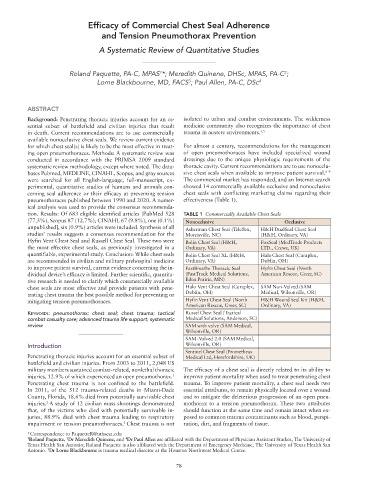
          pneumothoraces published between 1990 and 2020. A numer-  effectiveness (Table 1).
          ical analysis was used to provide the consensus recommenda-
          tion. Results: Of 683 eligible identified articles [PubMed 528   TABLE 1  Commercially Available Chest Seals
          (77.3%), Scopus 87 (12.7%), CINAHL 67 (9.8%), one (0.1%)   Nonocclusive             Occlusive
          unpublished], six (0.9%) articles were included. Synthesis of all   Asherman Chest Seal (Teleflex,   H&H DualSeal Chest Seal

          studies’ results suggests a consensus recommendation for the   Morrisville, NC)  (H&H, Ordinary, VA)
          Hyfin Vent Chest Seal and Russell Chest Seal. These two were   Bolin Chest Seal (H&H,   FoxSeal (MedTrade Products
          the most effective chest seals, as previously investigated in a   Ordinary, VA)  LTD., Crewe, UK)
          quantifiable, experimental study. Conclusion: While chest seals   Bolin Chest Seal XL (H&H,   Halo Chest Seal (Curaplex,

          are recommended in civilian and military prehospital medicine   Ordinary, VA)  Dublin, OH)
          to improve patient survival, current evidence concerning the in-  FastBreathe Thoracic Seal   Hyfin Chest Seal (North

          dividual device’s efficacy is limited. Further scientific, quantita-  (FastTrack Medical Solutions,   American Rescue, Greer, SC)
          tive research is needed to clarify which commercially available   Eden Prairie, MN)

          chest seals are most effective and provide patients with pene-  Halo Vent Chest Seal (Curaplex,   SAM Non-Valved (SAM
          trating chest trauma the best possible method for preventing or   Dublin, OH)  Medical, Wilsonville, OR)


          mitigating tension pneumothoraces.                  Hyfin Vent Chest Seal (North   H&H Wound Seal Kit (H&H,
                                                              American Rescue, Greer, SC)  Ordinary, VA)

          Keywords: pneumothorax; chest seal; chest trauma; tactical   Russel Chest Seal (Tactical
          combat casualty care; advanced trauma life support; systematic   Medical Solutions, Anderson, SC)
          review                                              SAM with valve (SAM Medical,


                                                              Wilsonville, OR)
                                                              SAM -Valved 2.0 (SAM Medical,


          Introduction                                        Wilsonville, OR)
                                                              Sentinel Chest Seal (Prometheus

          Penetrating thoracic injuries account for an essential subset of   Medical Ltd, Herefordshire, UK)
          battlefield and civilian injuries. From 2003 to 2011, 2,048 US
          military members sustained combat-related, nonlethal thoracic   The efficacy of a chest seal is directly related to its ability to
          injuries, 12.9% of which experienced an open pneumothorax.    improve patient mortality when used to treat penetrating chest
                                                         1
          Penetrating chest trauma is not confined to the battlefield.   trauma. To improve patient mortality, a chest seal needs two
          In 2011, of the 512 trauma-related deaths in   Miami-Dade   essential attributes, to remain physically located over a wound
          County, Florida, 18.6% died from potentially survivable chest   and to mitigate the deleterious progression of an open pneu-
                2
          injuries. A study of 12 civilian mass shootings demonstrated   mothorax to a tension pneumothorax. These two attributes
          that, of the victims who died with potentially survivable in-  should function at the same time and remain intact when ex-
          juries, 88.9% died with chest trauma leading to respiratory   posed to common trauma contaminants such as blood, perspi-
          impairment or tension pneumothoraces. Chest trauma is not   ration, dirt, and fragments of tissue.
                                         3
          *Correspondence to PaquetteR@uthscsa.edu
          1 Roland Paquette,  Dr Meredith Quinene, and  Dr Paul Allen are affiliated with the Department of Physician Assistant Studies, The University of
                                          4
                       2
          Texas Health San Antonio; Roland Paquette is also affiliated with the Department of Emergency Medicine, The University of Texas Health San
                 3
          Antonio.  Dr Lorne Blackbourne is trauma medical director at the Houston Northwest Medical Center.
                                                           78
                                                           78

