


Page 75 - JSOM Fall 2021
P. 75
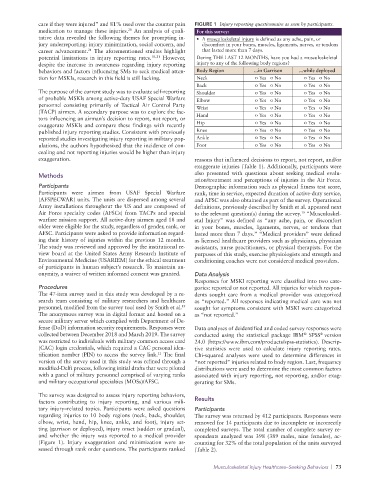
care if they were injured” and 81% used over the counter pain   FIGURE 1  Injury reporting questionnaire as seen by participants.
                                           20
              medication to manage these injuries.  An analysis of quali-  For this survey:
              tative data revealed the following themes for prompting in-  •  A musculoskeletal injury is defined as any ache, pain, or
              jury underreporting: injury minimization, social concern, and   discomfort in your bones, muscles, ligaments, nerves, or tendons
                              21
              career  advancement.   The  aforementioned  studies  highlight   that lasted more than 7 days.
              potential limitations in injury reporting rates. 18–21  However,   During THE LAST 12 MONTHS, have you had a musculoskeletal
              despite the increase in awareness regarding injury reporting   injury to any of the following body regions?
              behaviors and factors influencing SMs to seek medical atten-  Body Region  ...in Garrison  ...while deployed
              tion for MSKIs, research in this field is still lacking.  Neck        o Yes   o No    o Yes   o No
                                                                 Back               o Yes   o No    o Yes   o No
              The purpose of the current study was to evaluate self- reporting   Shoulder  o Yes   o No  o Yes   o No
              of probable MSKIs among active-duty USAF Special Warfare   Elbow      o Yes   o No    o Yes   o No
              personnel consisting primarily of Tactical Air Control Party   Wrist  o Yes   o No    o Yes   o No
              (TACP) airmen. A secondary purpose was to explore the fac-
              tors influencing an airman’s decision to report, not report, or   Hand  o Yes   o No  o Yes   o No
              exaggerate MSKIs and compare these findings with recently   Hip       o Yes   o No    o Yes   o No
              published injury reporting studies. Consistent with previously   Knee  o Yes   o No   o Yes   o No
              reported studies investigating injury reporting in military pop-  Ankle  o Yes   o No  o Yes   o No
              ulations, the authors hypothesized that the incidence of con-  Foot   o Yes   o No    o Yes   o No
              cealing and not reporting injuries would be higher than injury
              exaggeration.                                      reasons that influenced decisions to report, not report, and/or
                                                                 exaggerate injuries (Table 1). Additionally, participants were
                                                                 also presented with questions about seeking medical evalu-
              Methods
                                                                 ation/treatment and perceptions of injuries in the Air Force.
              Participants                                       Demographic information such as physical fitness test score,
              Participants were airmen from USAF Special Warfare   rank, time in service, expected duration of active-duty service,
              ( AFSPECWAR) units. The units are dispersed among several   and AFSC was also obtained as part of the survey. Operational
              Army installations throughout the US and are composed of   definitions, previously described by Smith et al. appeared next
              Air Force specialty codes (AFSCs) from TACPs and special   to the relevant question(s) during the survey.  “Musculoskel-
                                                                                                   19
              warfare mission support. All active-duty airmen aged 18 and   etal  Injury”  was defined  as  “any  ache,  pain, or  discomfort
              older were eligible for the study, regardless of gender, rank, or   in your bones, muscles, ligaments, nerves, or tendons that
              AFSC. Participants were asked to provide information regard-  lasted more than 7 days.” “Medical providers” were defined
              ing their history of injuries within the previous 12 months.   as licensed healthcare providers such as physicians, physician
              The study was reviewed and approved by the institutional re-  assistants, nurse practitioners, or physical therapists. For the
              view board at the United States Army Research Institute of   purposes of this study, exercise physiologists and strength and
              Environmental Medicine (USARIEM) for the ethical treatment   conditioning coaches were not considered medical providers.
              of participants in human subject’s research. To maintain an-
              onymity, a waiver of written informed consent was granted.  Data Analysis
                                                                 Responses for MSKI reporting were classified into two cate-
              Procedures                                         gories: reported or not reported. All injuries for which respon-
              The 47-item survey used in this study was developed by a re-  dents sought care  from a medical provider was categorized
              search team consisting of military researchers and healthcare   as “reported.” All responses indicating medical care was not
                                                            19
              personnel, modified from the survey tool used by Smith et al.    sought for symptoms consistent with MSKI were categorized
              The anonymous survey was in digital format and hosted on a   as “not reported.”
              secure military server which complied with Department of De-
              fense (DoD) information security requirements. Responses were   Data analyses of deidentified and coded survey responses were
              collected between December 2018 and March 2019. The survey   conducted using the statistical package IBM  SPSS version
                                                                                                          ®
                                                                                                    ®
              was restricted to individuals with military common access card   24.0 (https://www.ibm.com/products/spss-statistics). Descrip-
              (CAC) login credentials, which required a CAC personal iden-  tive statistics were used to calculate injury reporting rates.
                                                     22
              tification number (PIN) to access the survey link.  The final   Chi-squared analyses were used to determine differences in
              version of the survey used in this study was refined through a   “not reported” injuries related to body region. Last, frequency
              modified-Delfi process, following initial drafts that were piloted   distributions were used to determine the most common factors
              with a panel of military personnel comprised of varying ranks   associated with injury reporting, not reporting, and/or exag-
              and military occupational specialties (MOSs)/AFSC.  gerating for SMs.
              The survey was designed to assess injury reporting behaviors,
              factors contributing to injury reporting, and various mili-  Results
              tary injury–related topics. Participants were asked questions   Participants
              regarding injuries to 10 body regions (neck, back, shoulder,   The survey was returned by 412 participants. Responses were
              elbow, wrist, hand, hip, knee, ankle, and foot), injury set-  removed for 14 participants due to incomplete or incorrectly
              ting (garrison or deployed), injury onset (sudden or gradual),   completed surveys. The total number of complete survey re-
              and whether the injury was reported to a medical provider   spondents analyzed was 398 (389 males, nine females), ac-
              (Figure 1). Injury exaggeration and minimization were as-  counting for 32% of the total population of the units surveyed
              sessed through rank order questions. The participants ranked   (Table 2).

                                                                       Musculoskeletal Injury Healthcare–Seeking Behaviors  |  73

