


Page 63 - JSOM Fall 2021
P. 63
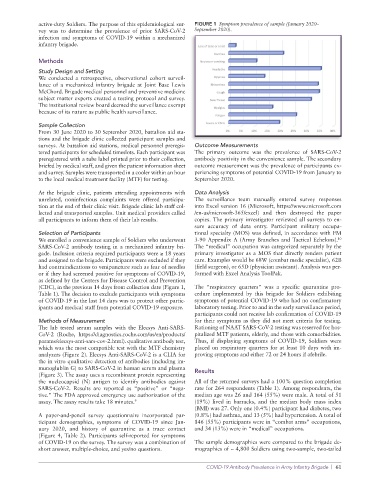
active-duty Soldiers. The purpose of this epidemiological sur-  FIGURE 1  Symptom prevalence of sample (January 2020–
              vey was to determine the prevalence of prior SARS-CoV-2   September 2020).
              infection and symptoms of COVID-19 within a mechanized
              infantry brigade.


              Methods
              Study Design and Setting
              We  conducted  a  retrospective,  observational  cohort  surveil-
              lance of a mechanized infantry brigade at Joint Base Lewis
              McChord. Brigade medical personnel and preventive medicine
              subject matter experts created a testing protocol and survey.
              The institutional review board deemed the surveillance exempt
              because of its nature as public health surveillance.

              Sample Collection
              From 30 June 2020 to 30 September 2020, battalion aid sta-
              tions and the brigade clinic collected participant samples and
              surveys. At battalion aid stations, medical personnel preregis-  Outcome Measurements
              tered participants for scheduled timeslots. Each participant was   The primary outcome was the prevalence of SARS-CoV-2
              preregistered with a tube label printed prior to their collection,   anti body positivity in the convenience sample. The secondary
              briefed by medical staff, and given the patient information sheet   outcome measurement was the prevalence of participants ex-
              and survey. Samples were transported in a cooler within an hour   periencing symptoms of potential COVID-19 from January to
              to the local medical treatment facility (MTF) for testing.  September 2020.

              At the brigade clinic, patients attending appointments with   Data Analysis
              unrelated, noninfectious complaints were offered participa-  The surveillance team manually entered survey responses
              tion at the end of their clinic visit. Brigade clinic lab staff col-  into Excel version 16 (Microsoft, https://www.microsoft.com
              lected and transported samples. Unit medical providers called   /en-us/microsoft-365/excel) and then destroyed the paper
              all participants to inform them of their lab results.  copies. The primary investigator reviewed all surveys to en-
                                                                 sure accuracy of data entry. Participant military occupa-
              Selection of Participants                          tional specialty (MOS) was defined, in accordance with FM
                                                                                                               10
              We enrolled a convenience sample of Soldiers who underwent   3-90 Appendix A (Army Branches and Tactical Echelons).
              SARS-CoV-2 antibody testing in a mechanized infantry bri-  The “medical” occupation was categorized separately by the
              gade. Inclusion criteria required participants were ≥ 18 years   primary investigator as a MOS that directly renders patient
              and assigned to the brigade. Participants were excluded if they   care. Examples would be 68W (combat medic specialist), 62B
              had contraindications to venipuncture such as fear of needles   (field surgeon), or 65D (physician assistant). Analysis was per-
              or if they had screened positive for symptoms of COVID-19,   formed with Excel Analysis ToolPak.
              as defined by the Centers for Disease Control and Prevention
              (CDC), in the previous 14 days from collection date (Figure 1,   The “respiratory quarters” was a specific quarantine pro-
              Table 1). The decision to exclude participants with symptoms   cedure implemented by this brigade for Soldiers exhibiting
              of COVID-19 in the last 14 days was to protect other partic-  symptoms of potential COVID-19 who had no confirmatory
              ipants and medical staff from potential COVID-19 exposure.  laboratory testing. Prior to and in the early surveillance period,
                                                                 participants could not receive lab confirmation of COVID-19
              Methods of Measurement                             for their symptoms as they did not meet criteria for testing.
              The lab tested serum samples with the Elecsys Anti-SARS-  Rationing of NAAT SARS-CoV-2 testing was reserved for hos-
              CoV-2 (Roche,  https://diagnostics.roche.com/us/en/products/  pitalized MTF patients, elderly, and those with comorbidities.
              params/elecsys-anti-sars-cov-2.html). qualitative antibody test,     Thus, if displaying symptoms of COVID-19, Soldiers were
              which was the most compatible test with the MTF chemistry   placed on respiratory quarters for at least 10 days with im-
              analyzers (Figure 2). Elecsys Anti-SARS-CoV-2 is a CLIA for   proving symptoms and either 72 or 24 hours if afebrile.
              the in vitro qualitative detection of antibodies (including im-
              munoglublin G) to SARS-CoV-2 in human serum and plasma
              (Figure 3). The assay uses a recombinant protein representing   Results
              the nucleocapsid (N) antigen to identify antibodies against   All of the returned surveys had a 100% question completion
              SARS-CoV-2. Results are reported as “positive” or “nega-  rate for 264 respondents (Table 1). Among respondents, the
              tive.” The FDA approved emergency use authorization of the   median age was 26 and 164 (55%) were male. A total of 51
              assay. The assay results take 18 minutes. 9        (19%) lived in barracks, and the median body mass index
                                                                 (BMI) was 27. Only one (0.4%) participant had diabetes, two
              A paper-and-pencil survey questionnaire incorporated par-  (0.8%) had asthma, and 13 (5%) had hypertension. A total of
              ticipant demographics, symptoms of COVID-19 since Jan-  146 (55%) participants were in “combat arms” occupations,
              uary 2020, and history of quarantine as a trace contact   and 34 (13%) were in “medical” occupations.
              (Figure 4, Table 2). Participants self-reported for symptoms
              of COVID-19 on the survey. The survey was a combination of   The sample demographics were compared to the brigade de-
              short answer, multiple-choice, and yes/no questions.  mographics of ~ 4,800 Soldiers using two-sample, two-tailed

                                                                    COVID-19 Antibody Prevalence in Army Infantry Brigade  |  61

