


Page 60 - JSOM Fall 2021
P. 60
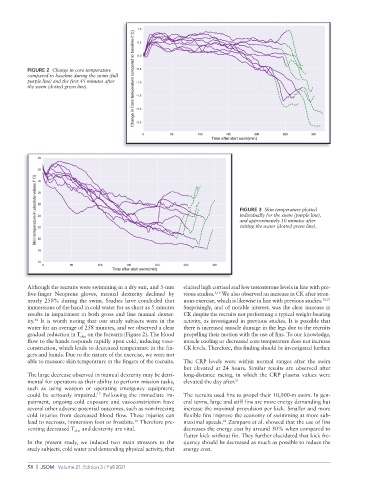
FIGURE 2  Change in core temperature
          compared to baseline during the swim (full
          purple line) and the first 45 minutes after
          the swim (dotted green line).


                                                                               FIGURE 3  Skin temperature plotted
                                                                               individually for the swim (purple line),
                                                                               and approximately 10 minutes after
                                                                               exiting the water (dotted green line).


          Although the recruits were swimming in a dry suit, and 5-mm   elicited high cortisol and low testosterone levels in line with pre-
          five-finger Neoprene gloves, manual dexterity declined by   vious studies. 5,19  We also observed an increase in CK after stren-
          nearly 250% during the swim. Studies have concluded that   uous exercise, which is likewise in line with previous studies. 20,21
          immersions of the hand in cold water for as short as 5 minutes   Surprisingly, and of notable interest, was the clear increase in
          results in impairment in both gross and fine manual dexter-  CK despite the recruits not performing a typical weight-bearing
          ity.  It is worth noting that our study subjects were in the   activity, as investigated in previous studies. It is possible that
            16
          water for an average of 258 minutes, and we observed a clear   there is increased muscle damage in the legs due to the recruits
          gradual reduction in T skin  on the forearm (Figure 2). The blood   propelling their motion with the use of fins. To our knowledge,
          flow to the hands responds rapidly upon cold, inducing vaso-  muscle cooling or decreased core temperature does not increase
          constriction, which leads to decreased temperature in the fin-  CK levels. Therefore, this finding should be investigated further.
          gers and hands. Due to the nature of the exercise, we were not
          able to measure skin temperature in the fingers of the recruits.  The CRP levels were within normal ranges after the swim
                                                             but  elevated  at 24  hours.  Similar results  are observed  after
          The large decrease observed in manual dexterity may be detri-  long-distance racing, in which the CRP plasma values were
          mental for operators as their ability to perform mission tasks,   elevated the day after. 21
          such  as using  weapon or  operating emergency  equipment,
                                 17
          could be seriously impaired.  Following the immediate im-  The recruits used fins to propel their 10,000-m swim. In gen-
          pairment, ongoing cold exposure and vasoconstriction have   eral terms, large and stiff fins are more energy demanding but
          several other adverse potential outcomes, such as non- freezing   increase the maximal propulsion per kick. Smaller and more
          cold injuries  from decreased  blood flow.  These injuries  can   flexible fins improve the economy of swimming at more sub-
                                                                          22
          lead to necrosis, immersion foot or frostbite.  Therefore pre-  maximal speeds.  Zamparo et al. showed that the use of fins
                                             18
          venting decreased T skin  and dexterity are vital.  decreases the energy cost by around 50% when compared to
                                                             flutter kick without fin. They further elucidated that kick fre-
          In the present study, we induced two main stressors to the   quency should be decreased as much as possible to reduce the
          study subjects, cold water and demanding physical activity, that   energy cost.


          58  |  JSOM   Volume 21, Edition 3 / Fall 2021

