


Page 65 - JSOM Fall 2021
P. 65
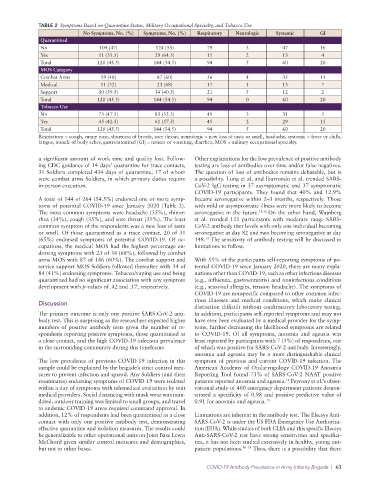
TABLE 2  Symptoms Based on Quarantine Status, Military Occupational Specialty, and Tobacco Use
                            No Symptoms, No. (%)  Symptoms, No. (%)  Respiratory  Neurologic  Systemic    GI
              Quarantined
              No                 109 (47)           124 (53)         79          3           47           16
              Yes                11 (35.5)          20 (64.5)        15          2           13           4
              Total              120 (45.5)        144 (54.5)        94          5           60           20
              MOS Category
              Combat Arms         59 (40)           87 (60)          56          4           35           11
              Medical             11 (32)           23 (68)          17          1           13           7
              Support            50 (59.5)          34 (40.5)        21          5           12           2
              Total              120 (45.5)        144 (54.5)        94          0           60           20
              Tobacco Use
              No                 75 (47.5)          83 (52.5)        49          3           31           5
              Yes                45 (42.5)          61 (57.5)        45          2           29           15
              Total              120 (45.5)        144 (54.5)        94          5           60           20
              Respiratory = cough, runny nose, shortness of breath, sore throat; neurologic = new loss of taste or smell, headache, systemic = fever or chills,
              fatigue, muscle of body aches, gastrointestinal (GI) = nausea or vomiting, diarrhea, MOS = military occupational specialty.


              a significant amount of work time and quality lost. Follow-  Other explanations for the low prevalence of positive antibody
              ing CDC guidance of 14 days’ quarantine for trace contacts,   testing are loss of antibodies over time and/or false negatives.
              31 Soldiers completed 434 days of quarantine, 17 of whom   The question of loss of antibodies remains debatable, but is
              were combat arms Soldiers, in which primary duties require   a possibility. Long et al. and Ibarrondo et al. trended SARS-
              in- person execution.                              CoV-2 IgG testing in 37 asymptomatic and 37 symptomatic
                                                                 COVID-19  participants.  They  found that  40%  and 12.9%
              A total of 144 of 264 (54.5%) endorsed one or more symp-  became seronegative within 2–3 months, respectively. Those
              toms of potential COVID-19 since January 2020 (Table 2).   with mild or asymptomatic illness were more likely to become
              The most common symptoms were headache (35%), rhinor-  seronegative in the future. 11,12  On the other hand, Wajnberg
              rhea (34%), cough (35%), and sore throat (31%). The least   et  al.  trended  121  participants  with  moderate  range  SARS-
              common symptom of the respondents was a new loss of taste   CoV-2 antibody titer levels with only one individual becoming
              or smell. Of those quarantined as a trace contact, 20 of 31   seronegative at day 82 and two becoming seronegative at day
              (65%) endorsed symptoms of potential COVID-19. Of oc-  148.  The sensitivity of antibody testing will be discussed in
                                                                    13
              cupations, the medical MOS had the highest percentage en-  limitations to follow.
              dorsing symptoms with 23 of 34 (68%), followed by combat
              arms MOS with 87 of 146 (60%). The combat support and   With 55% of the participants self-reporting symptoms of po-
              service support MOS Soldiers followed thereafter with 34 of   tential COVID-19 since January 2020, there are many expla-
              84 (41%) endorsing symptoms. Tobacco/vaping use and being   nations other than COVID-19, such as other infectious diseases
              quarantined had no significant association with any symptom   (e.g., influenza, gastroenteritis) and noninfectious conditions
              development with p-values of .42 and .17, respectively.  (e.g., seasonal allergies, tension headache). The symptoms of
                                                                 COVID-19 are nonspecific compared to other common infec-
                                                                 tious illnesses and medical conditions, which make clinical
              Discussion
                                                                 distinction difficult without confirmatory laboratory testing.
              The primary outcome is only one positive SARS-CoV-2 anti-  In addition, participants self-reported symptoms and may not
              body test. This is surprising as the researchers expected higher   have ever been evaluated by a medical provider for the symp-
              numbers of positive antibody tests given the number of re-  toms, further decreasing the likelihood symptoms are related
              spondents reporting positive symptoms, those quarantined as   to COVID-19. Of all symptoms, anosmia and ageusia was
              a close contact, and the high COVID-19 infection prevalence   least reported by participants with 7 (3%) of respondents, one
              in the surrounding community during this timeframe.  of which was positive for SARS-CoV-2 antibody. Interestingly,
                                                                 anosmia and ageusia may be a more distinguishable clinical
              The low prevalence of previous COVID-19 infection in this   symptom of previous and current COVID-19 infection. The
              sample could be explained by the brigade’s strict control mea-  American Academy of Otolaryngology COVID-19 Anosmia
              sures to prevent infection and spread. Any Soldiers (and their   Reporting  Tool found  73%  of  SARS-CoV-2  NAAT  positive
              roommates) endorsing symptoms of COVID-19 were isolated   patients reported anosmia and ageusia.  Peyrony et al.’s obser-
                                                                                              14
              within a day of symptoms with telemedical evaluation by unit   vational study of 400 emergency department patients demon-
              medical providers. Social distancing with mask wear was man-  strated a specificity of 0.98 and positive predictive value of
              dated, outdoor training was limited to small groups, and travel   0.91 for anosmia and ageusia. 15
              to endemic COVID-19 areas required command approval. In
              addition, 12% of respondents had been quarantined as a close   Limitations are inherent in the antibody test. The Elecsys Anti-
              contact with only one positive antibody test, demonstrating   SARS-CoV-2 is under the US FDA Emergency Use Authoriza-
              effective quarantine and isolation measures. The results could   tion (EUA). While studies of both CLIA and this specific Elecsys
              be generalizable to other operational units on Joint Base Lewis   Anti-SARS-CoV-2 test have strong sensitivities and specifici-
              McChord given similar control measures and demographics,   ties, it has not been studied extensively in healthy, young out-
              but not to other bases.                            patient populations. 16–18  Thus, there is a possibility that there

                                                                    COVID-19 Antibody Prevalence in Army Infantry Brigade  |  63

