


Page 69 - JSOM Fall 2021
P. 69
Methods                                            TABLE 1  Demographics of Patients Who Received Blood
              Ethics                                             Demographics             Age         30 (26–34)
              The US Air Force 59th Medical Wing regulatory office re-                   Male         100% (10)
              viewed protocol FWH20180147E and determined it was ex-                     Army          30% (3)
              empt from Institutional Review Board oversight. We obtained                Navy          50% (5)
              only de-identified data.                           Affiliation            Air Force      10% (1)
                                                                                        Civilian       10% (1)
              Subjects and Setting                                                       Urgent        40% (4)
              We conducted a retrospective review of prospectively en-
              tered in-transit records of patient care into TRAC2ES in the   Movement precedence  Priority  50% (5)
                AFRICOM theater of operations from 1 January 2008 to 31                 Routine        10% (1)
              December 2018. We included all military and civilian patients   Transport mode  Military Air  80% (8)
              that were tracked for transport by TRAC2ES during this time-             Civilian Air    20% (2)
              frame. We sought all available evacuation data on the initial
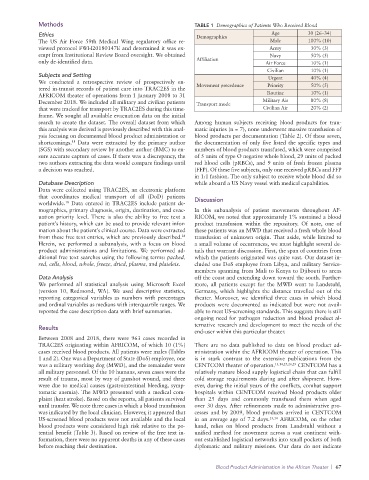
              search to create the dataset. The overall dataset from which   Among human subjects receiving blood products for trau-
              this analysis was derived is previously described with this anal-  matic injuries (n = 7), none underwent massive transfusion of
              ysis focusing on documented blood product administration or   blood products per documentation (Table 2). Of these seven,
              shortcomings.  Data were extracted by the primary author   the documentation of only five listed the specific types and
                         18
              (SGS) with secondary review by another author (BMC) to en-  numbers of blood products transfused, which were comprised
              sure accurate capture of cases. If there was a discrepancy, the   of 5 units of type O negative whole blood, 29 units of packed
              two authors extracting the data would compare findings until   red blood cells (pRBCs), and 9 units of fresh frozen plasma
              a decision was reached.                            (FFP). Of these five subjects, only one received pRBCs and FFP
                                                                 in 1:1 fashion. The only subject to receive whole blood did so
              Database Description                               while aboard a US Navy vessel with medical capabilities.
              Data were collected using TRAC2ES, an electronic platform
              that coordinates medical transport of all (DoD) patients
              worldwide.  Data entered in TRAC2ES include patient de-  Discussion
                      18
              mographics, primary diagnosis, origin, destination, and evac-  In this subanalysis of patient movements throughout AF-
              uation priority level. There is also the ability to free text a   RICOM, we noted that approximately 1% sustained a blood
              patient’s history, which can be used to provide relevant infor-  product transfusion within the repository. Of note, one of
              mation about the patient’s clinical course. Data were extracted   these patients was an MWD that received a fresh whole blood
              from these free text entries, which are previously described.    transfusion of unknown origin. That aside, while limited to
                                                            28
              Herein, we performed a subanalysis, with a focus on blood   a small volume of occurrences, we must highlight several de-
              product administrations and limitations. We performed ad-  tails that warrant discussion. First, the span of countries from
              ditional free text searches using the following terms: packed,   which the patients originated was quite vast. Our dataset in-
              red, cells, blood, whole, freeze, dried, plasma, and platelets.  cluded one DoS employee from Libya, and military Service-
                                                                 members spanning from Mali to Kenya to Djibouti to areas
              Data Analysis                                      off the coast and extending down toward the south. Further-
              We performed all statistical analysis using Microsoft Excel   more, all patients except for the MWD went to Landstuhl,
              (version 10, Redmond, WA). We used descriptive statistics,   Germany, which highlights the distance travelled out of the
              reporting categorical variables as numbers with percentages   theater. Moreover, we identified three cases in which blood
              and ordinal variables as medians with interquartile ranges. We   products were documented as indicated but were not avail-
              reported the case description data with brief summaries.  able to meet US-screening standards. This suggests there is still
                                                                 ongoing need for pathogen reduction and blood product al-
                                                                 ternative research and development to meet the needs of the
              Results
                                                                 end-user within this particular theater.
              Between 2008 and 2018, there were 963 cases recorded in
              TRAC2ES originating within AFRICOM, of which 10 (1%)   There are no data published to date on blood product ad-
              cases received blood products. All patients were males (Tables   ministration within the AFRICOM theater of operation. This
              1 and 2). One was a Department of State (DoS) employee, one   is in stark contrast to the extensive publications from the
              was a military working dog (MWD), and the remainder were     CENTCOM theater of operation. 13,14,25,26,29  CENTCOM has a
              all military personnel. Of the 10 humans, seven cases were the   relatively mature blood supply logistical chain that can fulfill
              result of trauma, most by way of gunshot wound, and three   cold storage requirements during and after shipment. How-
              were due to medical causes (gastrointestinal bleeding, symp-  ever, during the initial years of the conflicts, combat support
              tomatic anemia). The MWD presented with a medical com-  hospitals within CENTCOM received blood products older
              plaint (heat stroke). Based on the reports, all patients survived   than 25 days and commonly transfused them when aged
              until transfer. We note three cases in which a blood transfusion   over 30 days. After refinements made to administrative pro-
              was indicated by the local clinician. However, it appeared that   cesses and by 2009, blood products arrived in CENTCOM
              US-screened blood products were not available and the local   in an average age of 7.2 days. 13,14  AFRICOM, on the other
              blood products were considered high risk relative to the po-  hand, relies on blood products from Landstuhl without a
              tential benefit (Table 3). Based on review of the free text in-  unified method for movement across a vast continent with-
              formation, there were no apparent deaths in any of these cases   out established logistical networks into small pockets of both
              before reaching their destination.                 diplomatic and military missions. Our data do not indicate


                                                                       Blood Product Administration in the African Theater  |  67

