


Page 14 - JSOM Fall 2021
P. 14
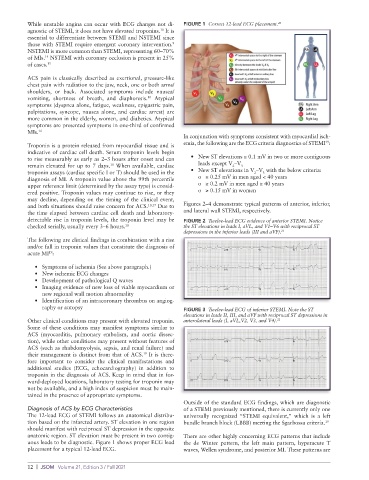
While unstable angina can occur with ECG changes not di-  FIGURE 1  Correct 12-lead ECG placement. 20
                                                     10
          agnostic of STEMI, it does not have elevated troponins.  It is
          essential to differentiate between STEMI and NSTEMI since
                                                         9
          those with STEMI require emergent coronary intervention.
          NSTEMI is more common than STEMI, representing 60–70%
                14
          of MIs.  NSTEMI with coronary occlusion is present in 25%
          of cases. 15
          ACS pain is classically described as exertional, pressure-like
          chest pain with radiation to the jaw, neck, one or both arms/
          shoulders, or back. Associated symptoms include nausea/
          vomiting, shortness of breath, and diaphoresis.  Atypical
                                                 10
          symptoms (dyspnea alone, fatigue, weakness, epigastric pain,
          palpitations, syncope, nausea alone, and cardiac arrest) are
          more common in the elderly, women, and diabetics. Atypical
          symptoms are presented symptoms in one-third of confirmed
          MIs. 16
                                                             In conjunction with symptoms consistent with myocardial isch-
                                                                                                           19
          Troponin is a protein released from myocardial tissue and is   emia, the following are the ECG criteria diagnostics of STEMI :
          indicative of cardiac cell death. Serum troponin levels begin
          to rise measurably as early as 2–3 hours after onset and can   •  New ST elevations ≥ 0.1 mV in two or more contiguous
                                     10
          remain elevated for up to 7 days.  When available, cardiac   leads except V –V 3
                                                                             2
          troponin assays (cardiac specific I or T) should be used in the   •  New ST elevations in V –V  with the below criteria:
                                                                                       3
                                                                                    2
          diagnosis of MI. A troponin value above the 99th percentile     o ≥ 0.25 mV in men aged < 40 years
          upper reference limit (determined by the assay type) is consid-    o ≥ 0.2 mV in men aged ≥ 40 years
          ered positive. Troponin values may continue to rise, or they     o ≥ 0.15 mV in women
          may decline, depending on the timing of the clinical event,
          and both situations should raise concern for ACS. 10,17  Due to   Figures 2–4 demonstrate typical patterns of anterior, inferior,
          the time elapsed between cardiac cell death and laboratory-   and lateral wall STEMI, respectively.
          detectable rise in troponin levels, the troponin level may be   FIGURE 2  Twelve-lead ECG evidence of anterior STEMI. Notice
          checked serially, usually every 3–6 hours. 18      the ST elevations in leads I, aVL, and V1–V6 with reciprocal ST
                                                             depressions in the inferior leads (III and aVF). 21
          The following are clinical findings in combination with a rise
          and/or fall in troponin values that constitute the diagnosis of
                 19
          acute MI :
            •  Symptoms of ischemia (See above paragraph.)
            •  New ischemic ECG changes
            •  Development of pathological Q waves
            •  Imaging evidence of new loss of viable myocardium or
               new regional wall motion abnormality
            •  Identification of an intracoronary thrombus on angiog-
               raphy or autopsy                              FIGURE 3  Twelve-lead ECG of inferior STEMI. Note the ST
                                                             elevations in leads II, III, and aVF with reciprocal ST depressions in
          Other clinical conditions may present with elevated troponin.   anterolateral leads (I, aVL,V2, V3, and V4). 22
          Some of these conditions may manifest symptoms similar to
          ACS (myocarditis, pulmonary embolism, and aortic dissec-
          tion), while other conditions may present without features of
          ACS (such as rhabdomyolysis, sepsis, and renal failure) and
                                                19
          their management is distinct from that of ACS.  It is there-
          fore  important  to consider  the  clinical  manifestations  and
          additional studies (ECG, echocardiography) in addition to
          troponin in the diagnosis of ACS. Keep in mind that in for-
          ward-deployed locations, laboratory testing for troponin may
          not be available, and a high index of suspicion must be main-
          tained in the presence of appropriate symptoms.
                                                             Outside of the standard ECG findings, which are diagnostic
          Diagnosis of ACS by ECG Characteristics            of a STEMI previously mentioned, there is currently only one
          The 12-lead ECG of STEMI follows an anatomical distribu-  universally recognized “STEMI equivalent,” which is a left
          tion based on the infarcted artery. ST elevation in one region   bundle branch block (LBBB) meeting the Sgarbossa criteria. 19
          should manifest with reciprocal ST depression in the opposite
          anatomic region. ST elevation must be present in two contig-  There are other highly concerning ECG patterns that include
          uous leads to be diagnostic. Figure 1 shows proper ECG lead   the de Winter pattern, the left main pattern, hyperacute T
          placement for a typical 12-lead ECG.               waves, Wellen syndrome, and posterior MI. These patterns are


          12  |  JSOM   Volume 21, Edition 3 / Fall 2021

