


Page 11 - JSOM Fall 2021
P. 11
the musculoskeletal injury self-reporting behaviors among   2021 SOMSA ABSTRACTS
                active-duty Air Force Special Warfare personnel to explore po-  2021 Scientific Assembly Research Award Winners and
              tential limitations of injury surveillance approaches.
                                                                 Presentations
              Penetrating thoracic injuries account for an essential subset   ONGOING SERIES
              of battlefield and civilian injuries that result in death. Current
              recommendations are to use commercially available nonocclu-  INJURY PREVENTION
                                                                 Update on Minimalist Running Shoes compares minimalist
              sive chest seals. The authors of Efficacy of Commercial Chest   running shoes with conventional running shoes.
              Seal Adherence and Tension Pneumothorax Prevention: A
              Systematic Review of Quantitative Studies review current ev-
              idence for which chest seal(s) is likely to be the most effective
              in treating open pneumothoraces and determine that further
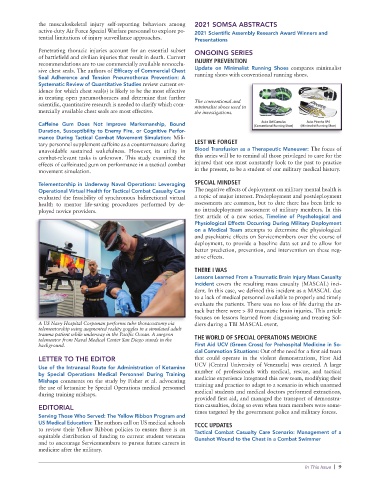
              scientific, quantitative research is needed to clarify which com-  The conventional and
                                                                 minimalist shoes used in
              mercially available chest seals are most effective.  the investigations.
              Caffeine Gum Does Not Improve Marksmanship, Bound
              Duration, Susceptibility to Enemy Fire, or Cognitive Perfor-
              mance During Tactical Combat Movement Simulation: Mili-
              tary personnel supplement caffeine as a countermeasure during   LEST WE FORGET
              unavoidable sustained wakefulness. However, its utility in   Blood Transfusion as a Therapeutic Maneuver: The focus of
              combat-relevant tasks is unknown. This study examined the   this series will be to remind all those privileged to care for the
              effects of caffeinated gum on performance in a tactical combat   injured that one must constantly look to the past to practice
              movement simulation.                               in the present, to be a student of our military medical history.
                                                                 SPECIAL MINDSET
              Telementorship in Underway Naval Operations: Leveraging
              Operational Virtual Health for Tactical Combat Casualty Care   The negative effects of deployment on military mental health is
              evaluated the feasibility of synchronous bidirectional virtual   a topic of major interest. Predeployment and postdeployment
              health  to mentor  life-saving  procedures  performed  by  de-  assessments are common, but to date there has been little to
              ployed novice providers.                           no intradeployment assessment of military members. In this
                                                                 first article of a new series,  Timeline of Psychological and
                                                                 Physiological Effects Occurring During Military Deployment
                                                                 on a Medical Team attempts to determine the physiological
                                                                 and psychiatric effects on Servicemembers over the course of
                                                                 deployment, to provide a baseline data set and to allow for
                                                                 better prediction, prevention, and intervention on these neg-
                                                                 ative effects.
                                                                 THERE I WAS
                                                                 Lessons Learned From a Traumatic Brain Injury Mass Casualty
                                                                 Incident covers the resulting mass casualty (MASCAL) inci-
                                                                 dent. In this case, we defined this incident as a MASCAL due
                                                                 to a lack of medical personnel available to properly and timely
                                                                 evaluate the patients. There was no loss of life during the at-
                                                                 tack but there were > 80 traumatic brain injuries. This article
                                                                 focuses on lessons learned from diagnosing and treating Sol-
              A US Navy Hospital Corpsman performs tube thoracostomy via   diers during a TBI MASCAL event.
              telementorship using augmented reality goggles in a simulated adult
              trauma patient while underway in the Pacific Ocean. A surgeon   THE WORLD OF SPECIAL OPERATIONS MEDICINE
              tele mentor from Naval Medical Center San Diego stands in the
              background.                                        First Aid UCV (Green Cross) for Prehospital Medicine in So-
                                                                 cial Commotion Situations: Out of the need for a first aid team
              LETTER TO THE EDITOR                               that could operate in the violent demonstrations, First Aid
                                                                 UCV (Central University of Venezuela) was created. A large
              Use of the Intranasal Route for Administration of Ketamine   number of professionals with medical, rescue, and tactical
              by  Special  Operations  Medical  Personnel  During  Training   medicine experience integrated this new team, modifying their
              Mishaps comments on the study by Fisher et al. advocating
              the use of ketamine by Special Operations medical personnel   training and practice to adapt to a scenario in which unarmed
              during training mishaps.                           medical students and medical doctors performed extractions,
                                                                 provided first aid, and managed the transport of demonstra-
                                                                 tion casualties, doing so even when team members were some-
              EDITORIAL
                                                                 times targeted by the government police and military forces.
              Serving Those Who Served: The Yellow Ribbon Program and
              US Medical Education: The authors call on US medical schools   TCCC UPDATES
              to review their Yellow Ribbon policies to ensure there is an
              equitable distribution of funding to current student veterans   Tactical Combat Casualty Care Scenario: Management of a
              and to encourage Servicemembers to pursue future careers in   Gunshot Wound to the Chest in a Combat Swimmer
              medicine after the military.

                                                                                                     In This Issue  |  9

