


Page 10 - JSOM Fall 2021
P. 10
FEATURE ARTICLES                                   The goal of Studies on the Correct Length of Nasopharyngeal
                                                             Airways in Adults: A Literature Review was to learn whether
          Joint Trauma System Clinical Practice Guideline: Acute Cor-
          onary Syndrome (ACS) 14 May 2021 provides guidance on   there is scientific evidence about the correct length and the
          best management for ACS patients in the deployed and re-  insertion depth, and also possible facial landmarks, that can
          source-constrained environment.                    predict the appropriate length of the nasopharyngeal airway.

          Compared with those of tourniquet application, tourniquet
          conversion concepts are underdeveloped. The authors of Ex-
          ploring  Tourniquet  Conversion  in  Simulation  to  Develop   Sagittal cross section of the head
          Concepts and Hypotheses sought to develop tourniquet con-  with the suggested position of a
          version concepts and generate hypotheses.          nasopharyngeal airway (NPA) tube.
                                                             The NPA tube must pass through the
                                                             nasopharyngeal space and go beyond
          The purpose of the small proof-of-concept study Limb Tour-  the base of the tongue, but not touch
          niquet Holding Location: Model Results Fail to Translate to   the epiglottis.
          Human Results was to determine whether the results observed
          with the model setups would translate to a strap-pulling ben-
          efit in human self- or buddy-applications on arms and thighs.
                                                             The authors of Chemical Warfare Agents in Terrorist Attacks:
                                                             An Interregional Comparison, Tactical Response Implications,
                                                             and the Emergence of Counterterrorism Medicine concluded
                                                             that  the use  of  chemical  warfare  agents  remains a  concern
                                                             given the rising rate of terrorist events. First responders and
                                                             healthcare workers should be aware of potential chemical haz-
                                                             ards that have been used regionally and globally and should
                                                             train and prepare to respond appropriately.

                                                             The results of Impact of a 10,000-m Cold-Water Swim on Nor-
                                                             wegian Naval Special Forces Recruits demonstrate that expo-
                                                             sure to a 10,000-m swim in 5°C water using standard equipment
                                                             led to a significant drop in the recruits’ temperature and perfor-
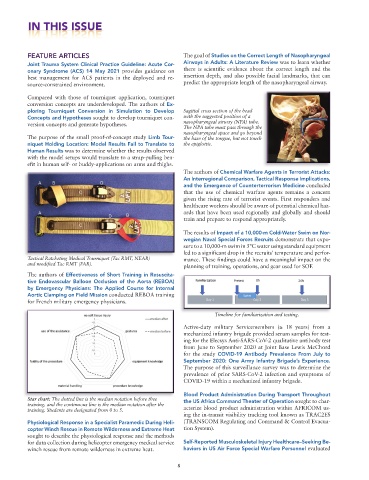
          Tactical Ratcheting Medical Tourniquet (Tac RMT, NEAR)    mance. These findings could have a meaningful impact on the
          and modified Tac RMT (FAR).                        planning of training, operations, and gear used for SOF.

          The authors of Effectiveness of Short Training in Resuscita-
          tive Endovascular Balloon Occlusion of the Aorta (REBOA)
          by Emergency Physicians: The Applied Course for Internal
          Aortic Clamping on Field Mission conducted REBOA training
          for French military emergency physicians.

                                                                       Timeline for familiarization and testing.
                                                             Active-duty military Servicemembers (≥ 18 years) from a
                                                             mechanized infantry brigade provided serum samples for test-
                                                             ing for the Elecsys Anti-SARS-CoV-2 qualitative antibody test
                                                             from June to September 2020 at Joint Base Lewis McChord
                                                             for the study  COVID-19 Antibody Prevalence From July to
                                                             September 2020: One Army Infantry Brigade’s Experience.
                                                             The purpose of this surveillance survey was to determine the
                                                             prevalence of prior SARS-CoV-2 infection and symptoms of
                                                             COVID-19 within a mechanized infantry brigade.

                                                             Blood Product Administration During Transport Throughout
          Star chart: The dotted line is the median notation before thee   the US Africa Command Theater of Operation sought to char-
          training, and the continuous line is the median notation after the
          training. Students are designated from 0 to 5.     acterize blood product administration within AFRICOM us-
                                                             ing the in-transit visibility tracking tool known as TRAC2ES
          Physiological Response in a Specialist Paramedic During Heli-  (TRANSCOM Regulating and Command & Control Evacua-
          copter Winch Rescue in Remote Wilderness and Extreme Heat   tion System).
          sought to describe the physiological response and the methods
          for data collection during helicopter emergency medical service   Self-Reported Musculoskeletal Injury Healthcare–Seeking Be-
          winch rescue from remote wilderness in extreme heat.  haviors in US Air Force Special Warfare Personnel evaluated

                                                           8

