


Page 19 - JSOM Fall 2021
P. 19
2.  Dopamine – 0.5 to 20mg/kg/minute IV (the use of lower   Ventilator Settings
                doses preferred).                                High intrathoracic pressures affect the right and left ventricles
                                                                 differently. High intrathoracic pressures impair right ventric-
              Mechanical Complications                           ular filling yet reduce left ventricular afterload. In a patient’s
              Mechanical complications primarily manifest as either acute   post-MI that requires mechanical ventilation, minimization of
              chordal rupture of the mitral valve, ventricular septal rupture,   intrathoracic pressures for a patient with inferior/right ventric-
              or left ventricular free wall rupture. These typically occur   ular infarction is essential to maintain cardiac output. PEEP
              within the first 24 hours but can present within a week, as   and tidal volume should be minimized as much as possible.
              well. The use of fibrinolytics is also a risk factor for an acute
              ventricular septal rupture and left ventricular free wall rup-
              ture. Medical therapy is only temporary with a high mortality   Considerations During Evacuation
              rate for those unable to undergo surgical correction. Echocar-  The care of ACS patients at deployed locations is limited
              diography is the modality of choice for rapid diagnosis. This   by the fact that cardiac care is provided in austere locations
              can show pericardial effusion when associated with left ven-  without rapid access to higher levels of care. While medi-
              tricular free wall rupture.                        cal therapies can stabilize patients for short periods of time,
                                                                 any complications that arise do not have the benefit of being
              Arrhythmias                                        treated urgently/emergently in a cardiac catheterization labo-
              There are multiple different tachyarrhythmias and brady-  ratory. A plan for urgent MEDEVAC/aeromedical evacuation
              arrhythmias that can occur with acute MI. Most can be ad-  to a PCI-capable center should be initiated as soon as they are
              dressed using ACLS protocols. The most common rhythm   diagnosed with ACS and initiated medical therapy.
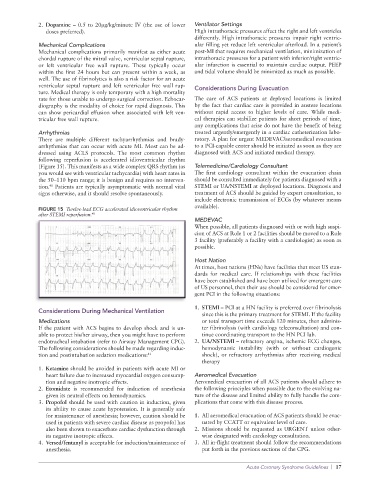
              following reperfusion is accelerated idioventricular rhythm
              (Figure 15). This manifests as a wide complex QRS rhythm (as   Telemedicine/Cardiology Consultant
              you would see with ventricular tachycardia) with heart rates in   The first cardiology consultant within the evacuation chain
              the 50–110 bpm range; it is benign and requires no interven-  should be consulted immediately for patients diagnosed with a
              tion.  Patients are typically asymptomatic with normal vital   STEMI or UA/NSTEMI at deployed locations. Diagnosis and
                 40
              signs otherwise, and it should resolve spontaneously.  treatment of ACS should be guided by expert consultation, to
                                                                 include electronic transmission of ECGs (by whatever means
                                                                 available).
              FIGURE 15  Twelve-lead ECG accelerated idioventricular rhythm
              after STEMI reperfusion. 40
                                                                 MEDEVAC
                                                                 When possible, all patients diagnosed with or with high suspi-
                                                                 cion of ACS at Role 1 or 2 facilities should be moved to a Role
                                                                 3 facility (preferably a facility with a cardiologist) as soon as
                                                                 possible.
                                                                 Host Nation
                                                                 At times, host nations (HNs) have facilities that meet US stan-
                                                                 dards for medical care. If relationships with these facilities
                                                                 have been established and have been utilized for emergent care
                                                                 of US personnel, then their use should be considered for emer-
                                                                 gent PCI in the following situations:

                                                                 1.  STEMI – PCI at a HN facility is preferred over fibrinolysis
              Considerations During Mechanical Ventilation
                                                                   since this is the primary treatment for STEMI. If the facility
              Medications                                          or total transport time exceeds 120 minutes, then adminis-
              If the patient with ACS begins to develop shock and is un-  ter fibrinolysis (with cardiology teleconsultation) and con-
              able to protect his/her airway, then you might have to perform   tinue coordinating transport to the HN PCI lab.
              endotracheal intubation (refer to Airway Management CPG).   2.  UA/NSTEMI – refractory angina, ischemic ECG changes,
              The following considerations should be made regarding induc-  hemodynamic  instability  (with  or  without  cardiogenic
              tion and postintubation sedation medications: 41     shock), or refractory  arrhythmias  after receiving  medical
                                                                   therapy
              1.  Ketamine should be avoided in patients with acute MI or
                heart failure due to increased myocardial oxygen consump-  Aeromedical Evacuation
                tion and negative inotropic effects.             Aeromedical evacuation of all ACS patients should adhere to
              2.  Etomidate is recommended for induction of anesthesia   the following principles when possible due to the evolving na-
                given its neutral effects on hemodynamics.       ture of the disease and limited ability to fully handle the com-
              3.  Propofol should be used with caution in induction, given   plications that come with this disease process.
                its ability to cause acute hypotension. It is generally safe
                for maintenance of anesthesia; however, caution should be   1.  All aeromedical evacuation of ACS patients should be evac-
                used in patients with severe cardiac disease as propofol has   uated by CCATT or equivalent level of care.
                also been shown to exacerbate cardiac dysfunction through   2.  Missions should be requested as URGENT unless other-
                its negative inotropic effects.                    wise designated with cardiology consultation.
              4.  Versed/fentanyl is acceptable for induction/maintenance of   3.  All in-flight treatment should follow the recommendations
                anesthesia.                                        put forth in the previous sections of the CPG.

                                                                                  Acute Coronary Syndrome Guidelines  |  17

