


Page 76 - JSOM Spring 2021
P. 76
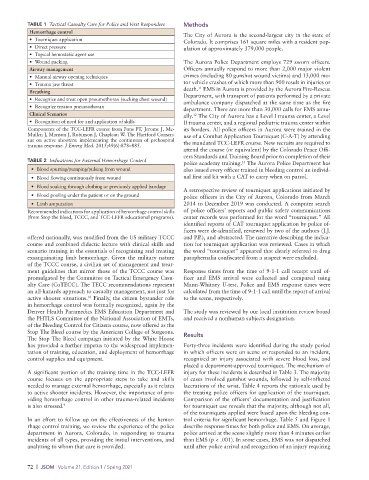
TABLE 1  Tactical Casualty Care for Police and First Responders  Methods
           Hemorrhage control                                The City of Aurora is the second-largest city in the state of
           • Tourniquet application                          Colorado. It comprises 161 square miles with a resident pop-
           • Direct pressure                                 ulation of approximately 379,000 people.
           • Topical hemostatic agent use
           • Wound packing                                   The Aurora Police Department employs 729 sworn officers.
           Airway management                                 Officers annually respond to more than 2,000 major violent
           • Manual airway opening techniques                crimes (including 80 gunshot wound victims) and 13,000 mo-
           • Trauma jaw thrust                               tor vehicle crashes of which more than 900 result in injuries or
                                                                  11
           Breathing                                         death.  EMS in Aurora is provided by the Aurora Fire-Rescue
                                                             Department, with transport of patients performed by a private
           • Recognize and treat open pneumothorax (sucking chest wound)  ambulance company dispatched at the same time as the fire
           • Recognize tension pneumothorax                  department. There are more than 30,000 calls for EMS annu-
           Clinical Scenarios                                ally.  The City of Aurora has a Level I trauma center, a Level
                                                                12
           • Recognition of need for and application of skills  II trauma center, and a regional pediatric trauma center within
          Components of the TCC-LEFR course from Pons PT, Jerome J, Mc-  its borders. All police officers in Aurora were trained in the
          Mullen J, Manson J, Robinson J, Chapleau W. The Hartford Consen-  use of a Combat Application Tourniquet (C-A-T) by attending
          sus on active shooters: implementing the continuum of prehospital   the mandated TCC-LEFR course. New recruits are required to
          trauma response. J Emerg Med. 2015;49(6):878–885.
                                                             attend the course (or equivalent) by the Colorado Peace Offi-
                                                             cers Standards and Training Board prior to completion of their
          TABLE 2  Indications for External Hemorrhage Control                  13
                                                             police academy training.  The Aurora Police Department has
           • Blood spurting/pumping/pulsing from wound       also issued every officer trained in bleeding control an individ-
           • Blood flowing continuously from wound           ual first aid kit with a CAT to carry when on patrol.
           • Blood soaking through clothing or previously applied bandage
                                                             A retrospective review of tourniquet applications initiated by
           • Blood pooling under the patient or on the ground  police officers in the City of Aurora, Colorado from March
           • Limb amputation                                 2014 to December 2019 was conducted. A computer search
          Recommended indications for application of hemorrhage control skills   of police officers’ reports and public safety communications
          (from Stop the Bleed, TCCC, and TCC-LEFR educational programs).  center records was performed for the word “tourniquet.” All
                                                             identified reports of CAT tourniquet application by police of-
                                                             ficers were de-identified, reviewed by two of the authors (J.J.
          offered nationally, was modified from the US military TCCC   and P.P.), and abstracted. The narrative describing the indica-
          course and combined didactic lecture with clinical skills and   tion for tourniquet application was reviewed. Cases in which
          scenario training in the essentials of recognizing and treating   the word “tourniquet” appeared that clearly referred to drug
          exsanguinating limb hemorrhage. Given the military nature   paraphernalia confiscated from a suspect were excluded.
          of the TCCC course, a civilian set of management and treat-


          ment guidelines that mirror those of the TCCC course was   Response times from the time of 9- 1-1 call receipt until of-


          promulgated by the Committee on Tactical Emergency Casu-  ficer and EMS arrival were collected and compared using
          alty Care (CoTECC). The TECC recommendations represent   Mann-Whitney U-test. Police and EMS response times were


          an all-hazards approach to casualty management, not just for   calculated from the time of 9-  1-1 call until the report of arrival

          active shooter situations.  Finally, the citizen bystander role   to the scene, respectively.
                              10
          in hemorrhage control was formally recognized, again by the
          Denver Health Paramedics EMS Education Department and   The study was reviewed by our local institution review board
          the PHTLS Committee of the National Association of EMTs,   and received a nonhuman subjects designation.
          of the Bleeding Control for Citizens course, now offered as the
          Stop The Bleed course by the American College of Surgeons.   Results
          The Stop The Bleed campaign initiated by the White House
          has provided a further impetus to the widespread implemen-  Forty-three incidents were identified during the study period
          tation of training, education, and deployment of hemorrhage   in which officers were on scene or responded to an incident,
          control supplies and equipment.                    recognized an injury associated with severe blood loss, and
                                                             placed a department-approved tourniquet. The mechanism of
          A significant portion of the training time in the TCC-LEFR   injury for these incidents is described in Table 3. The majority
          course focuses on the appropriate steps to take and skills   of cases involved gunshot wounds, followed by self-inflicted
          needed to manage external hemorrhage, especially as it relates   lacerations of the wrist. Table 4 reports the rationale used by
          to active shooter incidents. However, the importance of pro-  the treating police officers for application of the tourniquet.
          viding hemorrhage control in other trauma-related incidents   Comparison of the officers’ documentation and justification
          is also stressed. 9                                for tourniquet use reveals that the majority, although not all,
                                                             of the tourniquets applied were based upon the bleeding con-
          In an effort to follow up on the effectiveness of the hemor-  trol criteria for significant hemorrhage. Table 5 and Figure 1
          rhage control training, we review the experience of the police   describe response times for both police and EMS. On average,
          department  in  Aurora, Colorado,  in  responding  to trauma   police arrived at the scene slightly more than 4 minutes earlier
          incidents of all types, providing the initial interventions, and   than EMS (p < .001). In some cases, EMS was not dispatched
          analyzing to whom that care is provided.           until after police arrival and recognition of an injury requiring
          72  |  JSOM   Volume 21, Edition 1 / Spring 2021

