


Page 72 - JSOM Spring 2021
P. 72
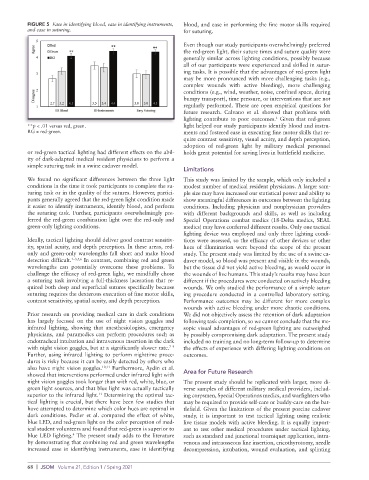
FIGURE 5  Ease in identifying blood, ease in identifying instruments,   blood, and ease in performing the fine motor skills required
          and ease in suturing.                              for suturing.
                                                             Even though our study participants overwhelmingly preferred
                                                             the red-green light, their suture times and suture quality were
                                                             generally similar across lighting conditions, possibly because
                                                             all of our participants were experienced and skilled in sutur-
                                                             ing tasks. It is possible that the advantages of red-green light
                                                             may be more pronounced with more challenging tasks (e.g.,
                                                             complex wounds with active bleeding), more challenging
                                                             conditions (e.g., wind, weather, noise, confined space, during
                                                             bumpy transport), time pressure, or interventions that are not
                                                             regularly performed. These are open empirical questions for
                                                             future research. Calvano et al. showed that problems with
                                                             lighting contribute to poor outcomes.  Given that red-green
                                                                                           1
          **p < .01 versus red, green.                       light helped our study participants identify blood and instru-
          RG = red-green.                                    ments and fostered ease in executing fine motor skills that re-
                                                             quire contrast sensitivity, visual acuity, and depth perception,
                                                             adoption of red-green light by military medical personnel
          or red-green tactical lighting had different effects on the abil-  holds great potential for saving lives in battlefield medicine.
          ity of dark-adapted medical resident physicians to perform a
          simple suturing task in a swine cadaver model.
                                                             Limitations
          We found no significant differences between the three light   This study was limited by the sample, which only included a
          conditions in the time it took participants to complete the su-  modest number of medical resident physicians. A larger sam-
          turing task or in the quality of the sutures. However, partici-  ple size may have increased our statistical power and ability to
          pants generally agreed that the red-green light condition made   show meaningful differences in outcomes between the lighting
          it easier to identify instruments, identify blood, and perform   conditions. Including physician and nonphysician providers
          the  suturing  task.  Further,  participants  overwhelmingly  pre-  with different backgrounds and skills, as well as including
          ferred the red-green combination light over the red-only and   Special Operations combat medics (18-Delta medics, SEAL
          green-only lighting conditions.                    medics) may have conferred different results. Only one tactical
                                                             lighting device was employed and only three lighting condi-
          Ideally, tactical lighting should deliver good contrast sensitiv-  tions were assessed, so the efficacy of other devices or other
          ity, spatial acuity, and depth perception. In these areas, red-  hues of illumination were beyond the scope of the present
          only and green-only wavelengths fall short and make blood   study. The present study was limited by the use of a swine ca-
          detection difficult. 1–3,5,6  In contrast, combining red and green   daver model, so blood was present and visible in the wounds,
          wavelengths can potentially overcome these problems. To   but the tissue did not yield active bleeding, as would occur in
          challenge the efficacy of red-green light, we mindfully chose   the wounds of live humans. This study’s results may have been
          a suturing task involving a full-thickness laceration that re-  different if the procedures were conducted on actively bleeding
          quired both deep and superficial sutures specifically because   wounds. We only studied the performance of a simple sutur-
          suturing requires the dexterous execution of fine motor skills,   ing procedure conducted in a controlled laboratory setting.
          contrast sensitivity, spatial acuity, and depth perception.  Performance outcomes may be different for more complex
                                                             wounds with active bleeding under more chaotic conditions.
          Prior research on providing medical care in dark conditions   We did not objectively assess the retention of dark adaptation
          has largely focused on the use of night vision goggles and   following task completion, so we cannot conclude that the me-
          infrared lighting, showing that anesthesiologists, emergency   sopic visual advantages of red-green lighting are outweighed
          physicians, and paramedics can perform procedures such as   by possibly compromising dark adaptation. The present study
          endotracheal intubation and intravenous insertion in the dark   included no training and no long-term follow-up to determine
                                                        7–9
          with night vision goggles, but at a significantly slower rate.    the effects of experience with differing lighting conditions on
          Further, using infrared lighting to perform nighttime proce-  outcomes.
          dures is risky because it can be easily detected by others who
          also have night vision goggles. 10,11  Furthermore, Aydin et al.   Area for Future Research
          showed that interventions performed under infrared light with
          night vision goggles took longer than with red, white, blue, or   The present study should be replicated with larger, more di-
          green light sources, and that blue light was actually tactically   verse samples of different military medical providers, includ-
          superior to the infrared light.  Determining the optimal tac-  ing corpsmen, Special Operations medics, and warfighters who
                                 11
          tical lighting is crucial, but there have been few studies that   may be required to provide self-care or buddy-care on the bat-
          have attempted to determine which color hues are optimal in   tlefield. Given the limitations of the present porcine cadaver
          dark conditions. Pedler et al. compared the effect of white,   study, it is important to test tactical lighting using realistic
          blue LED, and red-green light on the color perception of med-  live tissue models with active bleeding. It is equally import-
          ical student volunteers and found that red-green is superior to   ant to test other medical procedures under tactical lighting,
                         4
          blue LED lighting.  The present study adds to the literature   such as standard and junctional tourniquet application, intra-
          by demonstrating that combining red and green wavelengths   venous and intraosseous line insertion, cricothyrotomy, needle
          increased ease in identifying instruments, ease in identifying   decompression, intubation, wound evaluation, and splinting


          68  |  JSOM   Volume 21, Edition 1 / Spring 2021

