


Page 70 - JSOM Spring 2021
P. 70
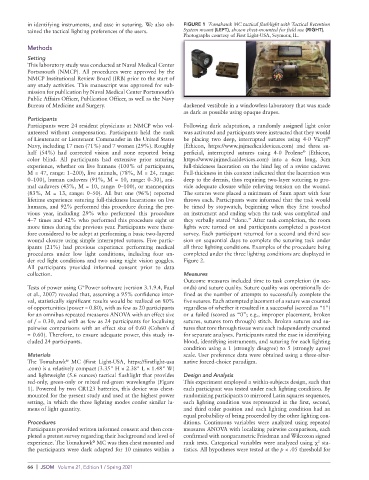
in identifying instruments, and ease in suturing. We also ob-  FIGURE 1  Tomahawk MC tactical flashlight with Tactical Retention
          tained the tactical lighting preferences of the users.  System mount (LEFT), shown chest-mounted for field use (RIGHT).
                                                             Photographs courtesy of First Light-USA, Seymour, IL.
          Methods
          Setting
          This laboratory study was conducted at Naval Medical Center
          Portsmouth (NMCP). All procedures were approved by the
          NMCP Institutional Review Board (IRB) prior to the start of
          any study activities. This manuscript was approved for sub-
          mission for publication by Naval Medical Center Portsmouth’s
          Public Affairs Officer, Publication Officer, as well as the Navy
          Bureau of Medicine and Surgery.                    darkened vestibule in a windowless laboratory that was made
                                                             as dark as possible using opaque drapes.
          Participants
          Participants were 24 resident physicians at NMCP who vol-  Following dark adaptation, a randomly assigned light color
          unteered  without  compensation.  Participants  held  the  rank   was activated and participants were instructed that they would
          of Lieutenant or Lieutenant Commander in the United States   be placing two deep, interrupted sutures using 4-0   Vicryl
                                                                                                            ®
          Navy, including 17 men (71%) and 7 women (29%). Roughly   (Ethicon,  https://www.jnjmedicaldevices.com) and three su-
          half (54%) had corrected vision and none reported being   perficial, interrupted sutures using 4-0 Prolene  (Ethicon,
                                                                                                    ®
          color blind. All participants had extensive prior suturing   https://www.jnjmedicaldevices.com) into a 6cm long, 3cm
          experience, whether on live humans (100% of participants,   full-thickness laceration on the hind leg of a swine cadaver.
          M = 47, range: 1–200), live animals, (78%, M = 24, range:   Full-thickness in this context indicated that the laceration was
          0–100), human cadavers (91%, M = 10, range: 0–30), ani-  deep to the dermis, thus requiring two-layer suturing to pro-
          mal cadavers (43%, M = 10, range: 0–100), or mannequins   vide adequate closure while relieving tension on the wound.
          (83%, M = 13, range: 0–50). All but one (96%) reported   The sutures were placed a minimum of 5mm apart with four
          lifetime experience suturing full-thickness lacerations on live   throws each. Participants were informed that the task would
          humans, and 92% performed this procedure during the pre-  be timed by stopwatch, beginning when they first touched
          vious year, including 29% who performed this procedure   an instrument and ending when the task was completed and
          4–7 times and 42% who performed this procedure eight or   they verbally stated “done.” After task completion, the room
          more times during the previous year. Participants were there-  lights were turned on and participants completed a post-test
          fore considered to be adept at performing a basic two-layered   survey. Each participant returned for a second and third ses-
          wound closure using simple interrupted sutures. Five partic-  sion on sequential days to complete the suturing task under
          ipants (21%) had previous experience performing medical   all three lighting conditions. Examples of the procedure being
          procedures under low light conditions, including four un-  completed under the three lighting conditions are displayed in
          der red light conditions and two using night vision goggles.   Figure 2.
          All participants provided informed consent prior to data
          collection.                                        Measures
                                                             Outcome measures included time to task completion (in sec-
          Tests of power using G*Power software (version 3.1.9.4, Faul   onds) and suture quality. Suture quality was operationally de-
          et al., 2007) revealed that, assuming a 95% confidence inter-  fined as the number of attempts to successfully complete the
          val, statistically significant results would be realized on 80%   five sutures. Each attempted placement of a suture was counted
          of opportunities (power = 0.80), with as few as 20 participants   regardless of whether it resulted in a successful (scored as “1”)
          for an omnibus repeated measures ANOVA with an effect size   or a failed (scored as “0”; e.g., improper placement, broken
          of f = 0.30, and with as few as 24 participants for localizing   sutures, sutures torn through) stitch. Broken sutures and su-
          pairwise comparisons with an effect size of 0.60 (Cohen’s d   tures that tore through tissue were each independently counted
          = 0.60). Therefore, to ensure adequate power, this study in-  for separate analyses. Participants rated the ease in identifying
          cluded 24 participants.                            blood, identifying instruments, and suturing for each lighting
                                                             condition using a 1 (strongly disagree) to 5 (strongly agree)
          Materials                                          scale. User preference data were obtained using a three-alter-
          The Tomahawk  MC (First Light-USA, https://firstlight-usa   native forced-choice paradigm.
                       ®
          .com) is a relatively compact (3.35" H × 2.38" L × 1.48" W)
          and lightweight (5.6 ounces) tactical flashlight that provides   Design and Analysis
          red-only, green-only or mixed red-green wavelengths (Figure   This experiment employed a within-subjects design, such that
          1). Powered by two CR123 batteries, this device was chest-  each participant was tested under each lighting condition. By
          mounted for the present study and used at the highest power   randomizing participants to mirrored Latin squares sequences,
          setting, in which the three lighting modes confer similar lu-  each lighting condition was represented in the first, second,
          mens of light quantity.                            and third order position and each lighting condition had an
                                                             equal probability of being proceeded by the other lighting con-
          Procedures                                         ditions. Continuous variables were analyzed using repeated
          Participants provided written informed consent and then com-  measures ANOVA with localizing pairwise comparison, each
          pleted a pretest survey regarding their background and level of   confirmed with nonparametric Friedman and Wilcoxon signed
          experience. The Tomahawk  MC was then chest mounted and   rank tests. Categorical variables were analyzed using χ  sta-
                                                                                                         2
                               ®
          the participants were dark adapted for 10 minutes within a   tistics. All hypotheses were tested at the p < .05 threshold for
          66  |  JSOM   Volume 21, Edition 1 / Spring 2021

