


Page 40 - JSOM Spring 2021
P. 40
cooker, with the top of the grate above the level of the wa-  FIGURE 1  Boxplot of time to pressure.
          ter. Both pressure cookers contained a test packet composed
          of a 3M Attest 1292 Rapid Readout Biological Indicator vial
          (3M Health Care, www.3m.com) and a 3M Comply SteriGage
          Steam Chemical Integrator strip (3M Health Care, www.3m
          .com) sealed within a 3.5 ´ 5.25-inch Henry Schein Self Seal
          sterilization pouch (Henry Schein, https://www.henryschein

          .com). A cotton surgical towel (Henry Schein) was placed be-
          tween the grate and the test pack to ensure the Attest vials
          did  not  melt  from  contact  with  the  metal  grate.  Two  pres-
          sure cookers were run simultaneously on two Cuisinart CB-
          30 cast-iron single burner hot plates (Cuisinart, https://www.
          cuisinart.com). A total of 128 trials were run, with 64 trials on
          each pressure cooker. Each run consisted of one test packet.
          The pressure cooker manufacturer established the operating
          pressure at 103.4kPa and the temperature at 121°C.  Estab-
                                                    4
          lished US Army sterilization protocols require 20 minutes to
          achieve sterility at this pressure and temperature.  After each
                                                 5
          trial, the pressure cookers and hot plates were allowed to cool
          for at least 5 minutes before the next trial was started.
          The readings for the pouch indicators and SteriGage strips
          were recorded at the end of each trial run. The Attest vials
          were incubated in a 3M Attest 290 Auto-reader (3M Health
          Care, www.3m.com) with a control vial for 3 hours following
          US Army protocol and the manufacturer’s recommendation.    Movement of the weight after the pressure cooker had reached
                                                         5,6
          The Attest vials were labeled to identify the day, trial, and the   103.4kPa was observed to stop in 56 of the 128 trials. However, inter-
          pressure cooker in which the vials were used. Positive or nega-  ruption of weight movement had no effect on the outcome.
          tive incubation was verified by a blinded observer (OW). The
          ambient temperature and humidity at the beginning of each   this study cannot be extrapolated to include all commercially
          day was measured using an AcuRite digital thermometer and   available pressure cookers. A study by Swenson et al. tested
                                      ®
          hygrometer (AcuRite, https://www.acurite.com).     four different 8-quart electric pressure cookers and found that
                                                             only the Instant Pot  (Instant Pot, https://instantpot.com) was
                                                                            ®
          Exploratory data analyses were conducted on all continuous   able to inactivate  G. sterothermophilus spores.  However,
                                                                                                    7
          data. The Shapiro-Wilk test was used to assess the normal-  sporicidal activity required a minimum of 120 minutes. A
          ity of the data distributions. Measures of central tendency are   likely explanation for the divergence in the results noted in
          presented as means with associated standard deviations (SD).   this protocol is that only the Presto pressure cooker is able
          Multiple regression analyses were used to test if the ambient   to achieve, and maintain, the pressure and temperature levels
          temperature and humidity affected either the pressure cooker’s   required for steam sterilization, unlike the products used in
          time to achieve 103.4kPa or the achieved depth on the steril-  the Swenson study. Further studies are necessary to develop a
          ity integrator strip. All analyses were weighted and conducted   proper protocol for the pressure cooker to be used in place of
          using SPSS  Complex Samples (SPSS version 25, https://www   an autoclave, and several questions not addressed in this study
                  ®
          .ibm.com/products/spss-statistics).                need to be answered. Primarily, what is a reliable protocol for
                                                             precleaning of contaminated instruments in an expeditionary
                                                             environment  to achieve  sterilization in  a pressure  cooker?
          Results
                                                             Studies have attributed the occurrence of surgical site infec-
          Sterility using the pressure cooker was achieved in all tested   tions to a breakdown of proper sterilization protocol rather
          bags, integrator strips, and Attest vials (n = 128). The mean   than equipment failures.  Sterilization is compromised if the
                                                                                8,9
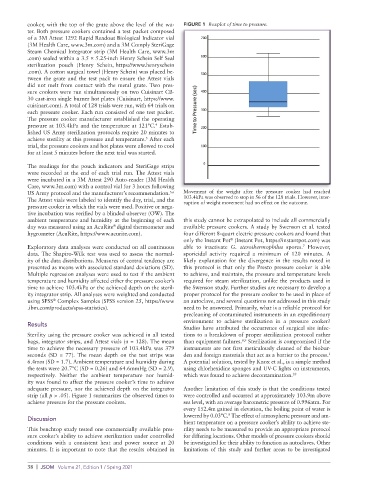
          time to achieve the necessary pressure of 103.4kPa was 379   instruments are not first meticulously cleaned of the biobur-
          seconds  (SD  =  77). The  mean  depth  on  the  test  strips  was   den and foreign materials that act as a barrier to the process.
                                                                                                            1
          6.4mm (SD = 1.7). Ambient temperature and humidity during   A potential solution, tested by Knox et al., is a simple method
          the tests were 20.7°C (SD = 0.26) and 64.6mmHg (SD = 2.9),   using chlorhexidine sponges and UV-C lights on instruments,
          respectively. Neither the ambient temperature nor humid-  which was found to achieve decontamination. 10
          ity was found to affect the pressure cooker’s time to achieve
          adequate pressure, nor the achieved depth on the integrator   Another limitation of this study is that the conditions tested
          strip (all p > .05). Figure 1 summarizes the observed times to   were controlled and occurred at approximately 103.9m above
          achieve pressure for the pressure cookers.         sea level, with an average barometric pressure of 0.996atm. For
                                                             every 152.4m gained in elevation, the boiling point of water is
                                                             lowered by 0.03°C.  The effect of atmospheric pressure and am-
                                                                            8
          Discussion
                                                             bient temperature on a pressure cooker’s ability to achieve ste-
          This benchtop study tested one commercially available pres-  rility needs to be measured to provide an appropriate protocol
          sure cooker’s ability to achieve sterilization under controlled   for differing locations. Other models of pressure cookers should
          conditions with a consistent heat and power source at 20   be investigated for their ability to function as autoclaves. Other
          minutes. It is important to note that the results obtained in   limitations  of this  study and  further  areas to  be investigated


          38  |  JSOM   Volume 21, Edition 1 / Spring 2021

