


Page 44 - JSOM Spring 2021
P. 44
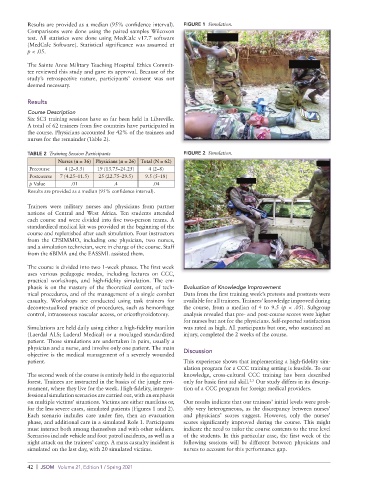
Results are provided as a median (95% confidence interval).   FIGURE 1  Simulation.
          Comparisons were done using the paired samples Wilcoxon
          test. All statistics were done using MedCalc v17.7 software
          (MedCalc Software). Statistical significance was assumed at
          p < .05.
          The Sainte Anne Military Teaching Hospital Ethics Commit-
          tee reviewed this study and gave its approval. Because of the
          study’s  retrospective  nature,  participants’  consent  was  not
          deemed necessary.

          Results
          Course Description
          Six SC3 training sessions have so far been held in Libreville.
          A total of 62 trainees from five countries have participated in
          the course. Physicians accounted for 42% of the trainees and
          nurses for the remainder (Table 2).

          TABLE 2  Training Session Participants             FIGURE 2  Simulation.
                    Nurses (n = 36) Physicians (n = 26)  Total (N = 62)
           Precourse  4 (2–5.5)  19 (13.75–24.25)  4 (2–8)
           Postcourse  7 (4.25–11.5)  25 (22.75–29.5)  9.5 (5–18)
           p Value      .01           .4           .04
          Results are provided as a median (95% confidence interval).

          Trainees  were  military  nurses  and physicians  from  partner
          nations of Central and West Africa. Ten students attended
          each course and were divided into five two-person teams. A
          standardized medical kit was provided at the beginning of the
          course and replenished after each simulation. Four instructors
          from the CESIMMO, including one physician, two nurses,
          and a simulation technician, were in charge of the course. Staff
          from the 6BIMA and the EASSML assisted them.

          The course is divided into two 1-week phases. The first week
          uses  various pedagogic  modes,  including lectures  on CCC,
          practical workshops, and high-fidelity simulation. The em-
          phasis is on the mastery of the theoretical content, of tech-  Evaluation of Knowledge Improvement
          nical procedures, and of the management of a single combat   Data from the first training week’s pretests and posttests were
          casualty. Workshops are conducted using task trainers for   available for all trainees. Trainees’ knowledge improved during
          decontextualized practice of procedures, such as hemorrhage   the course, from a median of 4 to 9.5 (p  < .05). Subgroup
          control, intraosseous vascular access, or cricothyroidotomy.  analysis revealed that pre- and post-course scores were higher
                                                             for nurses but not for the physicians. Self-reported satisfaction
          Simulations are held daily using either a high-fidelity manikin   was rated as high. All participants but one, who sustained an
          (Laerdal ALS; Laderal Medical) or a moulaged standardized   injury, completed the 2 weeks of the course.
          patient. Those simulations are undertaken in pairs, usually a
          physician and a nurse, and involve only one patient. The main   Discussion
          objective is the medical management of a severely wounded
          patient.                                           This experience shows that implementing a high-fidelity sim-
                                                             ulation program for a CCC training setting is feasible. To our
          The second week of the course is entirely held in the equatorial   knowledge, cross-cultural CCC training has been described
          forest. Trainees are instructed in the basics of the jungle envi-  only for basic first aid skill.  Our study differs in its descrip-
                                                                                   2,3
          ronment, where they live for the week. High-fidelity, interpro-  tion of a CCC program for foreign medical providers.
          fessional simulation scenarios are carried out, with an emphasis
          on multiple victims’ situations. Victims are either manikins or,   Our results indicate that our trainees’ initial levels were prob-
          for the less severe cases, simulated patients (Figures 1 and 2).   ably very heterogeneous, as the discrepancy between nurses’
          Each scenario includes care under fire, then an evacuation   and physicians’ scores suggest. However, only the nurses’
          phase, and additional care in a simulated Role 1. Participants   scores significantly improved during the course. This might
          must interact both among themselves and with other soldiers.   indicate the need to tailor the course contents to the true level
          Scenarios include vehicle and foot patrol incidents, as well as a   of the students. In this particular case, the first week of the
          night attack on the trainees’ camp. A mass casualty incident is   following  sessions will  be  different  between  physicians and
          simulated on the last day, with 20 simulated victims.  nurses to account for this performance gap.


          42  |  JSOM   Volume 21, Edition 1 / Spring 2021

