


Page 48 - JSOM Spring 2021
P. 48
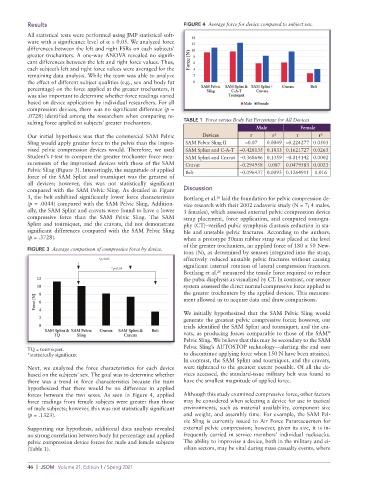
Results                                            FIGURE 4  Average force for device compared to subject sex.
          All statistical tests were performed using JMP statistical soft-
          ware with a significance level of α = 0.05. We analyzed force
          differences between the left and right FSRs on each subjects’
          greater trochanters. A one-way ANOVA revealed no signifi-
          cant differences between the left and right force values. Thus,
          each subject’s left and right force values were averaged for the
          remaining data analysis. While the team was able to analyze
          the effect of different subject qualities (e.g., sex and body fat
          percentage) on the force applied at the greater trochanters, it
          was also important to determine whether force readings varied
          based on device application by individual researchers. For all
          compression devices, there was no significant difference (p =
          .0728) identified among the researchers when comparing re-
          sulting force applied to subjects’ greater trochanters.  TABLE 1  Force versus Body Fat Percentage for All Devices
                                                                                     Male          Female
          Our initial hypothesis was that the commercial SAM Pelvic   Devices      r      r²      r      r²
          Sling would apply greater force to the pelvis than the impro-  SAM Pelvic Sling II  –0.07  0.0049 –0.224277 0.0503
          vised pelvic compression devices would. Therefore, we used   SAM Splint and C-A-T  –0.428135 0.1833 0.1621727 0.0263
          Student’s t-test to compare the greater trochanter force mea-  SAM Splint and Cravat –0.368646 0.1359 –0.014142 0.0002
          surements of the improvised devices with those of the SAM   Cravat   –0.294958  0.087  0.0479583 0.0023
          Pelvic Sling (Figure 3). Interestingly, the magnitude of applied   Belt  –0.096437 0.0093 0.1264911  0.016
          force of the SAM Splint and tourniquet was the greatest of
          all  devices;  however,  this was  not  statistically  significant
          compared with the SAM Pelvic Sling. As detailed in Figure   Discussion
          3, the belt exhibited significantly lower force characteristics     Bottlang et al.  laid the foundation for pelvic compression de-
                                                                        26
          (p = .0044) compared with the SAM Pelvic Sling. Addition-  vice research with their 2002 cadaveric study (N = 7; 4 males,
          ally, the SAM Splint and cravats were found to have a lower   3 females), which assessed external pelvic compression device
          compressive  force  than  the  SAM  Pelvic  Sling.  The  SAM   strap placement, force application, and computed tomogra-
          Splint and tourniquet, and the cravats, did not demonstrate   phy (CT)–verified pubic symphysis diastasis reduction in sta-
          significant  differences  compared with the  SAM  Pelvic Sling     ble and unstable pelvic fractures. According to the authors,
          (p = .3728).                                       when a prototype 50mm rubber strap was placed at the level
                                                             of the greater trochanters, an applied force of 180 ± 50 New-
          FIGURE 3  Average comparison of compressive force by device.
                                                             tons (N), as determined by sensors integrated into the strap,
                                 *p<0.05                     effectively reduced unstable pelvic fractures without causing
                                                             significant internal rotation of lateral compression fractures.
                                     *p<0.05
                                                             Bottlang et al.  measured the tensile force required to reduce
                                                                        26
                                                             the pubic diaphysis as visualized by CT. In contrast, our sensor
                                                             system assessed the direct normal compressive force applied to
                                                             the greater trochanters by the applied devices. This measure-
                                                             ment allowed us to acquire data and draw comparisons.
                                                             We initially hypothesized that the SAM Pelvic Sling would
                                                             generate the greatest pelvic compressive force; however, our
                                                             trials identified the SAM Splint and tourniquet, and the cra-
                                                             vats, as producing forces comparable to those of the SAM
                                                                                                            ®
                                                             Pelvic Sling. We believe that this may be secondary to the SAM
                                                             Pelvic Sling’s AUTOSTOP technology—alerting the end user
          TQ = tourniquet.
          *statistically significant                         to discontinue applying force when 150 N have been attained.
                                                             In contrast, the SAM Splint and tourniquet, and the cravats,
          Next, we analyzed the force characteristics for each device   were tightened to the greatest extent possible. Of all the de-
          based on the subjects’ sex. The goal was to determine whether   vices accessed, the standard-issue military belt was found to
          there  was  a  trend  in  force  characteristics  because  the  team   have the smallest magnitude of applied force.
          hypothesized  that  there  would  be  no  difference  in  applied
          forces between the two sexes. As seen in Figure 4, applied   Although this study examined compressive force, other factors
          force readings from female subjects were greater than those   may be considered when selecting a device for use in tactical
          of male subjects; however, this was not statistically significant     environments, such as material availability, component size
          (p = .1323).                                       and weight, and assembly time. For example, the SAM Pel-
                                                             vic Sling is currently issued to Air Force Pararescuemen for
          Supporting our hypothesis, additional data analysis revealed   external pelvic compression; however, given its size, it is in-
          no strong correlation between body fat percentage and applied   frequently carried in service members’ individual rucksacks.
          pelvic compression device forces for male and female subjects   The ability to improvise a device, both in the military and ci-
          (Table 1).                                         vilian sectors, may be vital during mass casualty events, where


          46  |  JSOM   Volume 21, Edition 1 / Spring 2021

