


Page 47 - JSOM Spring 2021
P. 47
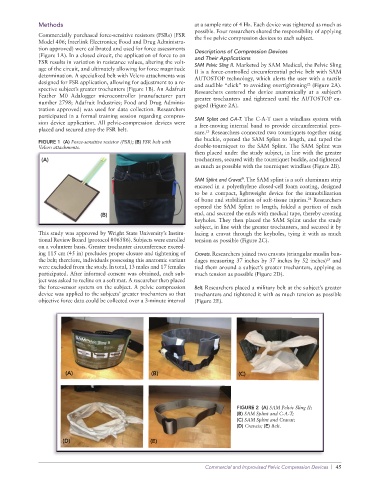
Methods                                            at a sample rate of 4 Hz. Each device was tightened as much as
                                                                 possible. Four researchers shared the responsibility of applying
              Commercially purchased force-sensitive resistors (FSRs) (FSR   the five pelvic compression devices to each subject.
              Model 406; Interlink Electronics; Food and Drug Administra-
              tion approved) were calibrated and used for force assessments   Descriptions of Compression Devices
              (Figure 1A). In a closed circuit, the application of force to an   and Their Applications
              FSR results in variation in resistance values, altering the volt-  SAM Pelvic Sling II. Marketed by SAM Medical, the Pelvic Sling
              age of the circuit, and ultimately allowing for force magnitude   II is a force-controlled circumferential pelvic belt with SAM
              determination. A specialized belt with Velcro attachments was   AUTOSTOP technology, which alerts the user with a tactile
              designed for FSR application, allowing for adjustment to a re-  and audible “click” to avoiding overtightening  (Figure 2A).
                                                                                                     22
              spective subject’s greater trochanters (Figure 1B). An Adafruit   Researchers centered the device anatomically at a subject’s
              Feather M0 Adalogger microcontroller (manufacturer part   greater trochanters and tightened until the AUTOSTOP en-
              number 2798; Adafruit Industries; Food and Drug Adminis-  gaged (Figure 2A).
              tration approved) was used for data collection. Researchers
              participated in a formal training session regarding compres-  SAM Splint and C-A-T. The C-A-T uses a windlass system with
              sion device application. All pelvic-compression devices were   a free-moving internal band to provide circumferential pres-
              placed and secured atop the FSR belt.
                                                                 sure.  Researchers connected two tourniquets together using
                                                                    23
                                                                 the buckle, opened the SAM Splint to length, and taped the
              FIGURE 1  (A) Force-sensitive resistor (FSR); (B) FSR belt with
              Velcro attachments.                                double-tourniquet to the SAM Splint. The SAM Splint was
                                                                 then placed under the study subject, in line with the greater
               (A)                                               trochanters, secured with the tourniquet buckle, and tightened
                                                                 as much as possible with the tourniquet windlass (Figure 2B).
                                                                 SAM Splint and Cravat . The SAM splint is a soft aluminum strip
                                                                                ®
                                                                 encased in a polyethylene closed-cell foam coating, designed
                                                                 to be a compact, lightweight device  for the immobilization
                                                                 of bone and stabilization of soft-tissue injuries.  Researchers
                                                                                                      24
                                                                 opened  the SAM Splint to length,  folded a portion of  each
                                  (B)                            end, and secured the ends with medical tape, thereby creating
                                                                 keyholes. They then placed the SAM Splint under the study
                                                                 subject, in line with the greater trochanters, and secured it by
              This study was approved by Wright State University’s Institu-  lacing a cravat through the keyholes, tying it with as much
              tional Review Board (protocol #06586). Subjects were enrolled   tension as possible (Figure 2C).
              on a volunteer basis. Greater trochanter circumference exceed-
              ing 115 cm (45 in) precludes proper closure and tightening of   Cravats. Researchers joined two cravats (triangular muslin ban-
              the belt; therefore, individuals possessing this anatomic variant   dages measuring 37 inches by 37 inches by 52 inches)  and
                                                                                                            25
              were excluded from the study. In total, 13 males and 17 females   tied them around a subject’s greater trochanters, applying as
              participated. After informed consent was obtained, each sub-  much tension as possible (Figure 2D).
              ject was asked to recline on a soft mat. A researcher then placed
              the force-sensor system on the subject. A pelvic compression   Belt. Researchers placed a military belt at the subject’s greater
              device was applied to the subjects’ greater trochanters so that   trochanters and tightened it with as much tension as possible
              objective force data could be collected over a 3-minute interval   (Figure 2E).


                                                                              FIGURE 2  (A) SAM Pelvic Sling II;
                                                                              (B) SAM Splint and C-A-T;
                                                                              (C) SAM Splint and Cravat;
                                                                              (D) Cravats; (E) Belt.


                                                                    Commercial and Improvised Pelvic Compression Devices  |  45

