


Page 37 - JSOM Spring 2021
P. 37
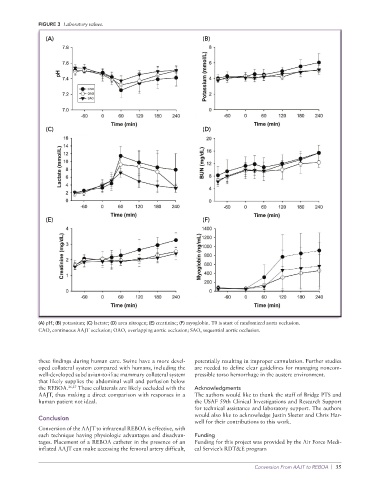
FIGURE 3  Laboratory values.

                (A)                                                (B)


                (C)                                                (D)


                (E)                                                (F)


              (A) pH; (B) potassium; (C) lactate; (D) urea nitrogen; (E) creatinine; (F) myoglobin. T0 is start of randomized aorta occlusion.
              CAO, continuous AAJT occlusion; OAO, overlapping aortic occlusion; SAO, sequential aortic occlusion.


              these findings during human care. Swine have a more devel-  potentially resulting in improper cannulation. Further studies
              oped collateral system compared with humans, including the   are needed to define clear guidelines for managing noncom-
              well-developed subclavian-to-iliac mammary collateral system   pressible torso hemorrhage in the austere environment.
              that likely supplies the abdominal wall and perfusion below
              the REBOA. 26,27  These collaterals are likely occluded with the   Acknowledgments
              AAJT, thus making a direct comparison with responses in a   The authors would like to thank the staff of Bridge PTS and
              human patient not ideal.                           the USAF 59th Clinical Investigations and Research Support
                                                                 for technical assistance and laboratory support. The authors
                                                                 would also like to acknowledge Justin Sleeter and Chris Har-
              Conclusion
                                                                 well for their contributions to this work.
              Conversion of the AAJT to infrarenal REBOA is effective, with
              each technique having physiologic advantages and disadvan-  Funding
              tages. Placement of a REBOA catheter in the presence of an   Funding for this project was provided by the Air Force Medi-
              inflated AAJT can make accessing the femoral artery difficult,   cal Service’s RDT&E program

                                                                                    Conversion From AAJT to REBOA  |  35

