


Page 115 - JSOM Spring 2021
P. 115
baseline individual profiles for 10% of her unit, amounting to   TABLE 2  A Side-by-Side Depiction of the Pursuing Meaning,
              87 MSMs by using the SSFS tool; and then (b) conduct focus   Purpose, and Values (PMPV) Subscale to Use for Assessing Programs
              groups with 15%, or those she had profiled, to debrief their   Devoted to this Key Spiritual Attribute
              responses and capture more nuanced information about their   1. I know what my life is about.  1. I know what my life is about.
              spiritual needs and interests.                       Strongly Agree          Strongly Agree
                                                                   Agree                   Agree
                                                                   Somewhat Agree          Somewhat Agree
              During this process, Chaplain Jones found quantitative and   Neutral         Neutral
              qualitative indications that her particular unit had a pro-  Somewhat Disagree  Somewhat Disagree
              nounced interest in spirituality related to PMPV. After discuss-  Disagree   Disagree
              ing this finding at length with her enlisted counterpart and   Strongly Disagree  Strongly Disagree
              then with her peers and supervisor, she developed a PMPV ini-  2.  I have been able to find a   2.  I have been able to find a
              tiative informed by a particular training resource she had care-  sense of meaning in my life.  sense of meaning in my life.
              fully selected. This training resource has no assumptions about   Strongly Agree  Strongly Agree
              a theistic worldview among participants, which was important   Agree         Agree
              to Chaplain Jones since her baseline assessment showed many   Somewhat Agree  Somewhat Agree
              constituents had opted out of PCHP but showed clear commit-  Neutral         Neutral
              ment to PMPV. Chaplain Jones concluded that her initiative   Somewhat Disagree  Somewhat Disagree
              should focus on finding/renewing a sense of ultimate purpose   Disagree      Disagree
                                                                   Strongly Disagree
                                                                                           Strongly Disagree
              in  life  and  aligning  personal/professional/family  goals  with
              that purpose in a renewable, reflective practice.  3.  Looking at my life as a whole,  3.  Looking at my life as a whole,
                                                                   things seem clear to me.
                                                                                           things seem clear to me.
                                                                   Strongly Agree          Strongly Agree
              She approached her unit leadership for funding and support of   Agree        Agree
              this new initiative, and defended her approach by sharing the   Somewhat Agree  Somewhat Agree
              findings from her SSFS baseline assessment. In turn, she ex-  Neutral        Neutral
              plained the evidence base for the SSFS, and the importance of   Somewhat Disagree  Somewhat Disagree
              PMPV as one of three core attributes of SP/SF within the scope   Disagree    Disagree
              of the SOF and CJCSI definitions. During the discussion, she   Strongly Disagree  Strongly Disagree
              mentioned a number of validated wellness outcomes that cor-  4.  I have a core of beliefs,    4.  I have a core of beliefs,
              related with growth in PMPV.                         ethics, and values that give   ethics, and values that give
                                                                   my life a sense of meaning   my life a sense of meaning
                                                                   and purpose.            and purpose.
              Her funding was approved, and Chaplain Jones launched her   Strongly Agree   Strongly Agree
              initiative. She used her appropriated resources to recruit 12   Agree        Agree
              participants at a time, with whom she met every Tuesday and   Somewhat Agree  Somewhat Agree
              Thursday for six weeks. Their meetings occurred during the   Neutral         Neutral
              noon meal and lasted for 50 minutes. After each 6-week pe-  Somewhat Disagree  Somewhat Disagree
              riod, she conducted an end-of-course assessment, took a week   Disagree      Disagree
              off, and then prepared to launch a new iteration with 12 new   Strongly Disagree  Strongly Disagree
              participants.                                      5.  I am able to find meaning   5.  I am able to find meaning
                                                                   and purpose in my everyday   and purpose in my everyday
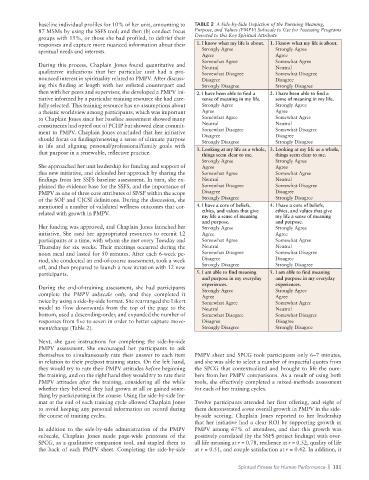
              During the end-of-training assessment, she had participants   experiences.   experiences.
              complete  the  PMPV  subscale  only,  and  they  completed  it   Strongly Agree  Strongly Agree
                                                                                           Agree
                                                                   Agree
              twice by using a side-by-side format. She rearranged the Likert   Somewhat Agree  Somewhat Agree
              model to flow downwards from the top of the page to the   Neutral            Neutral
              bottom, used a descending-order, and expanded the number of   Somewhat Disagree  Somewhat Disagree
              responses from five to seven in order to better capture move-  Disagree      Disagree
              ment/change (Table 2).                               Strongly Disagree       Strongly Disagree

              Next, she gave instructions for completing the side-by-side
              PMPV  assessment.  She  encouraged  her participants  to  ask
              themselves to simultaneously rate their answer to each item   PMPV sheet and SPCG took participants only 6–7 minutes,
              in relation to their pre/post training states. On the left hand,   and she was able to select a number of impactful quotes from
              they would try to rate their PMPV attitudes before beginning   the SPCG that contextualized and brought to life the num-
              the training, and on the right hand they would try to rate their   bers from her PMPV comparisons. As a result of using both
              PMPV attitudes  after  the training, considering all the while   tools, she effectively completed a mixed-methods assessment
              whether they believed they had grown at all or gained some-  for each of her training cycles.
              thing by participating in the course. Using the side-by-side for-
              mat at the end of each training cycle allowed Chaplain Jones   Twelve participants attended her first offering, and eight of
              to avoid keeping any personal information on record during   them demonstrated some overall growth in PMPV in the side-
              the course of training cycles.                     by-side scoring. Chaplain Jones reported to her leadership
                                                                 that her initiative had a clear ROI by supporting growth in
              In addition to the side-by-side administration of the PMPV   PMPV among 67% of attendees, and that this growth was
              subscale, Chaplain Jones made page-wide printouts of the   positively correlated (by the SSFS project findings) with over-
              SPCG, as a qualitative companion tool, and stapled them to   all life meaning at r = 0.78, resilience at r = 0.52, quality of life
              the back of each PMPV sheet. Completing the side-by-side   at r = 0.51, and couple satisfaction at r = 0.42. In addition, it

                                                                               Spiritual Fitness for Human Performance  |  111

