


Page 119 - JSOM Spring 2021
P. 119
Vitamin A and Bone Fractures


                                                          1
                                    Joseph J. Knapik, ScD *; Sally S. Hoedebecke, MS, RD 2


              ABSTRACT
              Vitamin A is a generic term describing compounds that have   the inflammatory processes, and 4) assists in the growth and
              the same biological activity as retinol. Dietary vitamin A can be   activation of lymphocytes. 1–3
              obtained from “provitamin A” carotenoids (e.g., β- carotene)
              found in plant foods such as carrots, cantaloupes, and sweet   Vitamin A can be obtained only in the diet because the body
              peppers, or as “preformed vitamin A” found in many dietary   cannot produce it. While consumption of an adequate amount
              supplements, animal livers, and vitamin A–fortified foods,   of vitamin A is important for physiological functioning, sev-
              such as breakfast cereals, milk, cheese, and yogurt. Low con-  eral observational studies suggest that consumption of high
              sumption of vitamin A can cause night blindness, reduce im-  levels of vitamin A is associated with a higher incidence of
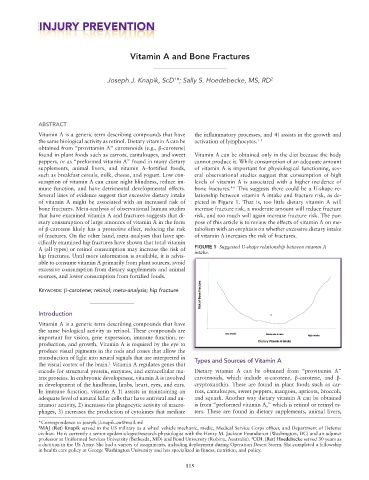
              mune function, and have detrimental developmental effects.   bone fractures.  This suggests there could be a U-shape re-
                                                                            4-6
              Several lines of evidence suggest that excessive dietary intake   lationship between vitamin A intake and fracture risk, as de-
              of vitamin A might be associated with an increased risk of   picted in Figure 1. That is, too little dietary vitamin A will
              bone fractures. Meta-analysis of observational human studies   increase fracture risk, a moderate amount will reduce fracture
              that have examined vitamin A and fractures suggests that di-  risk, and too much will again increase fracture risk. The pur-
              etary consumption of large amounts of vitamin A in the form   pose of this article is to review the effects of vitamin A on me-
              of β-carotene likely has a protective effect, reducing the risk   tabolism with an emphasis on whether excessive dietary intake
              of fractures. On the other hand, meta-analyses that have spe-  of vitamin A increases the risk of fractures.
              cifically examined hip fractures have shown that total vitamin
              A (all types) or retinol consumption may increase the risk of   FIGURE 1  Suggested U-shape relationship between vitamin A
              hip fractures. Until more information is available, it is advis-  intake.
              able to consume vitamin A primarily from plant sources, avoid
              excessive consumption from dietary supplements and animal
              sources, and lower consumption from fortified foods.
              Keywords: β-carotene; retinol; meta-analysis; hip fracture


              Introduction
              Vitamin A is a generic term describing compounds that have
              the same biological activity as retinol. These compounds are
              important for vision, gene expression, immune function, re-
              production, and growth. Vitamin A is required by the eye to
              produce visual pigments in the rods and cones that allow the
              transduction of light into neural signals that are interpreted in   Types and Sources of Vitamin A
                                     1
              the visual cortex of the brain.  Vitamin A regulates genes that
              encode for structural protein, enzymes, and extracellular ma-  Dietary vitamin A can be obtained from “provitamin A”
              trix proteins. In embryonic development, vitamin A is involved   carotenoids, which include  α-carotene,  β-carotene, and  β-
              in development of the hindbrain, limbs, heart, eyes, and ears.   cryptoxanthin. These are found in plant foods such as car-
              In immune function, vitamin A 1) assists in maintaining an   rots, cantaloupes, sweet peppers, mangoes, apricots, broccoli,
              adequate level of natural killer cells that have antiviral and an-  and squash. Another way dietary vitamin A can be obtained
              titumor activity, 2) increases the phagocytic activity of macro-  is from “preformed vitamin A,” which is retinol or retinyl es-
              phages, 3) increases the production of cytokines that mediate   ters.  These  are  found  in  dietary  supplements,  animal  livers,

              *Correspondence to joseph.j.knapik.ctr@mail.mil
              1 MAJ (Ret) Knapik served in the US military as a wheel vehicle mechanic, medic, Medical Service Corps officer, and Department of Defense
              civilian. He is currently a senior epidemiologist/research physiologist with the Henry M. Jackson Foundation (Washington, DC) and an adjunct
              professor at Uniformed Services University (Bethesda, MD) and Bond University (Robina, Australia).  COL (Ret) Hoedebecke served 30 years as
                                                                                   2
              a dietitian in the US Army. She had a variety of assignments, including deployment during Operation Desert Storm. She completed a fellowship
              in health care policy at George Washington University and has specialized in fitness, nutrition, and policy.
                                                              115

