


Page 117 - JSOM Spring 2021
P. 117
An Ongoing Series


                                               Cutaneous Leishmaniasis


                                                              1
                                       Elena M. Crecelius, MD *; Mark W. Burnett, MD  2


              ABSTRACT
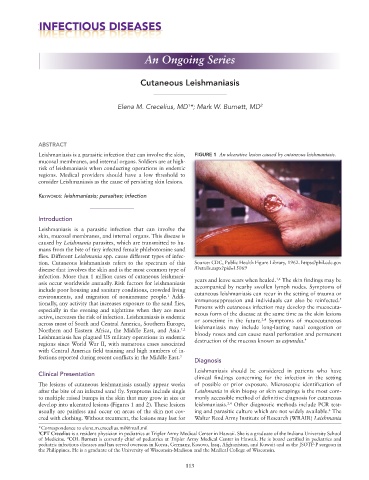
              Leishmaniasis is a parasitic infection that can involve the skin,   FIGURE 1  An ulcerative lesion caused by cutaneous leishmaniasis.
              mucosal membranes, and internal organs. Soldiers are at high-
              risk of leishmaniasis when conducting operations in endemic
              regions. Medical providers should have a low threshold to
              consider Leishmaniasis as the cause of persisting skin lesions.

              Keywords: leishmaniasis; parasites; infection


              Introduction
              Leishmaniasis is a parasitic infection that can involve the
              skin, mucosal membranes, and internal organs. This disease is
              caused by Leishmania parasites, which are transmitted to hu-
              mans from the bite of tiny infected female phlebotomine sand
              flies. Different Leishmania spp. cause different types of infec-
              tion.  Cutaneous  leishmaniasis  refers  to  the  spectrum  of  this   Source: CDC, Public Health Figure Library, 1962. https://phil.cdc.gov
              disease that involves the skin and is the most common type of   /Details.aspx?pid=15069
              infection. More than 1 million cases of cutaneous leishmani-                 1,4
              asis occur worldwide annually. Risk factors for leishmaniasis   years and leave scars when healed.  The skin findings may be

              include poor housing and sanitary conditions, crowded living   accompanied by nearby swollen lymph nodes. Symptoms of
              environments,  and  migration  of  nonimmune  people.   Addi-  cutaneous leishmaniasis can recur in the setting of trauma or
                                                        1
                                                                                                                5
              tionally, any activity that increases exposure to the sand flies,   immunosuppression and individuals can also be reinfected.
              especially in the evening and nighttime when they are most   Persons with cutaneous infection may develop the mucocuta-
              active, increases the risk of infection. Leishmaniasis is endemic   neous form of the disease at the same time as the skin lesions
                                                                                       2,4
              across most of South and Central America, Southern Europe,   or sometime in the future.  Symptoms of mucocutaneous
              Northern and Eastern Africa, the Middle East, and Asia. 1,2   leishmaniasis  may  include  long-lasting  nasal  congestion  or
              Leishmaniasis has plagued US military operations in endemic   bloody noses and can cause nasal perforation and permanent
                                                                                                     4
              regions since World War II, with numerous cases associated   destruction of the mucosa known as espundia.
              with Central America field training and high numbers of in-
              fections reported during recent conflicts in the Middle East. 3
                                                                 Diagnosis
                                                                 Leishmaniasis should be considered in patients who have
              Clinical Presentation
                                                                 clinical findings concerning  for the infection in the setting
              The lesions of cutaneous leishmaniasis usually appear weeks   of  possible or  prior exposure.  Microscopic  identification  of
              after the bite of an infected sand fly. Symptoms include single   Leishmania in skin biopsy or skin scrapings is the most com-
              to multiple raised bumps in the skin that may grow in size or   monly accessible method of definitive diagnosis for cutaneous
              develop into ulcerated lesions (Figures 1 and 2). These lesions   leishmaniasis.  Other diagnostic methods include PCR test-
                                                                           2,4
              usually are painless and occur on areas of the skin not cov-  ing and parasitic culture which are not widely available.  The
                                                                                                            4
              ered with clothing. Without treatment, the lesions may last for   Walter Reed Army Institute of Research (WRAIR) Leishmania
              *Correspondence to elena.m.crecelius.mil@mail.mil
              1 CPT Crecelius is a resident physician in pediatrics at Tripler Army Medical Center in Hawaii. She is a graduate of the Indiana University School
              of Medicine.  COL Burnett is currently chief of pediatrics at Tripler Army Medical Center in Hawaii. He is board certified in pediatrics and
                       2
              pediatric infectious diseases and has served overseas in Korea, Germany, Kosovo, Iraq, Afghanistan, and Kuwait and as the JSOTF-P surgeon in
              the Philippines. He is a graduate of the University of Wisconsin-Madison and the Medical College of Wisconsin.
                                                              113

