


Page 111 - JSOM Spring 2021
P. 111
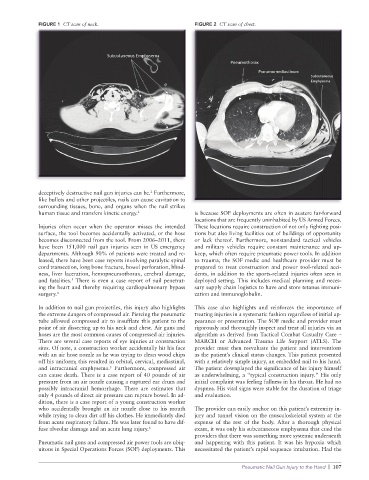
FIGURE 1  CT scan of neck.                         FIGURE 2  CT scan of chest.


                                                  2
              deceptively destructive nail gun injuries can be.  Furthermore,
              like bullets and other projectiles, nails can cause cavitation to
              surrounding tissues, bone, and organs when the nail strikes
              human tissue and transfers kinetic energy. 2       is because SOF deployments are often in austere far-forward
                                                                 locations that are frequently uninhabited by US Armed Forces.
              Injuries often occur when the operator misses the intended   These locations require construction of not only fighting posi-
              surface, the tool becomes accidentally activated, or the hose   tions but also living facilities out of buildings of opportunity
              becomes disconnected from the tool. From 2006 –2011, there   or lack thereof. Furthermore, nonstandard tactical vehicles
              have been 151,000 nail gun injuries seen in US emergency   and military vehicles require constant maintenance and up-
              departments. Although 90% of patients were treated and re-  keep, which often require pneumatic power tools. In addition
              leased, there have been case reports involving paralytic spinal   to trauma, the SOF medic and healthcare provider must be
              cord transection, long bone fracture, bowel perforation, blind-  prepared to treat construction and power tool-related acci-
              ness, liver laceration, hemopneumothorax, cerebral damage,   dents, in addition to the sports-related injuries often seen in
                        3
              and fatalities.  There is even a case report of nail penetrat-  deployed setting. This includes medical planning and neces-
              ing the heart and thereby requiring cardiopulmonary bypass   sary supply chain logistics to have and store tetanus immuni-
              surgery. 4                                         zation and immunoglobulin.

              In addition to nail gun projectiles, this injury also highlights   This case also highlights and reinforces the importance of
              the extreme dangers of compressed air. Piercing the pneumatic   treating injuries in a systematic fashion regardless of initial ap-
              tube allowed compressed air to insufflate this patient to the   pearance or presentation. The SOF medic and provider must
              point of air dissecting up to his neck and chest. Air guns and   rigorously and thoroughly inspect and treat all injuries via an
              hoses are the most common causes of compressed air injuries.   algorithm as derived from Tactical Combat Casualty Care –
              There are several case reports of eye injuries at construction   MARCH  or  Advanced  Trauma  Life  Support  (ATLS).  The
              sites. Of note, a construction worker accidentally hit his face   provider must then reevaluate the patient and interventions
              with an air hose nozzle as he was trying to clean wood chips   as the patient’s clinical status changes. This patient presented
              off his uniform; this resulted in orbital, cervical, mediastinal,   with a relatively simple injury, an embedded nail to his hand.
              and intracranial emphysema.  Furthermore, compressed air   The patient downplayed the significance of his injury himself
                                     5
              can cause death. There is a case report of 40 pounds of air   as underwhelming, a “typical construction injury.” His only
              pressure from an air nozzle causing a ruptured ear drum and   initial complaint was feeling fullness in his throat. He had no
              possibly intracranial hemorrhage. There are estimates that   dyspnea. His vital signs were stable for the duration of triage
              only 4 pounds of direct air pressure can rupture bowel. In ad-  and evaluation.
              dition, there is a case report of a young construction worker
              who accidentally brought an air nozzle close to his mouth   The provider can easily anchor on this patient’s extremity in-
              while trying to clean dirt off his clothes. He immediately died   jury and tunnel vision on the musculoskeletal system at the
              from acute respiratory failure. He was later found to have dif-  expense of the rest of the body. After a thorough physical
              fuse alveolar damage and an acute lung injury. 6   exam, it was only his subcutaneous emphysema that cued the
                                                                 providers that there was something more systemic underneath
              Pneumatic nail guns and compressed air power tools are ubiq-  and happening with this patient. It was his hypoxia which
              uitous in Special Operations Forces (SOF) deployments. This   necessitated the patient’s rapid sequence intubation. Had the

                                                                                Pneumatic Nail Gun Injury to the Hand  |  107

