


Page 43 - 2020 JSOM Winter
P. 43
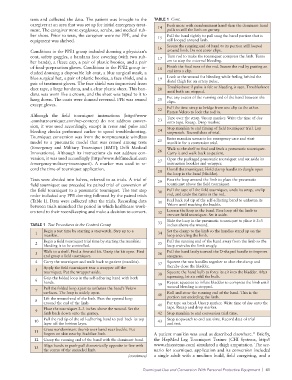
tests and collected the data. The patient was brought to the   TABLE 1  Cont.
              caregiver at an area that was set up for initial emergency treat-  Push more with nondominant hand than the dominant hand
              ment. The caregiver wore eyeglasses, scrubs, and medical rub-  14  pulls to still the limb on gurney.
              ber shoes. Prior to tests, the caregiver wore no PPE, and the   Pull the band tightly to pull snug the band portion that is
              equipment was shelved.                              15  still looped around limb.
                                                                      Secure the running end of band to its portion still looped
                                                                  16
              Conditions in the PPE1 group included donning a physician’s   around limb. Do not cover clips.
              coat, safety goggles, a bandana face covering (with two rub-  17  Turn rod to make the tourniquet compress the limb. Turns
              ber bands), a fleece cap, a pair of plastic booties, and a pair   are to stop the external bleeding.
              of food-preparation gloves. Conditions in the PPE2 group in-  18  Finish the final turn of the rod. Secure the rod by putting an
              cluded donning a disposable lab coat, a blue surgical mask, a   end into a clip.
              blue surgical hat, a pair of plastic booties, a face shield, and a   19  Look at the wound for bleeding while feeling behind the
              pair of treatment gloves. The face shield was improvised from   distal thigh for an artery pulse.
              duct tape, a large bandana, and a clear plastic sheet. This ban-  20  Troubleshoot if pulse is felt or bleeding is seen. Troubleshoot
              dana was worn like a crown, and the sheet was taped to it to   until both are stopped.
              hang down. The coats were donned reversed. PPE was reused   21  Put any excess of the running end of the band between the
              except gloves.                                          clips.
                                                                  22  Pull the time strap to bridge from one clip to the other.
                                                                      Fasten Velcro to lock the rod in.
              Although the field tourniquet instructions (http://www
              .combattourniquet.com/wp-content)  do  not  address  conver-  23  Tape over the strap. Uncap marker. Write the time of day
                                                                      onto tape. Recap. Drop marker.
              sion, it was used accordingly, except in reuse and pulse and   Stop manikin to end timing of field tourniquet trial. Lap
              bleeding checks performed earlier to speed troubleshooting.   24  stopwatch. Record data of trial.
              Tourniquet conversion was from the nonpneumatic windlass   Enter manikin scenario for emergency care and start
              model to a pneumatic model that was reused among tests   25  manikin for a conversion trial.
              (Emergency and Military Tourniquet [EMT]; Delfi Medical   Walk to the shelf to find and fetch a pneumatic tourniquet.
              Innovations). Although its instructions do not address con-  26  Carry it and walk back to patient.
              version, it was used accordingly (http://www.delfimedical.com   Open the packaged pneumatic tourniquet and set aside its
              /emergency-military-tourniquet/). A marker was used to re-  27  instruction booklet and wrapper.
              cord the time of tourniquet application.                Unroll the tourniquet. Hold clamp handle to dangle open
                                                                  28
                                                                      the loop in the band (bladder).
              Tests were divided into halves, referred to as trials. A trial of   29  Pass the loop around the limb to place the pneumatic
              field tourniquet use preceded its paired trial of conversion of   tourniquet above the field tourniquet.
              the field tourniquet to a pneumatic tourniquet. The test step   30  Pull the tape off the field tourniquet, undo its strap, unclip
              order included any PPE donning followed by the paired trials   rod, and undo the turns in the rod.
              (Table 1). Data were collected after the trials. Recording data   31  Peel back red tip of the self-adhering band to unfasten its
              between trials mimicked the period in which healthcare work-  Velcro until reaching the buckle.
              ers tend to their recordkeeping and make a decision to convert.  32  Loosen the loop in the band. Pass loop off the limb to
                                                                      remove field tourniquet. Set it aside.
                                                                      Slide the loop in the pneumatic tourniquet to place it 2–3
              TABLE 1  Test Procedures in the Control Group       33  inches above the wound.
                   Begin a test time by starting a stopwatch. Step up to a   Set the clamp to the limb so the handles stand up on the
                1                                                 34
                   manikin.                                           loop encircling the limb.
                2  Begin a field tourniquet trial time by starting the manikin:   35  Pull the running end of the band away from the limb so the
                   bleeding is to be controlled.                      loop encircles the limb snugly.
                   Walk to a shelf. Find a first-aid kit. Unzip the kit open. Find   Pull the band lastly toward the D-shaped handle to improve
                3                                                 36
                   and grasp a field tourniquet.                      snugness.
                4  Carry the tourniquet and walk back to patient (manikin).   Squeeze the two handles together to shut the clamp and
                                                                  37
                   Apply the field tourniquet: tear a wrapper off the   thereby close the bladder.
                5
                   tourniquet. Put the wrapper aside.             38  Squeeze the hand bulb to force its air into the bladder. After
                   Grip the folded loop in the self-adhering band with both   squeezing, let air refill the bulb.
                6
                   hands.                                         39  Repeat squeezes to inflate bladder to compress the limb until
                   Pull the folded loop apart to unfasten the band’s Velcro   wound bleeding is stopped.
                7
                   surfaces. The loop is widely open.             40  Roll and stow the running end of the band. This is the
                   Lift the wound-end of the limb. Pass the opened loop   portion not encircling the limb.
                8
                   around the end of the limb.                    41  Put tape on band. Uncap marker. Write time of day onto the
                   Place the tourniquet 2–3 inches above the wound. Set the   tape. Recap and drop marker.
                9
                   limb back down onto the gurney.                42  Stop manikin to end conversion trial time.
                   Pull the red tip of the self-adhering band to peel back its top   Stop stopwatch to end test time. Record data of trial
               10                                                 43
                   layer off the bottom layer.                        and test.
                   Cross nondominant thumb over band near buckle. Put
               11
                   fingers on skin nearby. Stabilize limb.       A patient manikin was used as described elsewhere.  Briefly,
                                                                                                         11
               12  Grasp the running end of the band with the dominant hand.   the HapMed Leg Tourniquet Trainer (CHI Systems,  http://
                   Align hands to push-pull diametrically opposite in-line with   www.chisystems.com) simulated a thigh amputation. The sce-
               13
                   the center of the encircled limb.             nario for tourniquet application and its conversion included
                                                      (continues)  a single adult  with a medium  build, field caregiving,  and a
                                                            Tourniquet Use and Conversion With Personal Protective Equipment  |  41

