


Page 84 - JSOM Spring 2020
P. 84
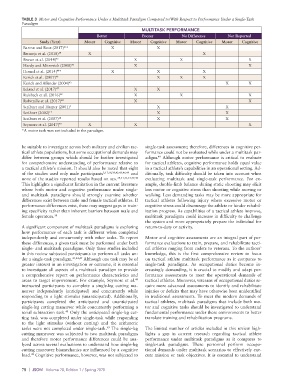
TABLE 3  Motor and Cognitive Performance Under a Multitask Paradigm Compared to/With Respect to Performance Under a Single-Task
          Paradigm
                                                            MULTITASK PERFORMANCE
                                         Better             Poorer          No Difference      Not Reported
                 Study (Year)       Motor   Cognitive  Motor   Cognitive  Motor   Cognitive  Motor   Cognitive
           Barron and Rose (2017) *            X                  X
                           41
                         39
           Bermejo et al. (2018)     X                                               X
                        42
           Brown et al. (2014)                          X                  X                            X
           Hardy and Mitrovich (2008)                   X                                               X
                               43
           Honzel et al. (2014) *              X                  X                  X
                         44
           Kerick et al. (2007)                                   X        X         X
                        46
           Kerick and Allender (2004)                                                         X         X
                              45
                        47
           Leland et al. (2017)                         X         X
           Raisbeck et al. (2016)                       X                  X                            X
                          48
           Robitaille et al. (2017)                     X                                               X
                          40
           Scribner and Harper (2001)                             X                           X
                              3
           Scribner (2002)                                        X                           X
                     17
           Scribner et al. (2007)                                 X                           X
                         18
           Seymore et al. (2017)     X                  X                                               X
                         49
          *A motor task was not included in the paradigm.
          be suitable to investigate across both military and civilian tac-  single-task assessment; therefore, differences in cognitive per-
          tical athlete populations, but some occupational demands may   formance could not be evaluated while under a multitask par-
                                                                  49
          differ between groups which should be further investigated   adigm.  Although motor performance is critical to evaluate
          for comprehensive understanding of performance relative to   for tactical athletes, cognitive performance holds equal value
          a tactical athlete’s mission. It should also be noted that eight   in a tactical athlete’s capabilities in an operational setting. Ad-
          of the studies used only male participants 3,17,18,39,42,45,46,49  and   ditionally, task difficulty should be taken into account when
          none of the studies reported results based on sex. 39,41,43,44,47,48    evaluating multitask and single-task performance. For ex-
          This highlights a significant limitation in the current literature   ample, double-limb balance during static shooting may elicit
          where both motor and cognitive performance under single-   less motor or cognitive stress than shooting while moving or
          and multitask paradigms should strongly examine whether   walking. Less demanding tasks may be more appropriate for
          differences exist between male and female tactical athletes. If   tactical athletes following injury where excessive motor or
          performance differences exist, these may suggest gaps in train-  cognitive stress could discourage the athlete or hinder rehabil-
          ing specificity rather than inherent barriers between male and   itation progress. As capabilities of a tactical athlete improve,
          female operators. 50                               multitask paradigms could increase in difficulty to challenge
                                                             the system and more appropriately prepare the individual for
          A significant component of multitask paradigms is exploring   return-to-duty or activity.
          how performance of each task is different when completed
          independently and concurrently with other tasks. To report   Motor and cognitive assessments are an integral part of per-
          these differences, a given task must be performed under both   formance evaluations to train, prepare, and rehabilitate tacti-
          single- and multitask paradigms. Only three studies included   cal athletes ranging from cadets to veterans. To the authors’
          in this review subjected participants to perform all tasks un-  knowledge, this is the first comprehensive review to focus
          der a single-task paradigm. 41,44,45  Although one task may be of   on tactical athlete multitask performance as it compares to
          greater interest in an investigation or outcome, it is essential   single-task paradigms. As occupational duties become in-
          to investigate all aspects of a multitask paradigm to provide   creasingly demanding, it is crucial to modify and adapt per-
          a  comprehensive  report  on  performance  characteristics  and   formance  assessments  to  meet the  operational  demands of
                                                         49
          areas to target improvement. For example, Seymore et al.    tactical athletes. Moreover, veterans of occupational duties re-
          instructed  participants  to complete  a single-leg  cutting  ma-  quire more advanced assessments to identify and rehabilitate
          neuver independently (anticipated) and concurrently while   injuries or deficits that may have otherwise been unidentified
          responding to a light stimulus (unanticipated). Additionally,   in traditional assessments. To meet the modern demands of
          participants completed the anticipated and unanticipated   tactical athletes, multitask paradigms that include both mo-
          single-leg cutting maneuver while concurrently performing a   tor and cognitive tasks should be investigated to understand
                            49
          serial subtraction task.  Only the anticipated single-leg cut-  fundamental performance under these environments to better
          ting task was completed under single-task while responding   translate training and rehabilitation programs.
          to the light stimulus (without  cutting) and the arithmetic
          tasks were not completed under single-task.  The single-leg   The limited number of articles included in this review high-
                                             49
          cutting maneuver was subjected to two multitask paradigms   lights a gap in current research regarding tactical athlete
          and therefore motor performance differences could be ana-  performance under multitask paradigms as it compares to
          lyzed across several evaluations to understand how single-leg   single-task  paradigms. These  personnel perform  occupa-
          cutting maneuver biomechanics are influenced by a cognitive   tional demands under multitask scenarios to effectively exe-
          load.  Cognitive performance, however, was not subjected to   cute mission or task objectives. It is essential to understand
              49

          78  |  JSOM   Volume 20, Edition 1 / Spring 2020

