


Page 79 - JSOM Spring 2020
P. 79
Methods                                            Criteria for inclusion were as follows: (1) study available in
                                                                 English or able to be translated into English, (2) study avail-
              Search Strategy                                    able in full text, (3) study used human participants only, and
              A two-stage approach was used to identify studies that were   (4) participants in the study completed a single-task and mul-
              relevant for initial assessment to include in this review. The   titask paradigm. After the studies were subjected to the inclu-
              first stage consisted of a cursory review of current litera-  sion criteria, full-text of the remaining studies were screened
              ture, which helped formulate the search strategy. Key search   using the following criteria for exclusion: (1) all participants
              terms were selected by extracting commonly used terms in the   in the study were not identified as tactical athletes, (2) study
              known literature that were relevant to this review. Final search   was a nonresearch article (e.g., editorials, letters), critical or
              terms were established and used for a more robust literature   systematic review, or case study or series, and (3) statistical
              review. The second stage consisted of applying the final search   analyses were not performed to compare single-task perfor-
              terms into PubMed, Web of Science, SPORTDiscus, and De-  mance to multitask performance.
              fense Technical Information Center (DTIC) databases. Search
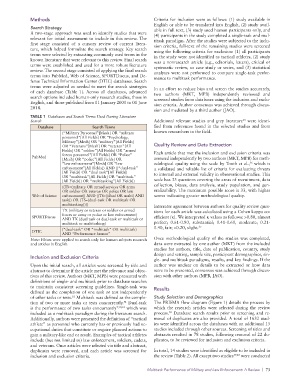
              terms were adjusted as needed to meet the search strategies   In an effort to reduce bias and screen the studies accurately,
              of each database (Table 1). Across all databases, advanced   two authors (MKT, MPB) independently reviewed and
              search options included human-only research studies, those in   screened studies from databases using the inclusion and exclu-
              English, and those published from 01 January 2000 to 01 June    sion criteria. Author consensus was achieved through discus-
              2018.
                                                                 sion and mediated by a third author (JAO).
              TABLE 1  Databases and Search Terms Used During Literature
              Search                                             Additional relevant studies and grey literature  were identi-
                                                                                                     35
                 Database              Search Terms              fied  from references  found in  the selected  studies  and  from
                           (“Military Personnel”[Mesh] OR “military   known researchers in the field.
                           personnel”[All Fields] OR “Psychology,
                           Military”[Mesh] OR “military”[All Fields]
                           OR “Veterans”[Mesh] OR “veteran”[All    Quality Review and Data Extraction
                           Fields] OR “soldier”[All Fields] OR “armed   Each article that met the inclusion and exclusion criteria was
              PubMed       forces personnel”[All Fields] OR “Police”   assessed independently by two authors (MKT, MPB) for meth-
                           [Mesh] OR “police”[All Fields] OR
                           “law enforcement”[Mesh] OR “law       odological quality using the scale by Tooth et al.,  which is
                                                                                                        36
                           enforcement”[All Fields]) AND ((“dual-task”   a validated and reliable list of criteria for evaluating threats
                           [All Fields] OR “dual task”[All Fields]    to internal and external validity in observational studies. This
                           OR “multitask”[All Fields] OR “multitask”
                           [All Fields]) OR “multitasking”[All Fields])  scale has 33 questions covering the areas of recruitment, data
                           ((TS=(military OR armed services OR army   collection,  biases,  data  analysis, study  population,  and gen-
                           OR soldier OR veteran OR police OR law   eralizability. The maximum possible score is 33, with higher
              Web of Science  enforcement)) AND ((TS=((dual OR multi) AND   scores indicating greater methodological quality.
                           task)) OR (TS=(dual-task OR multitask OR
                           multitasking))))                      Interrater agreement between authors for quality review ques-
                           TX (military or veteran or soldier or armed   tions for each article was calculated using a Cohen kappa co-
                           forces or army or police or law enforcement)
              SPORTDiscus                                        efficient (κ). We interpreted κ values as follows: >0.80, almost
                           AND TX (dual task or dual-task or multitask or
                           multitask or multitasking)            perfect;  0.61-0.80, substantial;  0.41-0.60, moderate;  0.21-
                           (“dual-task” OR “multitask” OR multitask)   0.40, fair; <0.20, slight. 37
              DTIC
                           AND “Performance human”
              Note: Filters were applied to search only for human subjects research   Once methodological quality of the studies was completed,
              and articles in English.                           data were extracted by one author (MKT) from the included
                                                                 studies for authors, title, date of publication, country, study
                                                                 design and setting, sample size, participant demographics, sin-
              Inclusion and Exclusion Criteria
                                                                 gle- and multitask paradigms, results, and key findings. If the
              Upon the initial search, all articles were screened by title and   author was unclear on details to be extracted or how data
              abstract to determine if the article met the relevance and objec-  were to be presented, consensus was achieved through discus-
              tives of this review. Authors (MKT, MPB) were presented with   sion with other authors (MPB, JAO).
              definitions of single- and multitask prior to database searches
              to maintain consistent screening guidelines. Single-task was   Results
              defined as the completion of one task or test independently
              of other tasks or tests.  Multitask was defined as the comple-  Study Selection and Demographics
                               16
              tion of two or more tasks or tests concurrently.  Dual-task   The PRISMA flow diagram (Figure 1) details the process by
                                                    34
              is the performance of two tasks concurrently 7,10,23  which was   which  the  research  articles  were  selected  during  the  review
              included as a multitask paradigm during the literature search.   process.  Database search results prior to screening and re-
                                                                       38
              Additionally, authors were presented the definition of “tactical   moval of duplicates are also provided. A total of 1632 stud-
              athlete” as personnel who currently has or previously had oc-  ies were identified across the databases with an additional 15
              cupational duties that constitute or require planned actions to   studies included through other sources. Screening of titles and
              gain a military-like end or result. Examples of tactical athletes   abstracts resulted in 78 studies, following removal of 22 du-
              include (but not limited to) law enforcement, soldiers, cadets,   plicates, to be reviewed for inclusion and exclusion criteria.
              and veterans. Once articles were selected via title and abstract,
              duplicates were removed, and each article was screened for   In total, 14 studies were identified as eligible to be included in
              inclusion and exclusion criteria.                  the review (Table 2). All except two studies 39,40  were conducted

                                                              Multitask Performance of Military and Law Enforcement: A Review  |  73

