


Page 80 - JSOM Spring 2020
P. 80
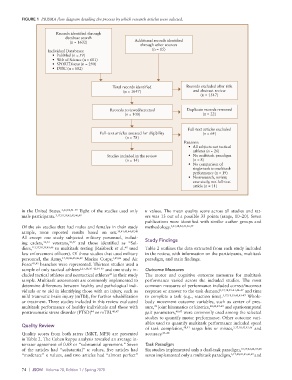
FIGURE 1  PRISMA flow diagram detailing the process by which research articles were selected.


                        Records identified through
                            database search
                              (n = 1632)                 Additional records identified
                                                           through other sources
                     Individual Databases:                      (n = 15)
                       •  PubMed (n = 59)
                       •  Web of Science (n = 601)
                       •  SPORTDiscus (n = 290)
                       •  DTIC (n = 682)


                                                Total records identified      Records excluded after title
                                                    (n = 1647)                   and abstract review
                                                                                    (n = 1547)


                                              Records reviewed/screened       Duplicate records removed
                                                     (n = 100)                       (n = 22)


                                                                               Full-text articles excluded
                                          Full-text articles assessed for eligibility  (n = 64)
                                                     (n = 78)
                                                                             Reasons:
                                                                               •  All subjects not tactical
                                                                                 athletes (n = 26)
                                             Studies included in the review    •  No multitask paradigm
                                                     (n = 14)                    (n = 8)
                                                                               •  No comparison of
                                                                                 single-task to multitask
                                                                                 performance (n = 19)
                                                                               •  Nonresearch, review,
                                                                                 case study, not full-text
                                                                                 article (n = 11)


          in the United States. 3,17,18,41–49  Eight of the studies used only   κ values. The mean quality score across all studies and rat-
          male participants. 3,17,18,39,42,45,46,49          ers was 13 out of a possible 33 points (range, 10–20). Seven
                                                             publications were identified with similar author groups and
          Of the six studies that had males and females in their study   methodology. 3,17,18,42,45,46,49
          sample, none reported results based on sex. 39,41,43,44,47,48
          All except one study subjected military personnel, includ-  Study Findings
          ing cadets, 41,43  veterans, 44,47  and those identified as “Sol-
                                                     48
          diers,” 3,17,18,39,45,46  to multitask testing (Raisbeck et al.  used   Table 2 outlines the data extracted from each study included
          law enforcement officers). Of those studies that used military   in the review, with information on the participants, multitask
          personnel, the Army, 17,18,42,45,46,49  Marine Corps, 3,45,46  and Air   paradigm, and main findings.
          Force 41,43  branches were represented. Thirteen studies used a
          sample of only tactical athletes 3,17,18,39–42,44–49  and one study in-  Outcome Measures
                                              43
          cluded tactical athletes and nontactical athletes  in their study   The motor and cognitive outcome measures for multitask
          sample. Multitask assessments are commonly implemented to   performance varied across the included studies. The most
          determine differences between healthy and pathological indi-  common measures of performance included correct/incorrect
          viduals or to aid in identifying those with an injury, such as   response or answer to the task demand 3,17,18,39–41,44–47  and time
          mild traumatic brain injury (mTBI), for further rehabilitation   to complete a task  (e.g., reaction time). 3,17,18,39,40,43–47  Whole-
          or treatment. Three studies included in this review evaluated   body movement outcome  variables, such as center of pres-
                                                                 39
          multitask performance of healthy individuals and those with   sure,  joint kinematics or kinetics, 40,42,47–49  and spatiotemporal
          posttraumatic stress disorder (PTSD)  or mTBI. 40,47  gait parameters, 40,47  were commonly used among the selected
                                       44
                                                             studies to quantify motor performance. Other outcome vari-
                                                             ables used to quantify multitask performance included speed
          Quality Review
                                                             of task completion, 40,41  target hits or misses, 3,17,18,43,45,46  and
          Quality scores from both raters (MKT, MPB) are presented   accuracy. 45–48
          in Table 2. The Cohen kappa analysis revealed an average in-
          terrater agreement of 0.68 or “substantial agreement.” Seven   Task Paradigm
          of the articles had “substantial”  κ values, five articles had   Six studies implemented only a dual-task paradigm, 18,39,42,44,47,48
          “moderate” κ values, and two articles had “almost perfect”   seven implemented only a multitask paradigm, 3,17,40,41,45,46,49  and


          74  |  JSOM   Volume 20, Edition 1 / Spring 2020

