


Page 74 - JSOM Spring 2020
P. 74
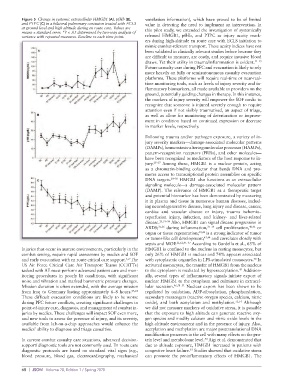
Figure 5  Change in systemic extracellular HMGB1 (A), pfHb (B),   ventilation information), which have proved to be of limited
          and PTPC (C) in a bilateral pulmonary contusion treated with ECLS   value  in  detecting the  need  to implement an  intervention.  In
          at ground level and high altitude during en route care. Values are   this pilot study, we extended the investigation of systemically
          means ± standard error. *P < .05 determined by two-way analysis of
          variance with repeated measures. Baseline vs each time point.  released HMGB1, pfHb, and PTPC as injury acuity mark-
                                                             ers during high-altitude en route care with ECLS initiation to
                                                             mimic combat-relevant transport. These acuity indices have not
                                                             been validated in clinically relevant studies before because they
                                                             are difficult to measure, are costly, and require invasive blood
                                                             draws. Yet their utility in trauma/inflammation is evident. 11–13
                                                             Future casualty care during PFC and evacuation is likely to rely
                                                             more heavily on fully or semiautonomous casualty evacuation
                                                             platforms. These platforms will require real-time or near-real-
                                                             time monitoring tools, such as levels of injury severity and in-
                                                             flammatory biomarkers, all made available to providers on the
                                                             ground, potentially guiding changes in therapy. In this instance,
                                                             the markers of injury severity will empower the SOF medic to
                                                             recognize that someone is injured severely enough to require
                                                             attention even if not visibly traumatized, an aspect of triage,
                                                             as well as allow for monitoring of deterioration or improve-
                                                             ment in condition based on continued expression or decrease
                                                             in marker levels, respectively.
                                                             Following trauma and/or pathogen exposure, a variety of in-
                                                             jury severity markers—damage-associated molecular patterns
                                                             (DAMPs), homeostasis-altering molecular processes (HAMPs),
                                                             pattern-recognition receptors (PRRs), and other molecules—
                                                             have been recognized as mediators of the host response to in-
                                                             jury. 25–27  Among these, HMGB1 is a nuclear protein, acting
                                                             as a chromatin-binding cofactor that bends DNA and pro-
                                                             motes access to transcriptional protein assemblies on specific
                                                             DNA targets. 28–30  HMGB1 also functions as an extracellular
                                                             signaling  molecule—a  damage-associated  molecular  pattern
                                                             (DAMP). The relevance of HMGB1 as a therapeutic target
                                                             and potential biomarker has been demonstrated by measuring
                                                             it in plasma and tissue in numerous human diseases, includ-
                                                             ing neurodegenerative disease, lung injury and disease, cancer,
                                                             cardiac and vascular disease or injury, trauma ischemia−
                                                             reperfusion injury, infection, and kidney- and liver-related
                                                             disease. 25,31–34  Also, HMGB1 can signal disease progression in
                                                             ARDS; 35,36  during inflammation, 37–39  cell proliferation, 40,41  or
                                                             organ or tissue regeneration; 39,42  is a strong indicator of tumor
                                                             or  tumor-like cell development; 43,44  and correlates closely with
                                                             sepsis and MOF. 11,12,45–47  According to Gardella et al., 65% of
          Injuries that occur in austere environments, particularly in the   HMGB1 is confined to the nucleus in resting monocytes, but
          combat setting, require rapid assessment by medics and SOF   only 26% of HMGB1 is nuclear and 74% appears associated
                                                                                                          48
          and early evacuation with en route critical care support.  The   with cyto plasmic organelles in LPS-stimulated monocytes.  In
                                                     1,2
          US Air Force Critical Care Air Transport Teams (CCATTs)   activated monocytes, the transfer of HMGB1 from the nucleus
                                                                                                    49
          tasked with AE must perform advanced patient care and mon-  to the cytoplasm is mediated by hyperacetylation.  Addition-
          itoring procedures in poorly lit conditions, with significant   ally, several types of inflammatory signals initiate export of
          noise and vibration and marked barometric pressure changes.   nuclear HMGB1 to the cytoplasm and culminate in extracel-
          Mission duration is often extended, with the average mission   lular secretion. 46,50–52  Nuclear export has been shown to be
          from Iraq to Germany lasting approximately 6–8 hours. 23,24    regulated by oxidation, ADP-ribosylation, phosphorylation,
          These difficult evacuation conditions are likely to be worse   secondary messengers (reactive oxygen species, calcium, nitric
          during PFC future conflicts, creating significant challenges in   oxide), and both acetylation and methylation. 53,54  Although
          point-of-injury care, diagnosis, and management of combat in-  we did not measure markers of oxidative stress, it is possible
          juries by medics. These challenges will impact SOF even more,   that the exposure to high altitude can generate reactive oxy-
          and new tools to assess the presence of injury, and its severity,   gen species and modify calcium and nitric oxide levels in the
          available from lab-on-a-chip approaches would enhance the   high-altitude environment and in the presence of injury. Also,
          medics’ ability to diagnose and triage casualties.  acetylation and methylation are major posttranslational DNA
                                                             modification processes in the cell with many effects on the pro-
                                                                                      54
          In current combat casualty care situations, advanced  decision-   tein level and metabolome level.  Aigi et al. demonstrated that
          support/ diagnostic tools are not commonly used. En route care   due to altitude exposure, HMGB1 increased in patients with
                                                                               55
          diagnostic protocols are based on standard vital signs (e.g.,   congestive heart failure.  Studies showed that oxidative stress
          blood pressure, blood gas, electrocardiography, mechanical   can  promote the  proinflammatory  effects  of HMGB1.  The

          68  |  JSOM   Volume 20, Edition 1 / Spring 2020

