


Page 89 - JSOM Spring 2020
P. 89
skills  and the  first  attempt  for vascular  access  and  REBOA   of all scoring results. The QRT-FF had significantly better scores
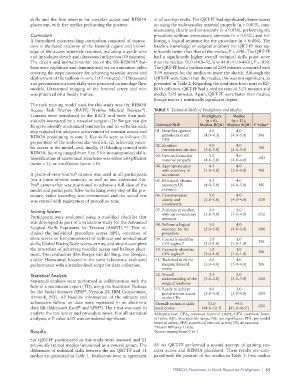
              placement, with five medics performing the posttest.  on using the endovascular material properly (n = 0.003), com-
                                                                 municating clearly and consistently (n = 0.038), performing the
              Curriculum                                         procedure without unnecessary attempts (n = 0.032), and fol-
              A formalized microteaching curriculum consisted of instruc-  lowing a logical sequence for the procedure (n = 0.006). The
              tion in the basic anatomy of the femoral region and knowl-  baseline knowledge of surgical anatomy for QRT-FF was sig-
              edge of the access materials required, including a guide wire   nificantly better than that of the medics, P = .048. The QRT-FF
              and introducer sheath and ultrasound utilization (30 minutes).   had a significantly higher overall technical skills point score
              The details and instructions for use of the ER-REBOA  bal-  than the medics: 51.0 (44.8–52.3) vs 44.0 (41.0–46.0), P = .030.
                                                         ®
              loon were explained and demonstrated via an animation video   The QRT-FF had a median time of 2:04 minutes compared with
              covering the steps necessary for achieving vascular access and   3:59 minutes for the medics to insert the sheath. Although the
              deployment of the balloon in zone I (15 minutes).  Ultrasound   QRT-FF were faster than the medics, this was not significant, as
                                                   13
              and percutaneous access skills were practiced on moulage flow   presented in Table 2. Regarding the total time from start to RE-
              models.  Ultrasound  imaging  of  the  femoral  artery  and  vein   BOA inflation, QRT-FF had a median time of 3:23 minutes and
              was practiced on a buddy trainee.                  medics 5:05 minutes. Again, QRT-FF were faster than medics,
                                                                 though not to a statistically significant degree.
              The task training model used for this study was the REBOA
              Access Task Trainer (RATT; Prytime Medical Devices ).   TABLE 1  Technical Skills of Firefighters and Medics
                                                           ™
              Trainees were introduced to the RATT and were then indi-               Firefighters   Medics
              vidually instructed by a vascular surgeon (Dr Borger van der            (n = 6),    (n = 11),
              Burg) to identify anatomical landmarks and to verbalize each   Technical Skill  Median [IQR] Median [IQR] P Value*
              step required for adequate achievement of vascular access and   01.  Identifies optimal   4.0    4.0
              REBOA positioning in zone 1. Key skills were as follows: (1)   introduction site   [4.0–4.3]  [4.0–5.0]  NS
              preparation of the endovascular tool kit, (2) achieving vascu-  CFA
              lar access in the model, and, finally, (3) bleeding control with   02.  Identifies   4.0    4.0    NS
              REBOA. Scoring ranged from 0 to 5 for nonanatomical skills.   introduction site skin  [3.8–5.0]  [4.0–5.0]
                                                                                       5.0
                                                                                                   4.0
              Identification of anatomical structures was either su0-pfficient   03.  Uses endovascular   [4.8–5.0]  [4.0–4.0]  .003
                                                                    material properly
              (score = 1), or insufficient (score = 0).
                                                                 04.  Appropriate pace   4.5       4.0
                                                                    with economy of   [3.8–5.0]  [3.0–4.0]  NS
              A point-of-view GoPro  camera was used in all participants   movement
                                ®
              (via a point-of-view camera), as well as one additional Go-  05.  Effectively obtains   4.5    4.0
              Pro  camera that was positioned to achieve a full view of the   necessary US   [4.0–5.0]  [4.0–5.0]  NS
                ®
              model and participant. After verbalizing every step of the pro-  exposure
              cedure, video recording was commenced and the actual test   06.  Communicates   5.0    4.0
              was started with registration of procedure time.      clearly and      [3.8–5.0]  [4.0–4.0]  .038
                                                                    consistently
                                                                                       5.0
                                                                                                   3.0
              Scoring System                                     07.  Performs procedure   [3.8–5.0]  [3.0–4.0]  .032
                                                                    without unnecessary
              Participants were evaluated using a modified checklist that   attempts
              was developed as part of a validation study for the Advanced
                                                                                                   4.0
                                                                                       5.0
              Surgical Skills Exposures for Trauma (ASSET). 14,15  This in-  08.  Follows a logical   [5.0–5.0]  [4.0–5.0]  .006
                                                                    sequence for the
              cluded the individual procedure scores (IPS), outcomes of   procedure
              these scores on five components of technical and nontechnical   09.  Correctly identifies   1.0    1.0
              skills, Global Rating Scale scores, errors, and time to complete   CFA sagittal †  [1.0–1.0]  [1.0–1.0]  NS
              the procedure of achieving vascular access and balloon place-  10.  Correctly identifies   1.0   1.0
              ment. Two evaluators (Drs Borger van der Burg, van Dongen,   CFV sagittal †  [1.0–1.0]  [1.0–1.0]  NS
              and/or Hoencamp) located in the same laboratory evaluated   11.  Technical skills for   4.0    4.0
              performance with a standardized script for data collection.  imaging femoral   [3.0–4.0]  [3.0–4.0]  NS
                                                                    artery
              Statistical Analysis                               12.  Overall          3.5         3.0
              Statistical analyses were performed in collaboration with the   understanding of the   [3.0–4.0]  [2.0–3.0]  .048
                                                                    surgical anatomy
              help of a statistician expert (TD), using the Statistical Package
                                                                                       4.0
                                                                                                   3.0
              for the Social Sciences (SPSS , Version 24; IBM Corporation,   13.  Ready to achieve   [3.8–4.3]  [3.0–4.0]  .024
                                    ®
                                                                    percutaneous access
              Armonk, NY). All baseline  information of the subjects  and   to the CFA
              subsequent follow up data were registered in an electronic   Overall: technical skills   51.0    44.0
              data file (Microsoft Excel  and SPSS ). The t test was used to   total points  [44.8–52.3]  [41.0–46.0]  .030
                                          ®
                                  ®
              analyze the test scores and procedure times. For all statistical   Abbreviations: CFA, common  femoral artery;  CFV, common  femo-
              analyses, a P value ≤.05 was considered significant.  ral vein; IQR, interquartile range; NS, not significant; PFA, profundal
                                                                 femoral artery; SFA, superficial femoral artery; US, ultrasound.
                                                                 *Mann-Whitney U test.
              Results                                            † Score ranging from 0 to 1.
              Six QRT-FF participated in this study were assessed and 11
              previously trained medics functioned as a control group. The   All six QRT-FF performed a second attempt of gaining vas-
              differences of technical skills between the six QRT-FF and 11   cular access and REBOA placement. These results are com-
              medics are presented in Table 1. Evaluators were in agreement   pared with the posttest of the medics in Table 3. Five medics
                                                                        TREBOA Placement in Quick Response Firefighters  |  83

