


Page 90 - JSOM Spring 2020
P. 90
performed a second attempt  at gaining vascular access and   access in unstable patients in austere environments is challeng-
          REBOA placement and were compared with the QRT-FF. All   ing for providers without a surgical skillset and should be the
          QRT-FF improved their procedure time, as were four of the   focus of further training.
          five medics (Table 4).
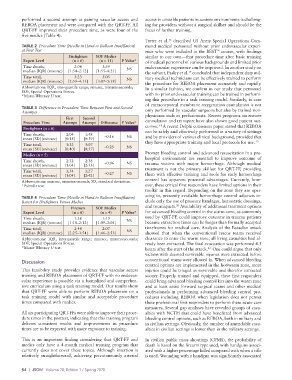
                                                             Teeter et al.  described US Army Special Operations Com-
                                                                       16
          TABLE 2  Procedure Time (Needle in Hand to Balloon Insufflation)   mand medical personnel without prior endovascular experi-
          at First Test                                      ence who were included in the BEST  course, with findings
                                                                                           ™
                             Firefighters    SOF Medics      similar to our own—that procedure time after basic training
           Expert Level        (n = 6)    (n = 11)  P Value*    of medical personnel of various backgrounds and limited prior
           Time sheath,         2:04       3:59              endovascular experience can be improved. In another study on
           median [IQR] (min:sec)  [1:54–2:12]  [1:55–4:21]  NS  the subject, Pasley et al.  concluded that independent duty mil-
                                                                               17
           Time total,          3:23       5:05      NS      itary medical technicians can be effectively trained to perform
           median [IQR] (min:sec)  [2:59–4:13]  [3:07–5:38]  the procedure for REBOA placement accurately and rapidly.
          Abbreviations: IQR, interquartile range; min:sec, minutes:seconds;   In a similar fashion, we confirm in our study that personnel
          SOF, Special Operations Forces.                    with no prior endovascular training can be trained in perform-
          *Mann-Whitney U test.
                                                             ing this procedure in a task training model. Similarly, in case
                                                             of extracorporeal membrane oxygenation cannulation is not
          TABLE 3  Difference in Procedure Time Between First and Second   only performed by vascular surgeons but also by trained non-
          Attempts                                           physicians such as perfusionists. Recent programs on remote
                            First   Second
           Procedure Time  Attempt  Attempt  Difference P Value*    cannulation and transport have also shown good patient out-
                                                                   18
           Firefighters (n = 6)                              comes.  A recent Delphi consensus paper stated that REBOA
                                                             can be safely and effectively performed in a variety of settings
           Time sheath,     2:04    1:48    –0:16    NS      and by providers of various clinical background, provided that
           mean [SD] (min:sec)  [0:18]  [0:39]               they have appropriate training and local protocols for use.  19
           Time total,      3:32    3:07
           mean [SD] (min:sec)  [0:40]  [0:57]  –0:25  NS
           Medics (n = 5)                                    Prompt bleeding control and advanced resuscitation in a pre-
                                                             hospital environment are essential to improve outcome of
           Time sheath,     2:32    2:38    +0:06    NS      trauma  victims  with  major  hemorrhage.  Although  medical
           mean [SD] (min:sec)  [1:04]  [2:33]               treatment is not the primary skillset for QRT-FF, providing
           Time total,      3:54    3:27    –0:27    NS
           mean [SD] (min:sec)  [1:04]  [2:42]               them with effective training and tools for early hemorrhage
          Abbreviations: min:sec, minutes:seconds; SD, standard deviation.  control has apparent potential advantages. Currently, how-
          *Paired t test.                                    ever, these critical first responders have limited options in their
                                                             toolkit in this regard. Depending on the zone they are oper-
                                                             ating in, presently available hemorrhage control adjuncts in-
          TABLE 4  Procedure Time (Needle in Hand to Balloon Insufflation)
          Retest for Firefighters Versus Medics              clude only the use of pressure bandages, hemostatic dressings,
                                                                          20
                              Firemen    SOF Medics          and tourniquets.  Availability of additional treatment options
           Expert Level        (n = 6)     (n = 4)  P Value*  for advanced bleeding control in the warm zone, as commonly
           Time sheath,         1:38       1:19      NS      used by QRT-FF, could improve outcome in trauma patients
           median [IQR] (mm:sec)  [1:18–2:12]  [1:09–2:04]   because extraction times can be longer than formally accepted
           Time total,          2:44       2:07              timeframes for medical care. Analysis of the Bataclan attack
           median [IQR] (mm:sec)  [2:25–3:54]  [1:46–2:53]  NS  showed that when the conventional rescue teams received
          Abbreviations: IQR, interquartile range; mm:sec, minutes:seconds;   clearance to enter the warm zone, all living casualties had al-
          SOF, Special Operations Forces.                    ready been extracted. The final evacuation was performed 4.5
          *Mann-Whitney U test.                              hours after the start of the attack.  One could argue that only
                                                                                       4,5
                                                             victims with deemed survivable injuries were extracted before
                                                             conventional teams were allowed in. When advanced bleeding
          Discussion
                                                             control options are implemented in the hot/warm zone, more
          This feasibility study provides evidence that vascular access   injuries could be triaged as survivable and therefor extracted
          training and REBOA placement of QRT-FF with no endovas-  sooner. Properly trained and equipped, these first responders
          cular experience is possible via a formalized and comprehen-  could bring advanced bleeding control kits into the warm zone
          sive curriculum using a task training model. Our results show   and at least assist forward surgical teams and other medical
          that QRT-FF were able to perform REBOA placement on a   professionals in performing advanced bleeding control pro-
          task training model with similar and acceptable procedure   cedures including REBOA when legislation does not permit
          times compared with medics.                        these professional first responders to perform these acute care
                                                             measures. Several gap analyses have revealed groups of casu-
          All six participating QRT-FFs were able to improve their proce-  alties with NCTH that could have benefitted from advanced
          dure times in the posttest, indicating that this training program   bleeding control options, such as REBOA, both in military and
          delivers consistent results and improvements in procedure   in civilian settings. Obviously, the number of amendable casu-
          times are to be expected with more exposure to training.  alties in civilian settings is lower than in the military settings.

          This is an important finding considering that QRT-FF and   In civilian public mass shootings (CPMS), the probability of
          medics only have a 4-month medical training program that   death is based on the firearm type used, with handguns associ-
          currently does not cover these topics. Although insertion is   ated with a higher percentage killed compared with when a rifle
          relatively  straightforward,  achieving  percutaneously  arterial   is used. Wounding with a handgun was significantly associated


          84  |  JSOM   Volume 20, Edition 1 / Spring 2020

