


Page 94 - JSOM Spring 2020
P. 94
Methods                                            Results
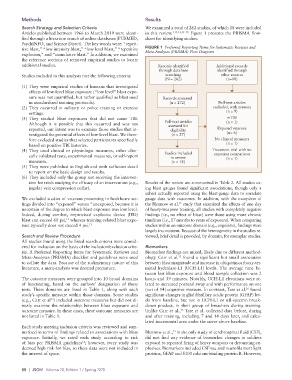
          Search Strategy and Selection Criteria             We examined a total of 262 studies, of which 18 were included
          Articles published between 1966 to March 2019 were identi-  in this review. 1,12,13,15–29  Figure 1 presents the PRISMA flow-
          fied through a literature search of online databases (PUBMED,   chart for identifying studies.
          PsychINFO, and Science Direct). The key words were: “repeti-
          tive blast,” “low intensity blast,” “low level blast,” “repetitive   FIGURE 1  Preferred Reporting Items for Systematic Reviews and
          explosion,” and “cumulative blast.” In addition, we examined   Meta-Analyses (PRISMA) Flow Diagram
          the reference sections of retrieved empirical studies to locate
          additional studies.                                     Records identified      Additional records
                                                                   through database        identified through
          Studies included in this analysis met the following criteria:  searching          other sources
                                                                     (N = 262)                (n=10)
          (1)  They were empirical studies of humans that investigated
             effects of low-level blast exposure (“low level” blast expo-
             sure was not quantified, but rather qualified as blast used   Records screened
             in standardized training protocols).                      (n = 272)           Full-text articles
          (2)  They occurred in military or police training or exercise                  excluded, with reasons
             settings.                                                                        (n = 9)
          (3)  They studied blast exposures that did not cause TBI.                            mTBI
             Although it is possible that this occurred and was not   Full-text articles      (n = 1)
                                                                       assessed for
             reported, our intent was to examine those studies that in-  eligibility       Exposed veterans
             vestigated the potential effects of low-level blast. We there-  (n = 27)          (n= 6)
             fore excluded studies that selected participants specifically                No clinical measures
             based on positive TBI histories.                                                 (n = 1)
          (4)  They used clinical or physiologic measures, either clini-  Studies included    Treatment trial with no
             cally validated tests, experimental measures, or self-report   in review    exposure comparison
                                                                                              (n = 1)
             measures.                                                  (n = 18)
          (5)  They were published in English and with sufficient detail
             to report on the basic design and results.
          (6)  They included only the group not receiving the interven-
             tion for trials studying the efficacy of an intervention (e.g.,   Results of the review are summarized in Table 2. All studies us-
             jugular vein compression collar).               ing blast gauges found significant associations, though only a
                                                             subset actually reported using the blast-gauge data to correlate
          We excluded studies of veterans presenting in healthcare set-  gauge data with outcomes. In addition, with the exception of
          tings divided into “exposed” versus “unexposed, because it is   the Blennow et al.  study that examined the effects of one day
                                                                           15
          uncertain of the degree to which blast exposure was low level.   of heavy-weapons training, all studies with completely negative
          Indeed, during combat, improvised explosive device (IED)   findings (i.e., no effect of blast) were those using more chronic
          blast can exceed 60 psi,  whereas training-related blast expo-  timelines (i.e., 17 months to years of exposure). When comparing
                            11
          sure typically does not exceed 4 psi. 12           studies within an outcome domain (e.g., cognitive), findings were
                                                             largely inconsistent. Because of the heterogeneity in the studies re-
          Search and Review Procedure                        viewed, brief detail is provided, by domain, for exemplar studies.
          All studies found using the listed search criteria were consid-
          ered for inclusion on the basis of the inclusion/exclusion crite-  Biomarkers
          ria. A Preferred Reporting Items for Systematic Reviews and   Biomarker findings are mixed, likely due to different method-
                                                                           13
          Meta-Analyses (PRISMA) checklist and guidelines were used   ology. Carr et al.  found a significant but small association
          to collate the data. Because of the rudimentary nature of this   between blast magnitude and increase in ubiquitin carboxy-ter-
          literature, a meta-analysis was deemed premature.  minal hydrolase-L1 (UCH-L1) levels. The average time be-
                                                             tween last blast exposure and blood sample collection was 2
          The outcome measures were grouped into 10 broad domains   hours and 39 minutes. Notably, UCH-L1 elevations were re-
          of functioning, based on the authors’ designation of those   lated to increased postural sway and with performance on one
                                                                                                       16
          tests. These domains are listed in Table 1, along with each   (out of 14) cognitive measure. In contrast, Tate et al.  found
          study’s specific measure within those domains. Some studies   significant changes in glial fibrillary acidic protein (GFAP) lev-
          (e.g., Carr et al ) included outcome measures but did not di-  els from baseline, but not in UCH-L1 or αII- spectrin break-
                      13
          rectly examine the relationship between blast exposure and   down product, in their group of breachers during training.
                                                                            13
          outcome measure. In these cases, these outcome measures are   Unlike Carr et al.,  Tate et al. collected data before, during
          not listed in Table 1.                             and after training, including 7 and 14 days later, and calcu-
                                                             lated incremental area under the curve above baseline.
          Each study meeting inclusion criteria was reviewed and sum-
                                                                        15
          marized in terms of findings related to associations with blast   Blennow et al.,  in the only study of cerebrospinal fluid (CSF),
          exposure. Initially, we rated each study according to risk   did not find any evidence of biomarker changes in soldiers
                                   14
          of bias per PRISMA guidelines ; however, every study was   exposed to repeated firing of heavy weapons or detonating ex-
          deemed high risk for bias, so these data were not included in   plosives. Biomarkers included CSF tau and neurofilament light
          the interest of space.                             proteins, GFAP and S100 calcium-binding protein B. However,


          88  |  JSOM   Volume 20, Edition 1 / Spring 2020

