


Page 74 - JSOM Winter 2018
P. 74
A point-of-view GoPro  camera (https://gopro.com/) was used   physicians, as shown in Table 2. Regarding the total time from
                            ®
          in all participants (via a helmet camera), as well as one ad-  start to REBOA inflation, medics had a median time of 5:05
          ditional GoPro  camera that was positioned to achieve a full   minutes; nurses, 4:06; military physicians, 3:36; and surgeons,
                      ®
          view of the model and participant. After verbalization of each   2:36. Again, surgeons were significantly faster than medics
          step of the procedure, video recording was commenced and the   and nurses (P = .013 resp. 0.034) but not significantly faster
          actual test was started with registration of procedure time.  than physicians (Table 2).

          Scoring system                                     Six SOF medics performed a second attempt at gaining vas-
          Participants were evaluated using a modified checklist that   cular access and REBOA placement. One participant was ex-
          was developed as part of a validation study for the Advanced   cluded due to technical failure of the RATT. The remaining
          Surgical Skills Exposures for Trauma (ASSET).  This in-  five participants were not significantly faster or slower the
                                                 7,8
          cluded the individual procedure scores (IPS), outcomes of   second time (Table 3). When the only participant who expe-
          these scores on five components of technical and nontechnical   rienced difficulties in operating the RATT was excluded, the
          skills, Global Rating Scale scores, errors, and time to complete   remaining four participants showed a near significant decrease
          the procedure of achieving vascular access and balloon place-  of 64 seconds in sheath insertion time and a significant de-
          ment. Two evaluators (BBB, TD, and/or RH) located in the   crease of 96 seconds in the total time (Table 3).
          same laboratory evaluated performance with a standardized
          script for data collection. For the military surgeons only, the   Discussion
          total procedure time was scored.
                                                             This feasibility study provides evidence that training for
          Statistical analysis                                 REBOA placement by military nonmedical personnel with no
          Statistical analyses were performed in collaboration with the   endovascular experience is possible using a formalized and
          help of a statistician expert, using the Statistical Package for   comprehensive  curriculum  that  includes  basic  anatomy  of
          the Social Sciences (SPSS , Version 24, IBM Corporation, Ar-  the femoral region and basic training in endovascular access
                             ®
          monk, NY). All baseline information of the subjects and sub-  materials with the use of a task training model. Our results
          sequent follow-up data were registered in an electronic data   show that SOF medics and medical personnel (nurses and non-
          file (Microsoft Excel  and SPSS ). The t-test was used to ana-  surgeon physicians) with limited or no endovascular or ultra-
                                  ®
                          ®
          lyze the test scores and procedure times. For all statistical anal-  sound experience were able to perform REBOA placement on
          yses, a value of P ≤ .05 was considered statistically significant.  a task training model with acceptable procedure times after
                                                             a curriculum of 30 minutes. Shoji et al. show that the use of
                                                               REBOA is easy and safe for trained emergency physicians.
                                                                                                            9
          Results
                                                             This is an important finding considering that SOF medics have
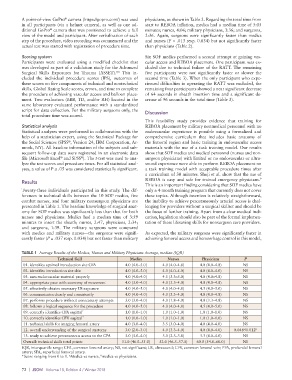
          Twenty-three individuals participated in this study. The dif-  only a 4-month training program that currently does not cover
          ferences in technical skills between the 10 SOF medics, five   these topics. Although insertion is relatively straightforward,
          combat nurses, and four military nonsurgeon physicians are   the inability to achieve percutaneously arterial access is chal-
          presented in Table 1. The baseline knowledge of surgical anat-  lenging for providers without a surgical skillset and should be
          omy for SOF medics was significantly less than that for both   the focus of further training. Apart from a clear medical indi-
          nurses and physicians. Medics had a median time of 3:59   cation, legislation should also be part of the formal implemen-
          minutes to insert the sheath; nurses, 2:47, physicians, 2:34;   tation of these lifesaving skills for nonsurgeon care providers.
          and  surgeons, 1:39.  The  military  surgeons were  compared
          with medics and military nurses—the surgeons were signifi-  As expected, the military surgeons were significantly faster in
          cantly faster (P = .037 resp. 0.034) but not faster than military   achieving femoral access and hemorrhage control in this model,

          TABLE 1  Average Results of the Medics, Nurses and Military Physicians Average, median (IQR)
                         Technical Skill               Medics         Nurses        Physicians        P
           01. identifies optimal introduction site CFA  4.0 (4.0–5.0)  4.0 (4.0–4.8)  4.0 (4.0–4.8)  NS
           02. identifies introduction site skin     4.0 (4.0–5.0)  4.0 (4.0–4.0)   4.0 (4.0–4.0)    NS
           03. uses endovascular material properly   4.0 (4.0–4.0)  4.5 (3.3–5.0)   4.0 (4.0–4.8)    NS
           04. appropriate pace with economy of movement  4.0 (3.0–4.0)  4.0 (3.3–4.0)  4.0 (4.0–4.8)  NS
           05. effectively obtains necessary US exposure  4.0 (4.0–5.0)  4.0 (4.0–4.8)  4.5 (4.0–5.0)  NS
           06. communicates clearly and consistently  4.0 (4.0–4.0)  4.0 (3.3–4.0)  4.0 (4.0–4.8)    NS
           07. performs procedure without unnecessary attempts  3.0 (3.0–4.0)  4.0 (1.8–4.0)  4.0 (3.3–4.8)  NS
           08. follows a logical sequence for the procedure  4.0 (4.0–5.0)  4.0 (4.0–4.8)  4.5 (4.0–5.0)  NS
           09. correctly identifies CFA sagittal *   1.0 (1.0–1.0)  1.0 (1.0–1.0)   1.0 (1.0–1.0)    NS
           10. correctly identifies CFV sagittal *   1.0 (1.0–1.0)  1.0 (1.0–1.0)   1.0 (1.0–1.0)    NS
           11. technical skills for imaging femoral artery  4.0 (3.0–4.0)  3.5 (3.0–4.0)  4.0 (4.0–4.0)  NS
           12. overall understanding of the surgical anatomy  3.0 (2.0–3.0)  4.0 (3.3–4.0)  4.0 (4.0–4.0)  0.048 /0.012 b
                                                                                                      a
           13. ready to achieve percutaneous access to the CFA  3.0 (3.0–4.0)  3.0 (2.3–3.8)  3.3 (4.0–4.0)  NS
           Overall: technical skills total points  51.0 (46.0–55.0)  52.0 (46.5–57.5)  60.0 (54.0–60.0)  NS
          IQR, interquartile range; CFA, common femoral artery; NS, not significant; US, ultrasound; CFV, common femoral vein; PFA, profundal femoral
          artery; SFA, superficial femoral artery.
          *Score ranging from 0 to 1.  Medics vs nurses,  medics vs physicians.
                              a
                                           b
          72  |  JSOM   Volume 18, Edition 4 / Winter 2018

