


Page 79 - JSOM Winter 2018
P. 79
(1) thinking power, (2) personal effectiveness, (3) interpersonal   The group was divided into summiteers and nonsummiteers
              effectiveness, (4) working approach, and (5) management. Sec-  retrospectively. Besides hemoglobin (9.1 [0.4] versus 9.6 [0.2];
              ond, soft skills were judged on experiences gained during visits   p < .05) and hematocrit (42.6 [1.4] versus 45.1 [0.9]; p < .01)
              or prior experience in extreme team projects. Third, technical   values of summiteers and nonsummiteers, respectively, there
              skills were assessed during a project performed a year earlier,   were no differences between the groups in physical competen-
              the Alps project 2015. Fourth, the physical fitness of the se-  cies (Table 3). One climber consulted the expedition doctor
              lected members was judged during the Alps project 2015 and   with symptoms related to his medical history (an episode of
              also objectified by an incremental cycling test.   recurrent migraine; Figure 2).

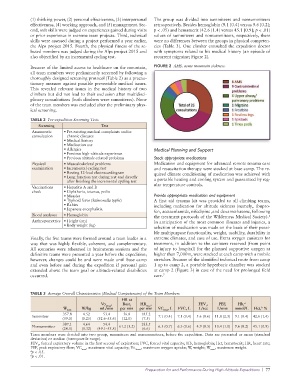
              Because of the limited access to healthcare on the mountain,   FIGURE 2  AMS, acute mountain sickness.
              all team members were preliminarily screened by following a
              thoroughly designed screening protocol (Table 2) as a precau-
              tionary measure against possible preventable medical issues.
              This revealed relevant issues in the medical history of two
              climbers but did not lead to their exclusion after multidisci-
              plinary consultations (both climbers were summiteers). None
              of the team members was excluded after the preliminary phys-
              ical screening.
              TABLE 2  Pre-expedition Screening Tests
                 Screening                 Test
              Anamnestic   • Pre-existing medical complaints and/or
              consultation   chronic diseases
                           • Medical history
                           • Medication use
                           • Allergies                           Medical Planning and Support
                           • Previous high-altitude experience
                           • Previous altitude-related problems  Stock appropriate medications
              Physical     • Musculoskeletal problems            Medication and equipment for advanced remote trauma care
              examination  • Incremental cycling test            and resuscitation therapy were stocked at base camp. The re-
                           • Resting 12-lead electrocardiogram   quired climate conditioning of medication was achieved with
                           • Lung function test during rest and directly   a portable heating and cooling system and guaranteed by reg-
                             after finishing the incremental cycling test
              Vaccinations   • Hepatitis A and B                 ular temperature controls.
              check        • Diphtheria, tetanus, polio
                           • Measles                             Provide appropriate medication and equipment
                           • Typhoid fever (Salmonella typhi)    A first aid trauma kit was provided to all climbing teams,
                           • Rabies                              including medication for altitude sickness (namely,. ibupro-
                           • Japanese encephalitis.              fen, acetazolamide, nifedipine ,and dexamethasone, following
              Blood analyses  • Hemoglobin                       the treatment protocols of the Wilderness Medical Society).
                                                                                                                6
              Anthropometrics • Height (cm)                      In anticipation of the most common illnesses and injuries, a
                           • Body weight (kg)                    selection of medication was made on the basis of their possi-
                                                                 ble multipurpose functionality, weight, usability, durability in
              Finally, the five teams were formed around a team leader in a   extreme climates, and ease of use. Extra oxygen canisters for
              way that was highly flexible, coherent, and complementary.   treatment, in addition to the canisters reserved (from point
              All scenarios were rehearsed in brainstorm sessions and the   of injury to hospital) for the planned supportive oxygen at
              definitive teams were presented a year before the expedition;   higher than 7,000m, were stocked at each camp with a mobile
              however, changes could be and were made until base camp   stretcher. Because of the identified technical route from camp
              and even before and during the expedition if personal gain   1 up to camp 2, a portable hyperbaric chamber was stocked
              extended above the team goal or altitude-related disabilities   at camp 2 (Figure 3) in case of the need for prolonged field
              occurred.                                          care. 7


              TABLE 3  Average Overall Characteristics (Medical Competencies) of the Team Members
                                                   HR at
                                                                                                      a
                                           Vo 2max ,  Rest,    HR max ,            FEV ,    PEF,    Hb,
                                                                                      1
                                   W/kg   mL/min   per min  per min  VC max , L  FVC, L  L/sec  L/min  mmol/L  Hct,  %
                                                                                                             b
                           W max
                           357.8   4.52     53.4    56.8   185.2
              Summiteer                                           7.1 (0.4)  7.1 (0.4)  5.6 (0.6)  11.8 (2.3)  9.1 (0.4)  42.6 (1.4)
                           (39.3)  (0.25)  (52.6–55.6)  (12.0)  (7.3)
                           387.1   4.64     54.4           183.5
              Nonsummiteer                        61.2 (5.2)      6.5 (0.7)  6.3 (0.6)  4.9 (0.5)  10.4 (1.0)  9.6 (0.2)  45.1 (0.9)
                           (24.0)  (0.32)  (49.1–55.8)      (6.6)
              Team members were divided into two group, summiteers and nonsummiteers, before the expedition. Data are presented as mean (standard
              deviation) or median (interquartile range).
              FEV , forced expiratory volume in the first second of expiration; FVC, forced vital capacity; Hb, hemoglobin; Hct, hematocrit; HR, heart rate;
                 1
              PEF, peak expiratory flow; VC max , maximum vital capacity; Vo 2max , maximum oxygen uptake; W, weight; W max , maximum weight.
              a p < .05.
              b p < .01.
                                                             Preparation for and Performance During High-Altitude Expeditions  |  77

