


Page 80 - JSOM Winter 2018
P. 80
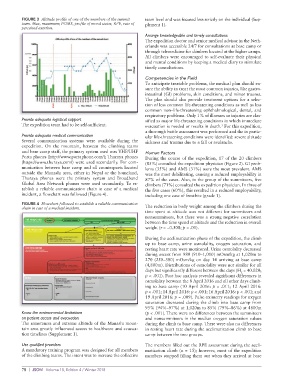
FIGURE 3  Altitude profile of one of the members of the summit   team level and was focused less strictly on the individual (Sup-
          team. Max, maximum; POMS, profile of mood states; RPE, rate of   plement 1).
          perceived exertion.
                                                             Arrange knowledgeable and timely consultations
                                                             The expedition doctor and senior medical advisor in the Neth-
                                                             erlands was accessible 24/7 for consultations at base camp or
                                                             through telemedicine for climbers located at the higher camps.
                                                             All climbers were encouraged to self-evaluate their physical
                                                             and mental conditions by keeping a medical diary to stimulate
                                                             timely consultations.

                                                             Competencies in the Field
                                                             To anticipate treatable problems, the medical plan should en-
                                                             sure the ability to treat the most common injuries, like gastro-
                                                             intestinal (GI) problems, skin conditions, and minor trauma.
                                                             The plan should also provide treatment options for a selec-
                                                             tion of less common life-threatening conditions as well as less
                                                             common non–life-threatening ophthalmological, dental, and
                                                             respiratory problems. Only 1% of illnesses or injuries are clas-
          Provide adequate logistical support                sified as major life-threatening conditions in which immediate
          The expedition team had to be self-sufficient.     evacuation is needed or results in death.  For this expedition,
                                                                                            3
                                                             a thorough battle assessment was performed and the in partic-
          Provide adequate medical communication             ular life-threatening conditions were identified: severe altitude
          Several communication systems were available during the   sickness and trauma due to a fall or avalanche.
          expedition. On the mountain, between the climbing teams
          and base camp staff, the primary system used was VHF/UHF   Human Factors
          Porta phones (http://www.portaphone.com/); Thuraya phones   During the course  of the expedition,  17 of the 20 climbers
          (https://www.thuraya.com/) were used secondarily. For com-  (85%) consulted the expedition physician (Figure 2). GI prob-
          munication between base camp and all counterparts located   lems (35%) and AMS (31%) were the most prevalent. AMS
          outside the Manaslu area, either in Nepal or the homeland,   was the most debilitating, causing a reduced employability in
          Thuraya phones were the primary system and Broadband   87% of the cases. Also, in the group of the summiteers, five
          Global Area Network phones were used secondarily. To es-  climbers (71%) consulted the expedition physician. In three of
          tablish a reliable communication chain in case of a medical   the five cases (60%), this resulted in a reduced employability,
          incident, a flowchart was followed (Figure 4).     including one case of frostbite (grade 1).

          FIGURE 4  Flowchart followed to establish a reliable communication   The reduction in body weight among the climbers during the
          chain in case of a medical incident.
                                                             time spent at altitude was not different for summiteers and
                                                             nonsummiteers,  but  there  was a strong  negative  correlation
                                                             between the time spend at altitude and the reduction in overall
                                                             weight (r = −0.508; p < .01).

                                                             During the acclimatization phase of the expedition, the climb
                                                             up to base camp, urine osmolality, oxygen saturation, and
                                                             resting heart rate were monitored. Urine osmolality decreased
                                                             during ascent from 980 (910–1,010) mOsm/kg at 1,020m to
                                                             270 (250–380) mOsm/kg on day 14 arriving at base camp
                                                             (4,800m). Distributions of osmolality were not similar for all
                                                             days but significantly different between the days (H  = 40.020;
                                                                                                     5
                                                             p < .001). Post hoc analysis revealed significant differences in
                                                             osmolality between the 8 April 2016 and all other days climb-
                                                             ing to base camp (10 April 2016: p = .011; 12 April 2016:
                                                             p < .001; 14 April 2016: p < .001; 16 April 2016: p < .001; and
                                                             19 April 2016: p = .009). Pulse oximetry readings for oxygen
                                                             saturation decreased during the climb into base camp from
                                                             95% (94%–97%) at 1,020m to 85% (79%–86%) at 4800m
          Know the environmental limitations                 (p < .001). There were no differences between the summiteers
          on patient access and evacuation                   and nonsummiteers in the median oxygen saturation values
          The remoteness and extreme altitude of the Manaslu moun-  during the climb to base camp. There were also no differences
          tain area greatly influenced access to healthcare and evacua-  in resting heart rate during the acclimatization climb to base
          tion timelines (Supplement 1).                     camp between the two groups.

          Use qualified providers                            The members filled out the RPE assessment during the accli-
          A mandatory training program was designed for all members   matization climb (n = 15); however, most of the expedition
          of the climbing teams. The intent was to increase the collective   members stopped filling them out when they arrived at base


          78  |  JSOM   Volume 18, Edition 4 / Winter 2018

