


Page 85 - JSOM Winter 2018
P. 85
and remove casualties from the warm zone for transport. The   Methods
              RTF concept uses a primary contact team of law enforcement
              officers to clear an area and downgrade that area from a hot   After review and approval by the institutional review board at
              zone to a warm zone. A secondary combined team comprising   East Carolina University Brody School of Medicine, an anon-
              law enforcement and EMS (the RTF) then enters the warm   ymous voluntary survey was distributed to participants at EM
              zone. The law enforcement component of the team provides   Today, a statewide, educational EMS conference held annu-
              cover and protection for the EMS portion of the team to   ally in North Carolina. To attract EMS professionals from the
              quickly assess, treat, and remove patients from the warm zone.  entire state, the conference is located in Greensboro, North
                                                                 Carolina, which is centrally located. Attendees are primarily
              To clarify, the RTF does not use tactical paramedics embed-  EMS field providers at all levels, but training officers and ad-
              ded with the initial law enforcement or Special Operations and   ministrators are not excluded.
              Tactical Team (SWAT) that enters a hot zone. The RTF con-
              sists of EMS personnel, not tactical paramedics, and thus does   After a review of the literature, the survey tool was developed
              not regularly train together with law enforcement or SWAT.   by the authors of the current study, who are experts in the field
              Instead, the RTF enters the warm zone only after the first wave   of emergency medicine and EMS, and have a combined expe-
              of law enforcement has somewhat secured the scene. By de-  rience of over 70 years. The closed-ended paper survey con-
              ploying EMS early in an active shooter incident, critical medi-  sisted of an introductory active shooter scenario, six simple
              cal interventions can be provided in a more timely manner and   closed-ended (i.e., yes or no) questions regarding their willing-
              thus prevent unnecessary loss of life.             ness to respond, and a short demographics section (Table 1).
                                                                 We purposefully decided  not to specify  the type or level  of
              In 2013, an expert panel convened in Hartford, Connecticut,   ballistic gear in the survey, because of the many different types
              to help address the medical care provided during an active   and levels of ballistic gear available.
              shooter incident, broaden the message, and engage the Amer-
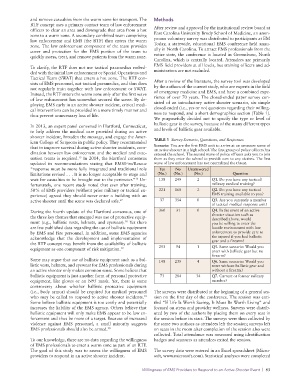
              ican College of Surgeons in public policy. They recommended   TABLE 1  Survey Scenario, Questions, and Responses
              that to improve survival during active shooter incidents, coor-  Scenario: You are the first EMS unit to arrive at an unsecure scene of
              dination between law enforcement and the medical and evac-  an active shooter in a high school. The first group of police officers has
                                                                 entered the school. The second wave of police officers asks you to join
              uation teams is required.  In 2014, the Hartford consensus   them as they enter the school to provide care to any victims. The first
                                  15
              updated its recommendations stating that EMS/Fire/Rescue   wave of law enforcement has not neutralized the threat.
              “response must be more fully integrated and traditional role   Yes   No   Unanswered
              limitations revised . . . It is no longer acceptable to stage and   (No.)  (No.)  (No.)  Question
              wait for casualties to be brought out to the perimeter.”  Un-  138  249  2  Q1. Do you have any tactical/
                                                         16
              fortunately, one recent study noted that even after training,             military medical training?
              50% of EMS providers (without prior military or tactical ex-  221  168  2  Q2. Do you have any tactical
              perience) agreed they should never enter a building with an               EMS training available to you?
              active shooter until the scene was declared safe. 17  37   354      0     Q3. Are you currently a member
                                                                                        of tactical medical response unit?
              During the fourth update of the Hartford consensus, one of   360  31  0   Q4. In the event of an active
              the three key themes that emerged was use of protective equip-            shooter situation such as
                                                                                        described above, would
              ment (e.g., ballistic vests, helmets, and eyewear).  Yet there            you be willing to enter the
                                                     18
              are few published data regarding the use of ballistic equipment           hostile environment with law
              by EMS and Fire personnel. In addition, some EMS agencies                 enforcement to provide care to
              acknowledge that the development and implementation of                    the injured if you had ballistic
              the RTF concept may benefit from the availability of ballistic            gear and a firearm?
              equipment as one component of risk mitigation. 19    293    94      1     Q5. Same scenario: Would you
                                                                                        enter with ballistic gear but no
                                                                                        firearm?
              Some may argue that use of ballistic equipment such as a bal-  148  239  4  Q6. Same scenario: Would you
              listic vests, helmets, and eyewear for EMS professionals during           enter without ballistic gear and
              an active shooter only makes common sense. Some believe that              without a firearm?
              ballistic equipment is just another form of personal protective   73  284  34  Q7. Current or former military
              equipment,  like  gloves  or  an  N95  mask.  Yet,  there  is  some       member?
              controversy about whether ballistic protective equipment
              (i.e., body armor) should be required for medical personnel   The surveys were distributed at the beginning of a general ses-
              who may be called to respond to active shooter incidents.    sion on the first day of the conference. The session was enti-
                                                            19
              Some believe ballistic equipment is too costly and potentially   tled “If Life Is Worth Saving, It Must Be Worth Living” and
              increases the liability of the EMS agency. Others believe that   focused on stress and provider wellness. Surveys were distrib-
              ballistic equipment will only make EMS appear to be law en-  uted by two of the authors by placing them on every seat in
              forcement and thus be more of a target. Because of increased   the session before its start. The surveys were then collected by
              violence against EMS personnel, a small minority suggests   the same two authors as attendees left the session; surveys left
              EMS professionals should also be armed. 20         on seats in the room after completion of the session also were
                                                                 collected. Total attendance was measured using identification
              To our knowledge, there are no data regarding the willingness   badges and scanners as attendees exited the session.
              of EMS professionals to enter a warm zone as part of an RTF.
              The goal of this study was to assess the willingness of EMS   The survey data were entered in an Excel spreadsheet (Micro-
              providers to respond in an active shooter incident.  soft, www.microsoft.com). Statistical analyses were completed

                                                            Willingness of EMS Providers to Respond to an Active Shooter Event  |  83

