


Page 69 - JSOM Winter 2018
P. 69
findings of this study, it appears that Operators exposed to the
                                                                 THOR3 program may have a greater opportunity for success
                                                                 when engaging targets under physical and psychological du-
                                                                 ress. This fills a significant gap in the current literature; to our
              FIGURE 4                                           knowledge, this is the first study to investigate the relationship
              Comparison                                         between stress shooting and participation in a human perfor-
              of positive
              identification                                     mance training and education program in the SOF community.
              time (PID)
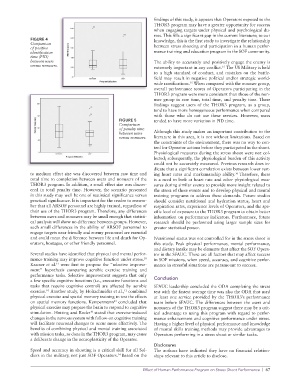
              between users                                      The ability to accurately and positively engage the enemy is
              versus nonusers.                                   extremely important in any conflict.  The US Military is held
                                                                                             15
                                                                 to a high standard of conduct, and mistakes on the battle-
                                                                 field may result in negative political and/or strategic world-
                                                                 wide ramifications.  When compared with the nonuser group,
                                                                               15
                                                                 overall performance scores of Operators participating in the
                                                                 THOR3 program were more consistent than those of the non-
                                                                 user group in raw time, total time, and penalty time. These
                                                                 findings suggest users of the THOR3 program, as a group,
                                                                 tend to have more homogeneous performance when compared
                                                                 with those who do not use these services. However, users
                                                  FIGURE 5       tended to have more variation in PID time.
                                                  Comparison
                                                  of penalty time   Although this study makes an important contribution to the
                                                  between users
                                                  versus nonusers.  literature in this area, it is not without limitations. Based on
                                                                 the constraints of the environment, there was no way to con-
                                                                 trol for Operator actions before they participated in the shoot.
                                                                 Physiological measures during the stress shoot were not col-
                                                                 lected; subsequently, the physiological burden of this activity
                                                                 could not be accurately measured. Previous research does in-
                                                                 dicate that a significant correlation exists between lower rest-
              to medium effect size was discovered between raw time and   ing heart rates and marksmanship ability. Therefore, there
                                                                                                  16
              total time to completion between users and nonusers of the   is a need to look at heart rate and other physiological mea-
              THOR3 program. In addition, a small effect size was discov-  sures during similar events to provide more insight related to
              ered  in  total  penalty  time.  However,  the  scenario  presented   the stress of these events and to develop physical and mental
              in this study may well be one of statistical significance versus   training programs to address these demands. Future studies
              practical significance. It is important for the reader to remem-  should consider nutritional and hydration status, heart and
              ber that all ARSOF personnel are highly trained, regardless of   respiration rates, experience levels of Operators, and the spe-
              their use of the THOR3 program. Therefore, any differences   cific level of exposure to the THOR3 program to obtain better
              between users and nonusers may be small enough that statisti-  information on performance indicators. Furthermore, future
              cal analysis will show no difference between groups. However,   research should be performed using larger sample sizes for
              such small differences in the ability of ARSOF personnel to   greater statistical power.
              engage targets near friendly and enemy personnel are essential
              and could mean the difference between life and death for Op-  Nutritional status was not controlled for in the stress shoot in
              erators, hostages, or other friendly personnel.    this  study.  Peak  physical  performance,  mental  performance,
                                                                 and dietary intake may be elements that affect the SOF Opera-
              Several studies have identified that physical and mental perfor-  tor in the SFAUC. These are all factors that may affect success
              mance training may improve cognitive function under stress. 10   in SOF missions, when speed, accuracy, and cognitive perfor-
              Kramer et al.  were first to propose the “selective improve-  mance in stressful situations are paramount to success.
                        11
              ment” hypothesis comparing aerobic exercise training and
              performance tasks. Selective improvement suggests that only
              a few specific cognitive functions (i.e., executive functions and   Conclusion
              tasks that require cognitive control) are affected by aerobic   SFAUC leadership concluded the ODA completing the stress
              exercise.  Another study, by Holzschneider et al.,  combined   test with the fastest average time was also the ODA that used
                                                    12
                    10
              physical exercise and spatial memory training to test the effects   at least one service provided by the THOR3’s performance
              on spatial memory functions. Kempermann  concluded that   team before SFAUC. The differences between the users and
                                                13
              physical exercise may prepare the brain to respond to cognitive   nonusers of the THOR3 program suggest there may be a crit-
              stimulation. Hotting and Roder  stated that exercise-induced   ical advantage to using this program with regard to perfor-
                                      10
              changes in the nervous system with follow-on cognitive training   mance enhancement and cognitive performance under stress.
              will facilitate neuronal changes to occur more effectively. The   Having a higher level of physical performance and knowledge
              benefits of combining physical and mental training associated   of mental skills training methods may provide advantages to
              with mission tasks, as done in the THOR3 program, may cause   Operators performing in a stress shoot or similar tasks.
              a deliberate change in the neuroplasticity of the Operator.
                                                                 Disclosures
              Speed and accuracy in shooting is a critical skill for all Sol-  The authors have indicated they have no financial relation-
              diers in the military, not just SOF Operators. Based on the   ships relevant to this article to disclose.
                                                  14
                                                            Effect of Human Performance Program on Stress Shoot Performance  |  67

