


Page 67 - JSOM Winter 2018
P. 67
THOR3 program, funded via The Preservation of the Force   archival nature of this analysis, the institutional ethics com-
              and Family, comprises subject matter experts in the fields of   mittee approved the use of retrospective nonidentifiable data.
              strength and conditioning, performance nutrition, mental per-  The Special Forces Group and the Army Human Research
              formance, athletic training, physical therapy, and performance   Protections Office gave permission to conduct this investiga-
              analytics.  For the Special Forces groups, initial priority for   tion. Furthermore, this research followed procedures in accor-
                     4,5
              support was to the Operational Detachment Alpha (ODA),   dance with the ethical standard of the Helsinki Declaration for
              but this later changed to encompass all assigned personnel   human subjects.
              within ARSOF, with priority given to the ODA. 4
                                                                 SFAUC stress shoot procedures
              At the request of USASOC, Kelly et al.  conducted a study to   The overall purpose of the SFAUC stress shoot was to evaluate
                                            6
              assess the effectiveness of the THOR3 program and to identify   the Operator’s ability to accurately engage targets near fellow
              areas for programmatic improvement. These researchers con-  assaulters, with increasing physiological and psychological de-
              cluded that USASOC should periodically ask outside organi-  mand. The stress shoot was a timed event consisting of the
              zations in the Department of Defense or organizations under   ability to maneuver over and around a variety of obstacles,
              contract to conduct independent assessments of the THOR3   and acquisition and engagement of several targets (i.e., combat
              program to provide objective evidence of its effectiveness for   marksmanship). Techniques, tactics, procedures, and accuracy
              the SOF Operator.                                  of the Operator were evaluated by the SFAUC instructors.

              Therefore, the purpose of this investigation was to determine   For the SFAUC stress shoot, Operators wore their duty uni-
              if SOF Operators who participate in the THOR3 program per-  form, Kevlar vest, and combat helmet, and carried two weapon
              form significantly better on a live, outdoor stress shoot than   systems (M4 5.56 assault rifle and the 9mm sidearm) with
              do Operators who do not participate in this program.  three fully loaded magazines for each weapon, and a radio. The
                                                                 average total weight for all personal protective equipment and
                                                                 weaponry was approximately 18kg. The THOR3 staff pre-
              Methods
                                                                 sented the Operator with a facial picture of a high-value target
              Experimental Approach                              (HVT) that they had to engage at the conclusion of the shoot.
              Deidentified archival data for 64 male SOF Operators (mean   Operators followed shot assessment protocols when engaging
              age ± standard deviation: 31.31 ± 4.96 years; SOF experience,   targets. Two shots were fired on all paper E-type silhouettes
              3.44 ± 4.10 years) completed the Special Forces Advanced Ur-  (law enforcement targets, International Practice Shooting Con-
              ban Combat (SFAUC) stress shoot at the conclusion of nine   federation target) and accuracy was assessed by target scoring
              flat-range combat marksmanship training days. Time, in sec-  zones. Steel targets required two hits with a maximum of five
              onds, was collected and comparisons made between users and   attempts, and accuracy was assessed as hit or no hit.
              nonusers in four categories: raw time, total time, positive iden-
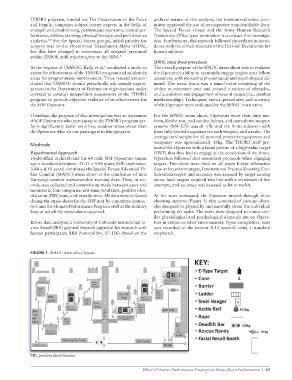
              tification (PID) time, and penalty time. All data were collected   At  the  start  command,  the  Operator  moved  through  three
              during the stress shoot for the SOF unit by committee instruc-  shooting stations (Figure 1) that consisted of various obsta-

              tors and the Human Performance Program staff at the military   cles designed to physically and mentally stress the individual
              base at which the stress shoot occurred.           performing the tasks. The tasks were designed to mimic sim-
                                                                 ilar physiological and psychological demands put on Opera-
              Before data analysis, a University of Colorado institutional re-  tors in certain combat environments. Upon completion, time
              view board (IRB) granted research approval for research with   was recorded to the nearest 0.10 seconds using a standard
              human participants (IRB Protocol No. 17-156). Based on the   stopwatch.


              FIGURE 1  SFAUC stress shoot layout.


              PID, positive identification.

                                                            Effect of Human Performance Program on Stress Shoot Performance  |  65

