


Page 65 - JSOM Fall 2018
P. 65
obstruction continue to be a common cause of preventable placed blindly in an emergent scenario, but this may be chal
death on the battlefield. 5,6,9 Providers in the austere environ lenging in a patient with CMF injury, because of disruption
ment should be adept at nonsurgical and surgical establish of normal anatomy. These devices are difficult to secure to
ment of a secure airway in the warfighter with CMF trauma. protect the airway and may become dislodged easily.
Battlefield CMF injuries can be from blunt mechanisms, pene If a definitive airway is needed, standard laryngoscopic en
trating mechanisms, or a combination of the two. With injuries dotracheal (ET) intubation is the safest option. 4,10 Extreme
to the CMF region, the airway may be obstructed by bleeding, care must be taken in patients with CMF, because they may
a foreign body, vomitus, edema, or prolapsed tissue. Patency have concomitant cervical spine injury. Maintenance of inline
must be quickly established and the obstruction removed. stabilization with rapid sequence ET intubation is the safest
Some CMF injuries may present with delayed airway com method. This may not be straightforward, because of the
promise due to swelling or accumulated blood. Obstruction pattern of injury and the anatomy involved. Extreme caution
may occur after several hours, and it is critical to constantly should be taken to avoid intracranial injury when inserting
reassess the patient’s airway to provide the best possible out a nasal ET in a patient with a midface injury. Video laryn
come. Patients with concomitant goscopy (Glidescope ; Verathon,
®
cervical spine injuries must be https://www.verathon.com) may
immobilized. Although this may be very useful to assist with ET
not be an issue for some, patients intubation but may not be avail
with CMF injuries that are bleed able to forward providers in an
ing, swollen, or may obstruct for austere environment. Awake,
other reasons are at high risk for controlled fiberopticassisted ET
airway compromise. Mandible intubation may be necessary in a
fractures may cause obstruction patient with CMF injury second
due to loss of support of the ary to distorted anatomy. These
tongue base, allowing the tongue devices are not available in the
to drop back into the airway. field, but if they are available in
Midface fractures can severely the medical treatment facility,
adversely affect airway patency they should be taken advantage of
as well by structural interference to provide safe, definitive airway
and swelling. Patients with asym establishment in the patient with
metry or swelling of the neck CMF injury. On occasion, when
may have an expanding vascular intubating, the provider can take
injury with impending airway advantage of a fractured mandi
compromise. Crepitus in the neck ble by distracting it forward to
may indicate an airway injury. help remove airway obstruction
Unconscious patients or patients by the tongue. In a patient with
with low Glasgow Coma Scale severe CMF injury, ET intubation
scores will not be able to main may become very difficult, and a
tain their airway on their own by surgical airway may be required
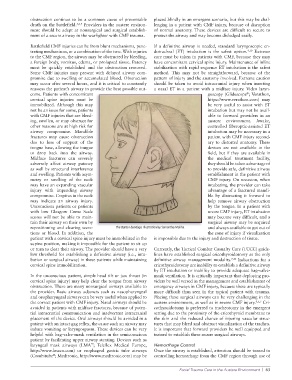
repositioning and clearing secre The Barton bandage. Illustration by Samantha Maliha. and always available to get out of
tions or blood. In addition, the the zone of injury if visualization
patient with a cervical spine injury must be immobilized in the is impossible due to the injury and destruction of tissue.
supine position, making it impossible for the patient to sit up
or turn to clear their airway. The provider should have a very Currently, the Tactical Combat Casualty Care (TCCC) guide
low threshold for establishing a definitive airway (i.e., intu lines have established surgical cricothyroidotomy as the only
bation or surgical airway) in these patients while maintaining definitive airway management modality. 7,10 Indications for a
cervical spine immobilization. cricothyroidotomy are inability to establish a definitive airway
by ET intubation or inability to provide adequate bagvalve
In the unconscious patient, simple head tilt or jaw thrust (in mask ventilation. It is critically important that deploying pro
cervical spine injury) may help clear the tongue from airway viders be well versed in the management and establishment of
obstruction. There are many nonsurgical airways available to emergency airways in CMF injury, because these are typically
the provider. Basic airway adjuncts such as nasopharyngeal more difficult than seen in the typical patient with trauma.
and oropharyngeal airways can be very useful when applied to Placing these surgical airways can be very challenging in the
the correct patient with CMF injury. Nasal airways should be austere environment, as well as in severe CMF injury. 4,5,7 Cri
avoided in patients with midface fractures, because of poten cothyroidotomy is preferred to tracheotomy in the emergent
tial intracranial communication and inadvertent intracranial setting due to the proximity of the cricothyroid membrane to
placement of the device. Oral airways should be avoided in a the skin and the reduced chance of injuring vascular struc
patient with an intact gag reflex, the cause such an airway may tures that may bleed and obstruct visualization of the trachea.
induce vomiting or laryngospasm. These devices can be very It is important that forward providers be well equipped and
helpful with bagvalvemask ventilation in the semiconscious trained to establish these secure surgical airways.
patient by facilitating upper airway stenting. Devices such as
laryngeal mask airways (LMA ; Teleflex Medical Europe, Hemorrhage Control
™
http://www.lmaco.com) or esophageal gastric tube airways Once the airway is established, attention should be turned to
(Combitube ; Medtronic, http://www.medtronic.com) may be controlling hemorrhage from the CMF region through use of
®
Facial Trauma Care in the Austere Environment | 63

