


Page 69 - JSOM Fall 2018
P. 69
Chemical Contamination Transfer
in the Management of War Casualties
Collectif MCV
ABSTRACT
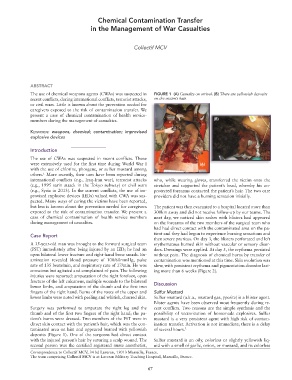
The use of chemical weapons agents (CWAs) was suspected in FIGURE 1 (A) Casualty on arrival. (B) There are yellowish deposits
recent conflicts, during international conflicts, terrorist attacks, on the victim’s hair.
or civil wars. Little is known about the prevention needed for
caregivers exposed to the risk of contamination transfer. We
present a case of chemical contamination of health service
members during the management of casualties. (B)
Keywords: weapons, chemical; contamination; improvised
explosive devices
Introduction
The use of CWAs was suspected in recent conflicts. Those
were extensively used for the first time during World War I (A)
with the use of chlorine, phosgene, or sulfur mustard among
others. More recently, their uses have been reported during
1
international conflicts (e.g., IraqIran war), terrorist attacks who, while wearing gloves, transferred the victim onto the
(e.g., 1995 sarin attack in the Tokyo subway) or civil wars stretcher and supported the patient’s head, whereby his un
(e.g., Syria in 2013). In the current conflicts, the use of im protected forearms contacted the patient’s hair. The two care
provised explosive devices (IEDs) valued with CWA was sus providers did not have a burning sensation initially.
pected. Many ways of curing the victims have been reported,
but less is known about the prevention needed for caregivers The patient was then evacuated to a hospital located more than
exposed to the risk of contamination transfer. We present a 300km away and did not receive followup by our teams. The
case of chemical contamination of health service members next day, we noticed skin rashes with blisters had appeared
during management of casualties. on the forearms of the two members of the surgical team who
had had direct contact with the contaminated area on the pa
tient and they had begun to experience burning sensations and
Case Report
then severe pruritus. On day 3, the blisters perforated and left
A 35yearold man was brought to the forward surgical team erythematous burned skin without vascular or sensory disor
(FST) immediately after being injured by an IED; he had an ders. Dressings were applied. At day 5, the erythema persisted
open bilateral lower fracture and righthand bone smash. Ex without pain. The diagnosis of chemical burns by transfer of
amination revealed blood pressure of 100/60mmHg, pulse contamination was mentioned at this time. Skin evolution was
rate of 135 beats/min, and respiratory rate of 17/min. He was slow, with persistent erythema and pigmentation disorder last
conscious but agitated and complained of pain. The following ing more than 6 weeks (Figure 2).
injuries were reported: amputation of the right forefoot, open
fracture of the left calcaneus, multiple wounds to the bilateral Discussion
lower limbs, and amputation of the thumb and the first two
fingers of the right hand. Burns of the roots of the upper and Sulfur Mustard
lower limbs were noted with peeling and whitish, charred skin. Sulfur mustard (a.k.a., mustard gas, yperite) is a blister agent.
Blister agents have been observed most frequently during re
Surgery was performed to amputate the right leg and the cent conflicts. Two reasons are the simple synthesis and the
thumb and of the first two fingers of the right hand; the pa possibility of vectorization of homemade explosives. Sulfur
tient’s burns were dressed. Two members of the FST were in mustard is a very persistent agent with high risk of contam
direct skin contact with the patient’s hair, which was the con ination transfer. Activation is not immediate; there is a delay
taminated area on him and appeared burned with yellowish of several hours. 2
deposits (Figure 1). One of the surgeons had direct contact
with the injured person’s hair by suturing a scalp wound. The Sulfur mustard is an oily, colorless or slightly yellowish liq
second person was the certified registered nurse anesthetist, uid with a smell of garlic, onion, or mustard, and its colorless
Correspondence to Collectif MCV, 34 bd Laveran, 13013 Marseille, France.
The team comprising Collectif MCV is at Laveran Military Teaching Hospital, Marseille, France.
67

