


Page 71 - JSOM Fall 2018
P. 71
Issues for Health Care Providers FIGURE 4 Detection paper.
In the event of a chemical attack, decontamination steps must
be implemented. The role of the physician is to identify the
clinical signs so the appropriate symptomatic treatments then
can be applied and to determine if there is a need to continue
to protect personnel from exposure. As long as the syndrome is
not identified, personnel must be protected from direct contact
with victims. However, high temperatures cause a substantial
risk of heat stroke to the personnel wearing protective clothing.
Detection
Sulfur mustard cannot be identified clinically initially. Danger
ous chemicals like sulfur mustard have effects that can occur
6
hours after exposure. Thus, it is necessary to develop markers
of exposure that can be quickly analyzed to help the rescue
teams identify contaminated victims and prioritize decontam
ination. Colorimetric tubes, flame photometry, photoioniza
tion, or ion mobility spectrometry are examples of procedures The blister agent (yperite) has the highest probability of in
7,8
already used in the field. These techniques require liquid or sidious contamination. Because of the potential spread of the
air samples or swabs from exposed surfaces (skin or material) chemical agent, it is the injured victims of IED or drone who
to detect potential contaminants. are most at risk of having chemical contamination. Gunshot
victims are at a lower risk, unless they come from an area
An appareil portatif de contrôle de la contamination (AP2C; where chemical toxins have been used. A systematic control of
portable contamination control device) is designed to detect contamination is impossible while taking care of these serious
and control the presence of toxic vapors in the air. It is com injuries. The procedure must be performed outdoors or in a
bined with a system used for the removal and evaporation of ventilated area. The procedure is summarized as follows:
persistent agents (système de prélèvement et d’evaporation
des agents persistants [S4PE]). Sampling and detection of liq There is suspicion of the presence of irritative signs on the
uids or solids can be done with the S4PE, but the procedure victims (e.g., ocular irritation) or on the carriers (e.g., via be
is slow and can be faulty if the contaminated area is not actu ing in an enclosed space of the vehicle and heat increasing the
ally tested (Figure 3). These methods detect the presence of an vaporization of the toxin).
atom or group of atoms, but not the molecule itself; therefore,
the risk of significant falsepositive results is increased. The • Oily substances may be observed on the clothes or the
problem comes from the background presence of sulfur from skin of the victims. CWA protective suits take time to
a standard explosion even without mustard gas. 9 equip and cannot be put on at each casualty arrival.
Butyl gloves provide the most protection but may not
FIGURE 3 Portable contamination control device. be readily available or optimal for medical procedures.
Therefore, wearing propyl gloves (e.g., Black Talon) or
vinyl seems preferable to wearing latex care gloves. In
case of suspected contact with nitrile, propyl, or vinyl
gloves, those gloves should be changed immediately. A
change of pair every 5 minutes is recommended.
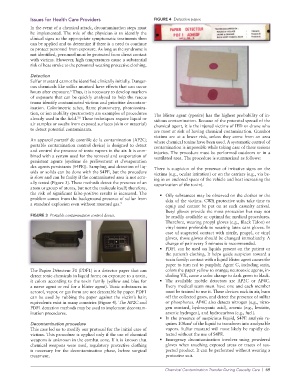
• PDF1 can be used on liquids present on the patient or
the patient’s clothing. It helps guide suspicion toward a
toxin family: contact with a liquid blister agent causes the
paper to turn red to purplish; Agent G, including sarin,
The Papier Détecteur F1 (PDF1) is a detector paper that can colors the paper yellow to orange; neurotoxic agents, in
detect toxic chemicals in liquid form; on exposure to a toxin, cluding VX, cause a color change to dark green to black.
it colors according to the toxin family (yellow and blue for • The available mobile detectors are AP2C or AP4C.
a nerve agent or red for a blister agent). Toxic substances in Every medical team must have one and each member
aerosol, vapor, or gas form are not detectable by paper. PDF1 must be trained to use it. These devices suck in air, burn
can be used by rubbing the paper against the victim’s hair; off the collected gases, and detect the presence of sulfur
equivalents exist in many countries (Figure 4). The AP2C and or phosphorus. AP4C also detects nitrogen (e.g., nitro
PDF1 detection methods may be used to implement decontam gen mustard, hydrocyanic acid), arsenic (e.g., lewisite,
ination procedures. arsenic hydrogen), and hydrocarbon (e.g., fuel).
• In the presence of suspicious liquid, S4PE analysis re
3
Decontamination procedure quires 100cm of the liquid to transform into analyzable
This case led us to modify our protocol for the initial care of vapors. Sulfur mustard will most likely be rapidly de
victims. This procedure is applied only if the use of chemical tected without the use of S4PE.
weapons is unknown in the combat zone. If it is known that • Emergency decontamination involves using powdered
chemical weapons were used, regulatory protective clothing gloves when touching exposed areas or traces of sus
is necessary for the decontamination phase, before surgical pected product. It can be performed without wearing a
treatment. protective suit.
Chemical Contamination Transfer During Casualty Care | 69

